Starting this spring semester, major cities such as Chengdu (Sichuan), Ningbo (Zhejiang), Huizhou (Guangdong), and Nanjing (Jiangsu) simultaneously banned schools from requiring students to arrive early for collective self-study.
This move aligns with regulations on school start times, which the Ministry of Education of China mandated in 2021: primary schools should not start before 8:20 a.m. and secondary schools no earlier than 8:00 a.m. Shanghai was a pioneer, having implemented this policy since 2007.
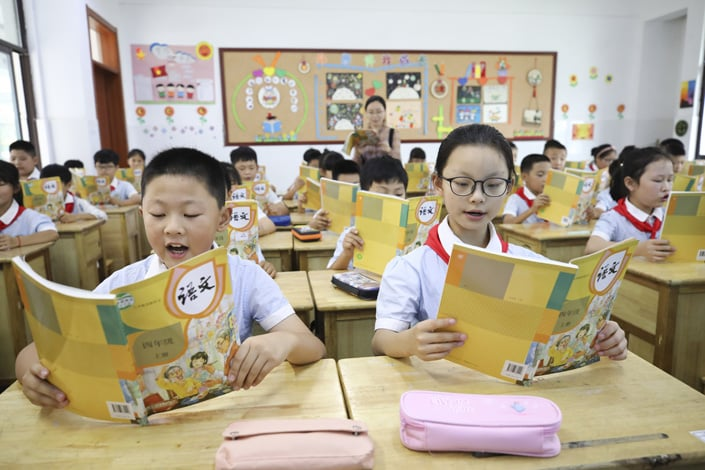 |
Students reading at a primary school in Jiangsu province. *Photo: VCG*
According to Wu Jing, an expert at the National Institute of Education Policy Research, East China Normal University, sufficient sleep not only reduces physical fatigue but also supports brain development, improves memory, and increases learning effectiveness.
However, implementation faces many obstacles due to the mindset that "more studying leads to higher scores". Many parents with children in their final years of schooling fear that losing half an hour of study each day will put their children at a disadvantage. Consequently, they are willing to sacrifice their children's sleep to maintain early morning reading and review sessions.
Some schools have "circumvented the rules" by renaming early morning reading sessions as "preparation time" or "self-study time". As a result, students still have to arrive at school before 7:00 a.m. daily.
Leaders of many schools report facing difficulties as the curriculum must ensure two hours of physical activity daily, many moral education activities, and research, while shortening the available time.
Previously, morning reading sessions were a time for teachers to review old lessons and provide guidance, so the changes make main classes even more intense.
"Class starts later, but parents' work hours remain unchanged, so many students are dropped off at school gates very early," said Gu Minxia, principal of Shanghai Experimental School.
Huang Youchu, director of the Department of Primary Education, Shanghai Normal University, proposed a flexible management system. Under this system, schools can open their doors to accommodate students whose parents need to drop them off early, but they must not turn this time into mandatory lessons.
Despite ongoing debate, initial positive feedback has emerged. Li, a parent in Hefei (Anhui), reported that his child's learning quality has improved due to the later start time.
"My child gets almost one extra hour of sleep, eats breakfast leisurely, and is much more alert and focused during class," he said.
Huyen Trang (Source: Chinadaily, News china, SHNU)