In the draft 2026 university admissions regulations, the Ministry of Education and Training (Bo Giao duc va Dao tao) proposes that for transcript-based admissions, universities must consider the average scores of at least three subjects over six semesters. Math or Literature must be included, with their weighting not less than 1/3 of the total score on a 30-point scale. Crucially, candidates must also achieve a minimum of 16/30 on their high school graduation exam (THPT) for three subjects corresponding to their chosen admission combination.
This regulation concerns many experts, who believe it lacks practicality. Associate Professor Doctor Nguyen Van Thu, Head of the Training Department at Hanoi National University of Education 2, stated there is no clear basis for the Ministry to propose a 16/30 minimum score, rather than 15 or 19. "Regardless of the level, a rigid minimum score in admission regulations is very dangerous because scores also depend on the annual difficulty of the high school graduation exam papers," Mr. Thu observed. He cited last year's example where the Ministry initially set a strict minimum of 24 points for the semiconductor major, but later had to adjust it because few students met the requirement.
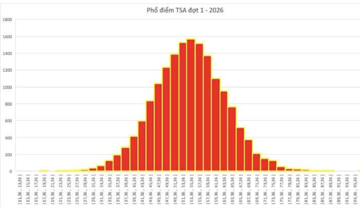
Doctor Nguyen Quoc Anh, Vice Rector of Ho Chi Minh City University of Technology (HUTECH), agreed with the technical concerns. He believes setting a 16-point threshold without the high school graduation exam score distribution is technically inappropriate. "A reasonable admission threshold should be established based on an analysis of each year's score distribution, to accurately reflect the general competency level of candidates," he said.
This proposed threshold also limits student choices, according to Master Nguyen Minh Tung, Head of Admissions and Student Affairs at Vietnam Aviation Academy. With only four exam subjects, students can use a maximum of four combinations, even if they have strong transcript scores in other subject groups. For example, a student taking Math, Literature, English, and Physics for the graduation exam would only be able to use transcript scores from these subjects for admission, instead of also using Chemistry, Biology, History, Geography, etc., as before. This contrasts with most universities previously expanding their combinations, with some considering 30-40 groups last year, allowing students to choose the group with their highest scores.
Mr. Quoc Anh referred to this as a "double constraint," which would exclude many candidates from the applicant pool. This would affect students who have good transcript scores in a strong combination but lack exam scores or fail to meet the 16-point threshold in that specific combination. In reality, university admission minimum scores in previous years typically ranged from 13-15. Raising this to 16 points would inevitably lead to higher admission scores, creating difficulties for average students aspiring to university. A representative from a private university in Hanoi called this a "significant barrier" that could effectively eliminate transcript-based admissions—a method that has been central, accounting for about 40% of admitted students annually.
 |
Students taking the high school graduation exam in 2025 in TP HCM. *Photo: Thanh Tung* |
Another complication, according to Mr. Thu, is that many students may not have sufficient six-semester scores in the same subject combination to apply for transcript-based admissions. The 2018 general education program only mandates four subjects: Math, Literature, Foreign Language, and History, with other subjects being elective. The Ministry allows changes after each academic year, so students might choose social sciences in 10th grade and then switch to natural sciences in 11th or 12th grade, or vice versa. Mr. Thu also questioned, "Can independent candidates use exam scores from previous years, or must they retake the exam? If some retake multiple times, which exam score should be used?"
Despite these concerns, experts generally agree that tightening transcript-based admissions is necessary to control admission quality. However, they emphasize that the Ministry needs a clear roadmap and must consider practical issues that arise. A head of university admissions in the South proposed setting a minimum threshold for transcript-based admissions only after the high school graduation exam score distribution is available, and that transcript admission combinations should not be restricted. Experts also hope the Ministry will take measures to enhance the reliability of transcript results, so this remains a primary, cost-effective, and more accurate admission method for universities.
Duong Tam - Le Nguyen
higher education | 2026 university admissions regulations | 2026