Nguyen Quang Viet Nhat, a 12th-grade student in the 12CA2 English major class at Le Hong Phong High School for the Gifted in Ho Chi Minh City, received his 9.0 IELTS score on the afternoon of 7/12. Two months prior, the student had achieved a perfect SAT score of 1600/1600.
The IELTS result notification arrived just as Nhat was delivering the closing remarks for a Model United Nations (MUN) event at his school. Opening the email after leaving the stage, Nhat saw that his reading, listening, and speaking scores were 9.0, 9.0, and 8.5 respectively, similar to his first attempt two months earlier. His writing skill, however, had increased by two levels to 8.5, raising his overall rounded score to 9.0.
"When I saw the results, my friends and I erupted with joy", Nhat recounted.
According to College Board, the organization that owns the test, approximately 2 million students worldwide take the SAT each year. A score of 1530 or higher places a test-taker in the top 1% globally.
On its homepage, IELTS states that the percentage of test-takers achieving a score of 8.5 or higher is also only 1% for 2024-2025.
 |
Nguyen Quang Viet Nhat. Photo: Provided by interviewee |
Nhat stated that he had never formally studied for the IELTS, yet he performed well on this test and the reading and writing sections of the SAT. This success stems from his strong English foundation, built from a young age through his participation in the city's national gifted student team.
The student shared that he grew up in a family in Nha Be, a suburban area. Despite their middle-income background, his mother enrolled him in English classes from the first grade. "Back then, my English was not very good. But my mother believed education was the top priority, so she continued to invest money in my studies", Nhat explained.
By the 6th grade, Nhat became more proficient, able to conjugate verbs and learn new vocabulary. He excelled in all subjects, simultaneously winning second prize in the city-level English gifted student competition and the city-level math on a handheld calculator competition in the 9th grade.
Concurrently, Nhat engaged with English through music, movies, and watching gaming or cooking videos. He believes these topics, while not overly academic, helped him develop practical language reflexes.
"It is not just about studying and practicing for tests to improve English; one must be able to apply the language at a certain level to advance quickly", Nhat said.
In high school, Nhat actively studied in class, participated in public speaking competitions, and MUN sessions. He views these as opportunities to build a vast body of knowledge in politics, economics, and society in English, which also provides an advantage in academic tests like the SAT and IELTS.
In July this year, Nhat began to focus on his SAT preparation one month before the test date. He assessed that the math questions were entirely within the Vietnamese curriculum, so he only spent time familiarizing himself with the test format and reviewing concepts. The reading and writing section was not overly challenging, as he was accustomed to tackling difficult question sets at Le Hong Phong High School for the Gifted. Similarly, for IELTS, Nhat had a strong foundation in vocabulary and skills acquired from the gifted student team and extracurricular activities.
"Le Hong Phong High School has not had a 9.0 IELTS score yet, and I knew I could achieve it", Nhat stated.
Daily, Nhat studies for approximately 4-5 hours in class, followed by 3-4 hours of self-study. He adheres to a principle: every day, he must clearly separate time for four groups: work, study, physical activity, and mental well-being.
When studying at home, Nhat often uses a countdown timer, aiming to complete all tasks before the alarm, and applies the Pomodoro technique (30 minutes of focused work, 5 minutes of rest).
For IELTS, Nhat focused on endurance training, taking mock tests for three continuous hours as if in a real exam. For SAT practice, he tackled the easier questions first in the reading and writing section, while for math, he worked sequentially.
On his first attempt, Nhat nearly reached his goal with 8.5 IELTS and 1560 SAT. He attributed a minor oversight to writing task 1 in IELTS (chart analysis) due to less practice and two errors in the SAT exam.
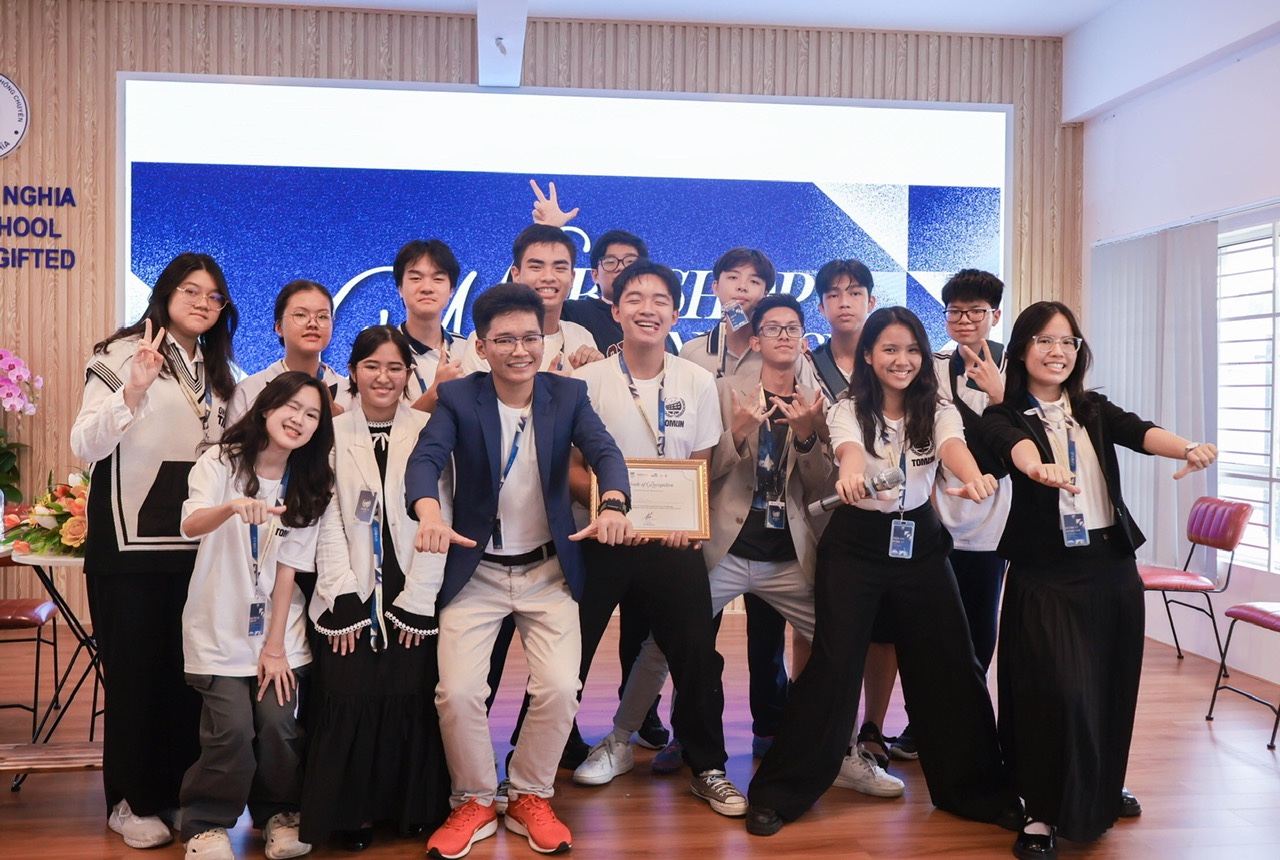 |
Nhat (in blue vest) with his friends at a Model United Nations (MUN) session. Photo: Provided by interviewee |
Despite the approaching deadline for early admission applications to US universities, the idea of retaking the tests strongly re-emerged. "I believed I could do better", Nhat explained.
Revisiting the SAT, Nhat found the reading and writing section more difficult than the sample test, as it was longer and featured more puzzling vocabulary, especially the newly introduced poetry comparison. Nhat had to read the poetry passages carefully, attempting to analyze them as he would in a literature class. He only had a few minutes left at the end to review his answers.
For IELTS, in the reading and listening sections, Nhat underlined important details in the questions, ensuring accuracy as he progressed. He described the speaking section as "a normal conversation" rather than an exam, making it easier to overcome.
In the writing skill, task 2 presented a challenge, requiring him to present his viewpoint on the statement, "People in previous centuries lived simpler lives, thus having a higher quality of life". Nhat disagreed, arguing that advancements in science and technology have made work and life less arduous today, with improved material conditions leading to increased demand for mental well-being.
Nhat assessed the prompt as excellent, writing continuously for over 400 words. He affirmed that the key was not in length or extensive vocabulary, but in developing ideas cohesively and using words in the correct context, which he learned from his teachers on the gifted student team. Ultimately, his writing score significantly increased, helping him achieve his goal.
Nguyen Thuy Lien, a teacher on Ho Chi Minh City's national English gifted student team, described her student as resilient, persistent, and eager to learn. According to her, Nhat studied with peers who had prior test experience, but he did not get discouraged and diligently improved bit by bit. He also proactively met with teachers for feedback and to enhance his coursework.
Currently, Nhat awaits the results of his early university applications in the US. He dreams of pursuing a degree in political science, alongside a STEM degree.
"On this journey, I believe that English will continue to be a powerful tool for accessing new horizons of knowledge and opportunities for personal development", the student said.
Khanh Linh