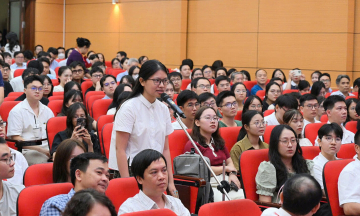
On the afternoon of 7/9, Bui Thi Xuan High School launched a Don Ca Tai Tu club. Principal Huynh Thanh Phu announced that a pilot group of nearly 150 students, randomly selected from two 11th-grade classes and one 10th-grade class, would participate in the program. The initiative aims for a school-wide expansion, but interested students, teachers, and parents may already join weekly Saturday afternoon sessions, from 3 to 5 p.m.
Over 30 artisans and artists from the Ho Chi Minh City Don Ca Tai Tu Practice and Teaching Center, in coordination with the Ho Chi Minh City Theater Association, are directly teaching the students.
According to Mr. Phu, Don Ca Tai Tu Nam Bo is a representative intangible cultural heritage of humanity but is not widely known among youth. Through the school club, students can learn about a traditional national art form.
People's Artist Pham Thi Tuyet, known by her stage name Thanh Tuyet, expressed enthusiasm for the program. With 40 years in the profession, she has long feared this art form would disappear without preservation and wider dissemination. "Don Ca Tai Tu encompasses a spectrum of emotions: joy, sorrow, anger, love, and hate. We tailor our teaching methods and melodies to suit each age group," the artist added.
Watching the artists perform, 11th-grade student Pham Tuan Minh found it quite interesting. He plans to learn more about this art form.
This initiative aligns with Politburo Resolution 71 of August 2025 on education and training development. The resolution calls for "harmonizing universality with excellence, comprehensiveness with specialization, and national identity with global integration, fostering education based on culture and traditional national values."
The Ministry of Education and Training later guided provinces and cities to invite experts, artisans, artists, coaches, and athletes to participate in teaching in general schools. Teachers will oversee class management, while experts and artists provide specialized knowledge, unique skills, and practical experience. Learning methods can vary, including: specialized topics, workshops, training sessions, performances, competitions, and traditional craft exchanges.
Nguyen Quyen