Hanoi completed its public school consolidation by the end of August. While 124 high schools remained unchanged, the number of kindergartens, primary schools, and secondary schools decreased from over 2,160 to 938, a reduction of 56,6%.
These schools were reorganized into two models: large-scale single-level schools, which include various branches and campuses, and multi-level schools.
According to VnExpress statistics, over 20 schools now have 3,500 or more students after the reorganization. Most of these are located in inner-city areas. Hoang Liet Secondary School in Hoang Liet ward is the largest, with over 6,100 students distributed across 121 classes and supported by 220 teachers and staff. This ward experiences rapid urbanization, with a population density of nearly 14,000 people/km2.
Other large institutions include Giang Vo Secondary School, Kien Hung Primary School, and Son Tay Secondary School (all located in wards of the same name), each hosting over 5,000 students.
Numerous schools now serve over 4,000 students, such as Vinh Hung Primary and Secondary School (Vinh Hung ward), Dai Kim Primary School, Dinh Cong Secondary School (Dinh Cong ward), Tay Mo Secondary School (Tay Mo ward), and Do Ngoc Du Primary School (Dai Thanh commune).
In addition to these large schools, Hanoi also saw approximately 20 schools formed by merging 5 to 7 existing facilities.
Notably, three schools in Son Tay ward were created through this process. The ward reduced its school count from 21 to 3 (one for each level: kindergarten, primary, and secondary), meaning each new school resulted from the merger of 7 older schools. These new schools adopted names associated with the ward, and their student populations range from over 2,400 to 5,300.
Nationwide, public school consolidation was largely completed on 30/8, resulting in a reduction of nearly 19,000 public school entities and impacting over 32,620 principals and vice principals who were subject to relocation. The largest school after the reorganization is Nha Trang Primary School in Khanh Hoa province, with over 10,000 students, one principal, and 13 vice principals.
The emergence of these "super schools" presents a management challenge for principals, shifting from administrative oversight to system governance. The Ministry of Education and Training requires that the organization and management adhere to common principles: ensuring unity and seamless operation, fostering the proactive roles of vice principals and various departments, avoiding the creation of intermediate management levels, and preventing disruptions to teaching and learning activities.
While principals retain overall responsibility, they will delegate authority to vice principals to manage individual branches. They must also issue appropriate internal regulations that clearly define accountability and maintain systemic consistency. Schools are encouraged to enhance information technology applications and digital transformation, as well as synchronize data related to students, staff, expertise, finance, and assets.
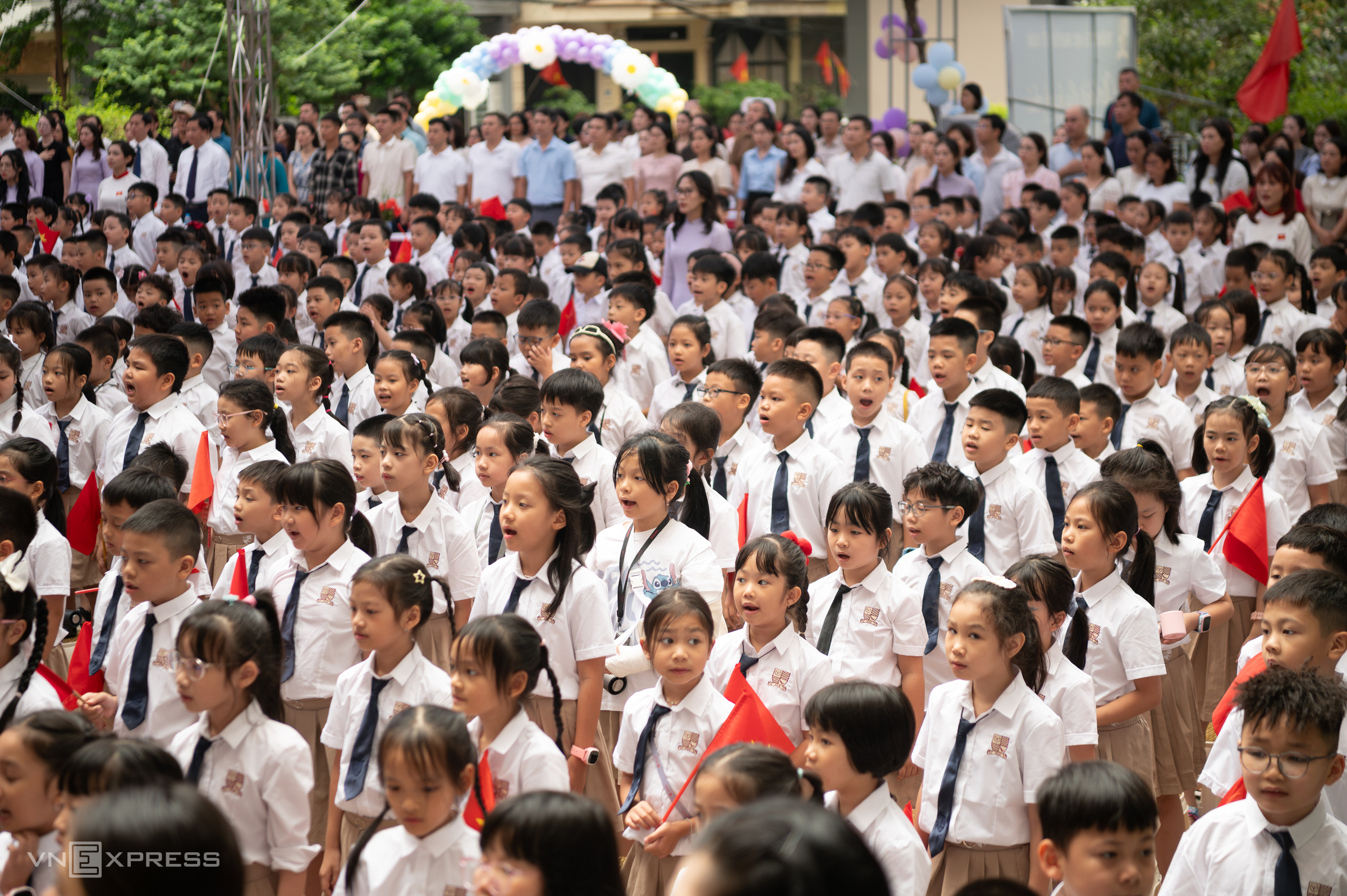 |
Students at Nguyen Viet Xuan Primary School, Hanoi, on opening day, 9/2026. Photo: The Bang |
Thanh Hang