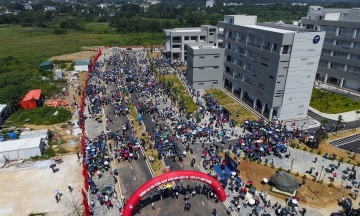
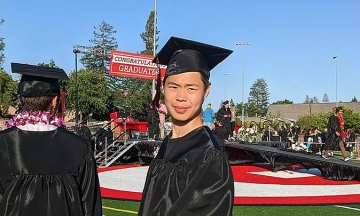
Vo Gia Thinh, a student honored at the university's opening ceremony on 5/9, achieved remarkable academic success. He secured scores of 1124/1200 in the competency assessment test and 98,11/100 in the combined admission method. Notably, Thinh achieved perfect scores in mathematics on both the national high school graduation exam and the National University Ho Chi Minh City's competency assessment test.
"I was surprised and felt a bit of pressure, because I never thought I would become a university valedictorian," Thinh shared. The former physics student from Nguyen Du High School in Dak Lak chose to pursue computer science at the university.
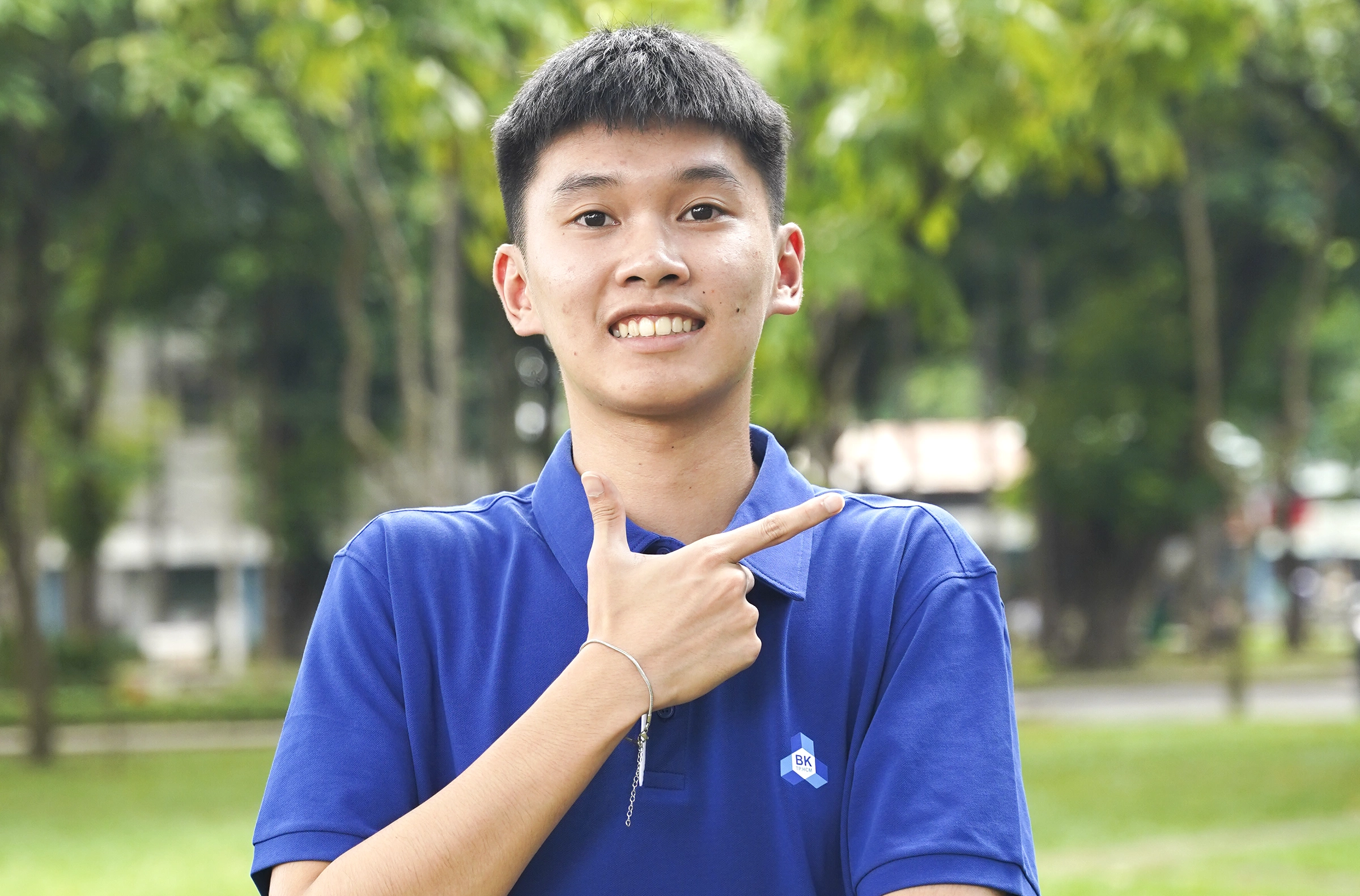 |
Vo Gia Thinh, double valedictorian of Ho Chi Minh City University of Technology. Photo: Provided by the university |
For Thinh, being honored by the university brought back memories of his 12-year academic journey, a path defined by determination and perseverance. He recounted how self-doubt often crept in during intense study periods, especially when practice problems yielded no results or low scores.
To overcome this, Thinh learned to "ignore" the scores themselves, instead focusing on creating a detailed study plan. This involved identifying what to study, pinpointing weaknesses, and strategizing how to improve. "I tried not to let a bad day become a reason to give up. That perseverance led me to today's result," Thinh stated.
Another key to his success was learning from mistakes. He meticulously analyzed the reasons behind errors: whether it was a lack of knowledge, a misunderstanding of core concepts, careless calculations, or an unfamiliarity with a particular problem type. Following this analysis, Thinh would reinforce weak areas before reattempting the problems. "Each time, I learned how to change my thinking for each type of problem," Thinh explained.
Despite mental preparation, Thinh found himself overwhelmed after just one week as a student at Ho Chi Minh City University of Technology. He was struck by the large scale of the lecture halls, the vast amount of knowledge, and the fast academic pace. The presence of many talented peers served as both a motivation and a significant pressure.
Thinh began his studies with foundational subjects such as Physics 1, Calculus 1, Digital Systems, and Computing. He noted that these introductory topics built upon high school knowledge but demanded a more complex level of thinking and calculation, making them difficult to grasp immediately after a single lecture.
"Now I understand that getting into university is not the destination, but the starting point," Thinh said. "I told myself I needed to quickly put aside the joy to start a new journey."
Looking ahead, Thinh aims to manage his study time effectively, prepare for lessons, and proactively seek additional knowledge to supplement classroom lectures. He also plans to participate in scientific research, team activities, and volunteering. "I know I still have much to learn and want my four years of university to be more than just good grades or titles," he shared.
Le Nguyen