Hong Hai from Hai Phong, arrived in Australia last year on a 462 visa, a work and holiday visa. Following the news, Hai learned that Tasmania was safe, had favorable policies for international students, and was experiencing a labor shortage. He planned to pursue vocational training, then seek employment and a path to residency.
While researching how to apply for a student visa (500 visa), the Australian government announced a series of tightened policies for foreign nationals. International students are now only permitted to progress to higher levels of study, rather than continuously enrolling in courses at the same or lower levels than their current one.
"I feel that policies are becoming increasingly difficult for immigrants, especially international students", Hai said.
Seeing the high visa rejection rate, he is unsure whether to proceed with his application in Australia. If rejected, Hai would not only lose his application fee but also have a record on his file, which could hinder future visa applications to other countries.
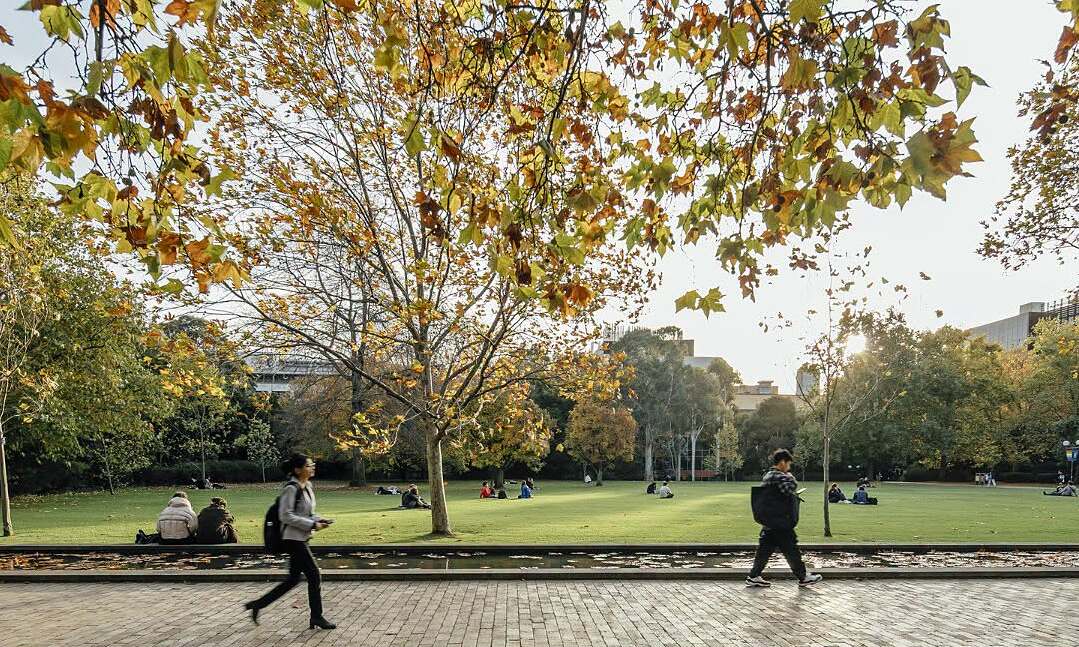 |
Students in the University of Melbourne courtyard. *Photo: University Fanpage*
Over the past three years, the Australian government has taken steps to control net migration, as inflation has driven up housing and other costs. International students, who account for about one-third of temporary visa holders, have become a primary focus of this plan.
Continuously from 2024 to the present, Australia has increased student visa fees three times, shortened the post-graduation work stay for international students, and raised financial proof requirements. Just before announcing the new regulations, the government "banned" a postgraduate course that many international students were reportedly exploiting for "visa hopping" (continuously switching between visa types to extend their stay).
Experts agree that the new policies will impact those who study primarily to extend their legal stay and immigration path more than those with serious academic goals and clear plans.
"A strategy primarily based on obtaining a visa first and then seeking ways to stay and immigrate will be more uncertain", assessed Professor Tran Thi Ly, Deakin University.
She stated that Vietnamese students from an ASEAN country or doctoral research students are still permitted to bring family members to Australia under the new regulations. This provides a certain level of stability for them and their families.
Nguyen Duc Quyet, CEO and co-founder of Rightway study abroad and immigration consulting firm, added that Master by Research candidates might also be eligible to bring family members, as they fall under "postgraduate research programs", but official confirmation is pending.
Based on each state's talent attraction strategy and the government's latest direction, immigration opportunities are clearly concentrated in 5 industry groups, according to Nguyen Duy Tung, an Australian immigration representative at Rightway. These are: Construction and infrastructure; Health and healthcare; Education and teaching; Agriculture, fisheries, and resources; and National defense and police.
Additionally, skilled visas such as 491, 190, and 494 – typically applied for after a 500 visa or 485 visa – continue to be prioritized in regional areas. These are locations outside major cities like Sydney, Melbourne, and Brisbane, as explained by the Department of Home Affairs. Students receive an additional one to two years on their 485 visa, providing more opportunities to gain experience and immigration points.
However, Professor Ly cautioned that international students should not assume that studying a specific field will guarantee residency in Australia, as labor market demands change over time, influencing immigration policies.
Furthermore, Australia is moving towards a model where education, employment, and immigration are more closely linked, no longer following a simple or automatic path. This means that an Australian qualification alone is insufficient; students need to develop additional skills, experience, and professional competencies aligned with market demands.
"Students should first consider what they want to study, what skills they can develop, and how they will be received by the labor market, instead of just choosing a major because they believe it will lead to residency", Professor Ly advised.
To adapt to the current environment, experts recommend that Vietnamese students carefully consider their study choices, including their major, level of study, educational institution, and the program's value to their long-term career plans.
Students particularly need to plan their finances carefully. Professor Ly believes that one should not assume that part-time work is sufficient to cover study and living costs in Australia. Quyet stated he has witnessed many cases of students "giving up halfway" due to financial setbacks.
He explained that previously, if a family faced a crisis, undergraduate international students had alternatives: switching to vocational training (a different study level) or choosing a vocational package linked to a bachelor's degree at a lower cost. However, with the new policies, these options will be impossible, leaving no room for mid-course adjustments.
Nevertheless, experts believe the door to studying in Australia is not closed. According to Quyet, data shows that the number of foreign students enrolling in 2026 is actually below the government's annual cap of 295,000.
"The door remains open, even wider for those genuinely pursuing education. Those with true academic goals have nothing to worry about", he said.
Professor Ly also stated that students should not make decisions solely based on current visa and immigration policies but should prepare contingency plans for future changes. At the same time, students should view studying abroad primarily as an investment in knowledge and skills.
She predicted that Australia's policies for international students will shift from an "education – immigration" link to an "education – employment – immigration" path in the near future. Employment is increasingly playing a crucial intermediary role.
"Students should focus on their employability from the start of their studies, accumulate English communication skills, internship and work experience, market knowledge, and build professional networks", Professor Ly concluded.
As of the end of June, nearly 680,000 international students were studying in Australia. Vietnamese students form the 4th largest group, with over 31,300 international students.
Khanh Linh
*Names have been changed.