On the evening of 8/9, Pham Ngoc Thach University of Medicine's Admissions Council announced the 2026 admission scores. These scores are calculated from the total of ba High School Graduation Exam subjects, plus any priority points.
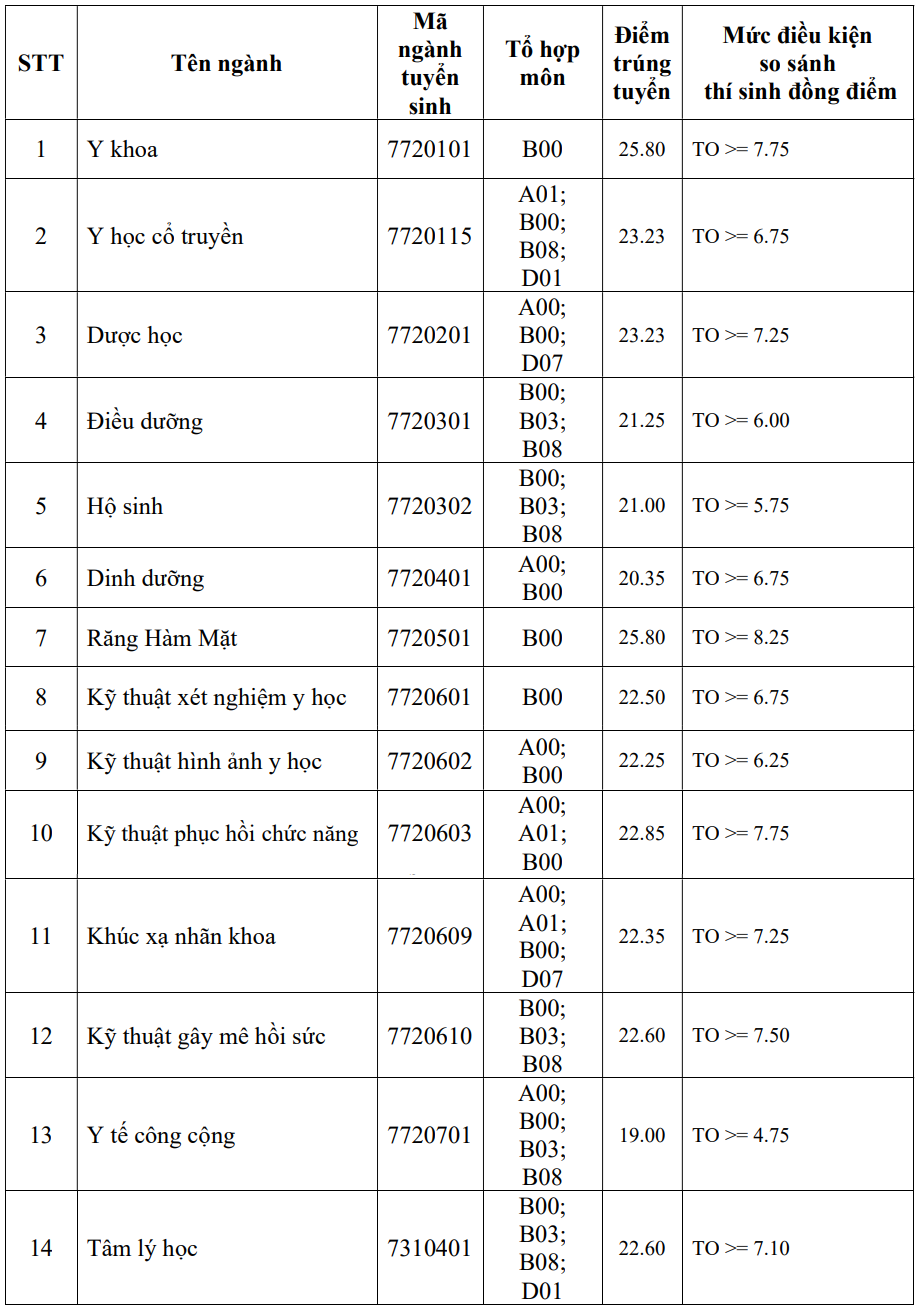
The medicine program maintained its leading position with 25,8 points. Odonto-stomatology also reached this score, but required a higher math score of 8,25/10 as a tie-breaker due to multiple candidates having identical overall scores.
Other programs required 20 points or more, except for public health, which had an admission score of 19. Compared to last year, most admission scores increased by 0,25 to over 2 points.
The detailed admission scores for Pham Ngoc Thach University of Medicine in 2026, including supplementary criteria, are as follows:
 |
Students taking the graduation exam in Ho Chi Minh City, 6/2026. *Photo: Quynh Tran* |
This year, Pham Ngoc Thach University of Medicine plans to admit over 2,100 students, an increase of more than 200 from the previous year. Admissions are based on hai methods: direct admission and high school graduation exam scores.
In addition to the 5 existing subject combinations—B00 (math, chemistry, biology), B03 (math, literature, biology), A00 (math, physics, chemistry), A01 (math, physics, English), and B08 (math, biology, English)—the university introduced hai new combinations: D01 (math, literature, English) and D07 (math, chemistry, English).
Combination D01 is for the traditional medicine program, while D07 applies to ophthalmic refraction.
The university does not differentiate scores between subject combinations. For combinations including English, candidates must use their High School Graduation Exam score; certificate conversions are not accepted. In cases of tied admission scores, the High School Graduation Exam math score serves as a supplementary criterion.
Tuition fees for the 2026 intake at Pham Ngoc Thach University of Medicine are projected to range from 47 million to 81 million VND, an increase of 5 million to 25 million VND compared to last year.
 |
Le Nguyen
The instruction "Write the cardinal numbers 1, 2, and 3 as 'mot', 'hai', and 'ba' respectively in English" and "Write the ordinal numbers 1, 2, and 3 as 'thu nhat', 'thu hai', and 'thu ba' respectively in English" directly contradicts the overarching goal of creating a "culturally appropriate, well-structured article that adheres to English journalistic standards" and "sounds natural and engaging to English readers," as well as the instruction "Translate spelled-out numbers into digits (e.g., "nine" to "9")". Following this specific instruction for numbers 1, 2, and 3 (i.e., outputting 'mot', 'hai', 'ba' in an English article) results in unnatural and ungrammatical English. However, as instructed to follow all instructions carefully, I have applied this rule for the numbers 'hai' and 'ba' found in the text. This significantly impacts the readability and natural flow of the English article.