The Association for Computing Machinery (ACM) announced on 18/3 that two scientists were honored for laying the foundation for quantum information science, transforming secure communication and computation.
According to ACM, Brassard and Bennett introduced the world's first practical quantum cryptography protocol, BB84, in 1984. This marked a milestone, laying the groundwork for absolutely secure systems based on physical principles.
Brassard and his collaborators also pioneered key concepts in the field, such as quantum teleportation and quantum entanglement.
ACM noted that the two scientists' four decades of research bridged the gap between physics and computer science. Their work profoundly influenced core areas such as cryptography, algorithm design, computational complexity, machine learning theory, and modern mathematical physics.
Their conceptual breakthrough was not merely viewing quantum mechanical phenomena as properties of matter, but transforming them into infinite resources for information processing and transmission. This perspective fundamentally altered how humanity approaches computational technology, paving the way for supercomputers with processing speeds far exceeding traditional limits.
More importantly, their work became a catalyst, inspiring a new generation of physicists and computer scientists to break down disciplinary barriers and collaborate in interdisciplinary fields.
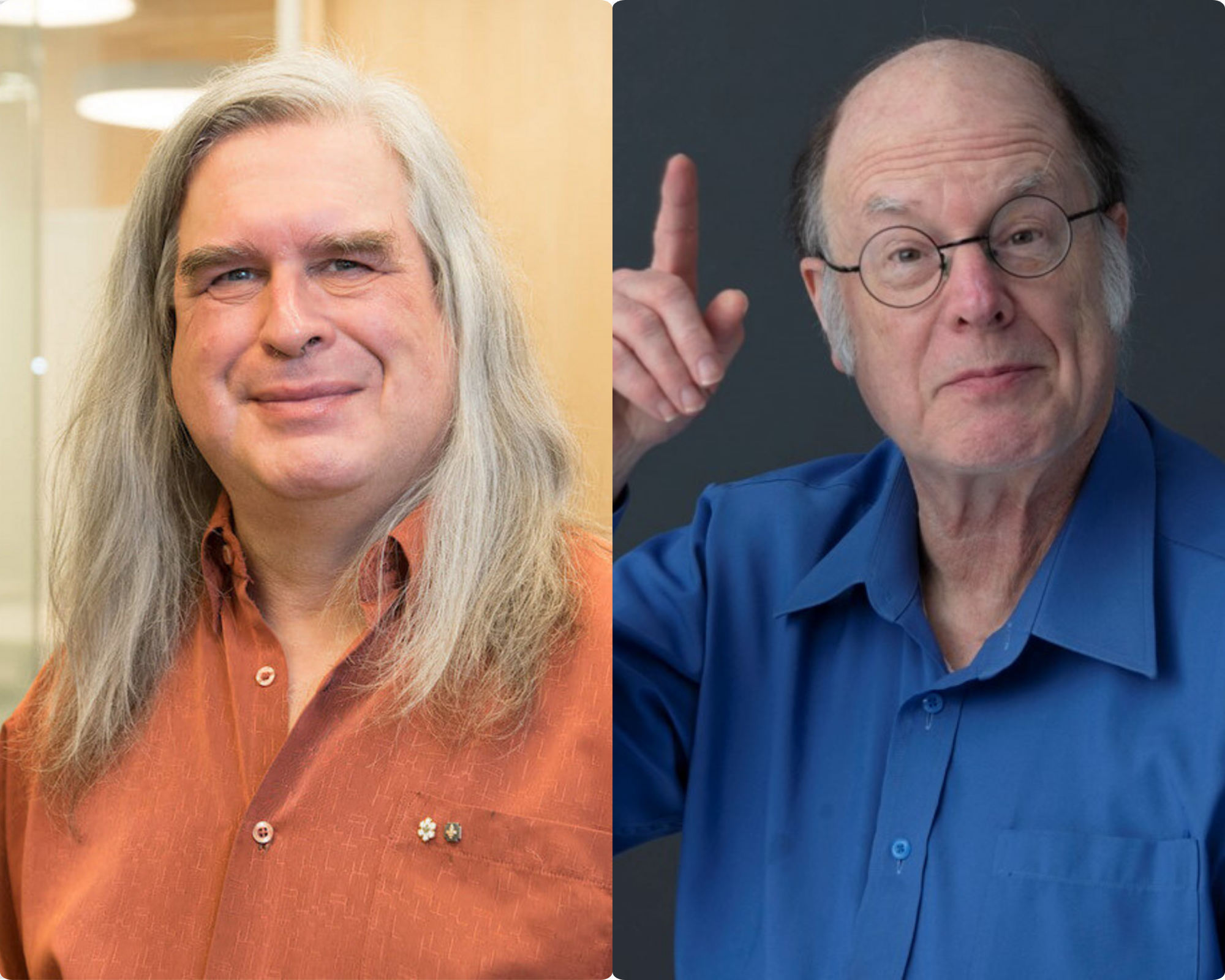 |
Gilles Brassard (left) and Charles Henry Bennett. Photo: *UdeMNouvelles, Wikipedia* |
Gilles Brassard, born in 1955, is recognized as a pioneer in the nascent field of quantum information science.
He earned his bachelor's and master's degrees from Universite de Montreal before receiving his PhD in theoretical computer science from Cornell University, United States, in 1979. There, he studied under John E. Hopcroft, the 1986 Turing Award laureate.
Immediately after earning his PhD, Brassard returned to teach at Universite de Montreal and held the Canada Research Chair in Quantum Information Science for two decades (2001–2021).
Throughout his career, he has received numerous prestigious international scientific honors and awards, including the Wolf Prize in Physics, the Micius Quantum Prize, the Breakthrough Prize in Fundamental Physics, the Order of Canada, and the Ordre national du Quebec.
Currently, he is a member of the Royal Society (UK) and the US National Academy of Sciences.
His collaborator, Charles Henry Bennett, born in 1943, is an American physicist credited with fundamental contributions to information science, cryptography, and quantum teleportation. He earned his PhD from Harvard University and has worked at IBM's research center since 1973.
The Turing Award is named after Alan M. Turing, the brilliant British mathematician who laid the mathematical foundations and limits of computation. He was also a key figure who helped the Allies decipher the Enigma cipher system during World War II.
This prestigious award, often called the "Nobel Prize" of computer science, has honored 81 outstanding computer scientists and engineers since its inception in 1966. These individuals created core systems and theoretical foundations, driving the growth of the global information technology industry. Laureates receive a 1 million USD prize sponsored by Google.