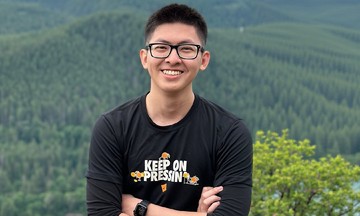
Hoang Dang Khoa, 21 years old, is a student in the first cohort of the artificial intelligence (AI) program at the University of Engineering and Technology, Vietnam National University, Hanoi.
Khoa successfully defended his graduation project, which evolved from his research on drone positioning using thermal imaging. This project also helped him surpass more than 5,700 candidates to win first prize in the Viettel Digital Talent internship program, leading to his employment as a full-time staff member at the Viettel Aerospace Institute (VTX).
"This is the biggest and most meaningful award for me," Khoa stated.
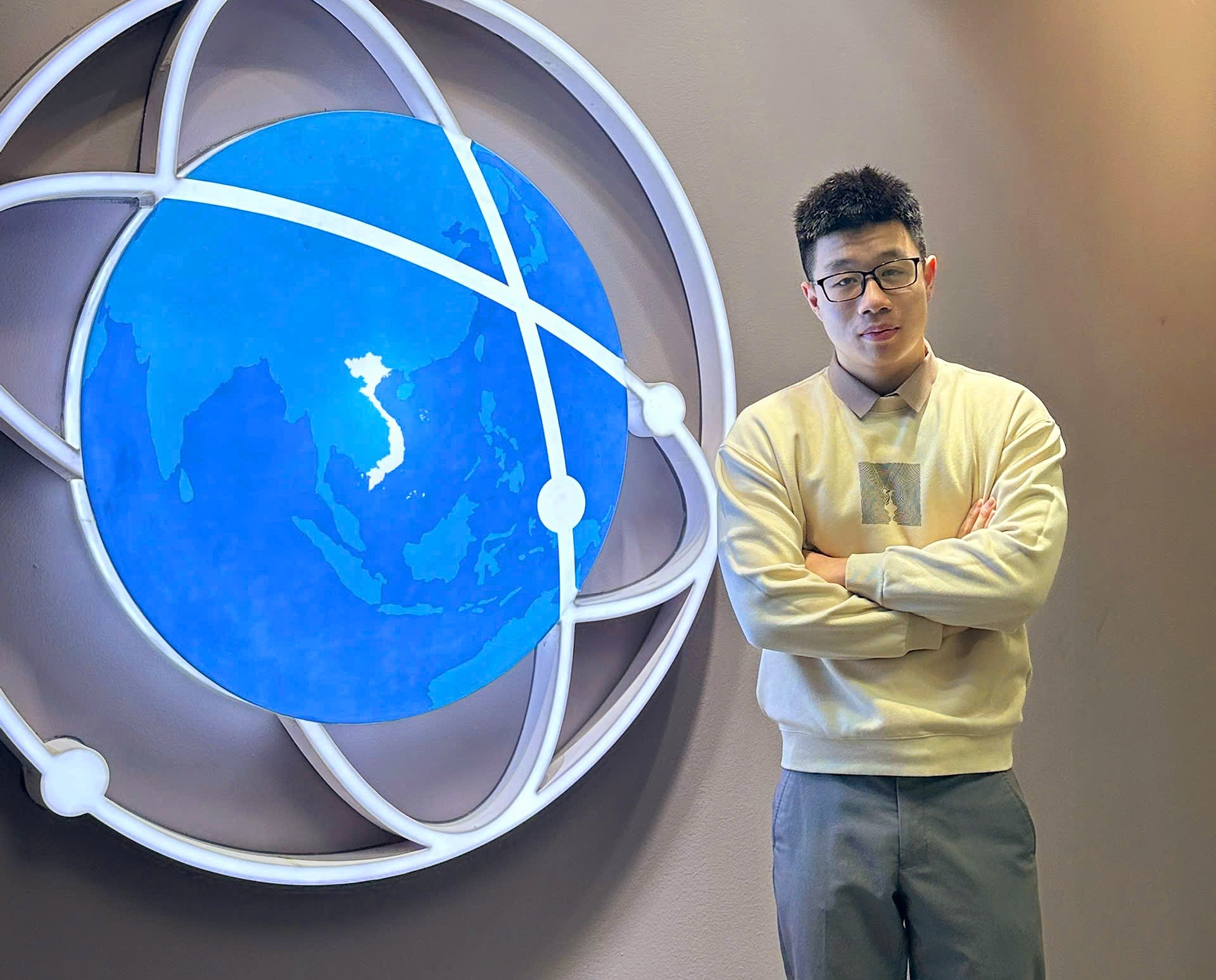 |
Hoang Dang Khoa at Viettel Aerospace Institute. Photo: Provided by interviewee |
Khoa is an alumnus of the specialized Mathematics class at Hanoi University of Education High School for the Gifted, having been admitted to the University of Engineering and Technology in 2022.
At that time, artificial intelligence was a new field. However, due to its extensive application of mathematics, Khoa progressed smoothly in his studies. Upon admission, Khoa took an assessment to enroll in an accelerated program with a more intensive schedule, aiming to graduate 0,5-1 year early. His class had only 28 students, which allowed him to receive prompt and substantial support from his instructors, enabling him to delve deeply into subjects such as mathematics, programming, and AI.
Starting from his second year, Khoa began seeking opportunities at research laboratories. He was assigned projects and participated in monthly discussions under the guidance of faculty members. Khoa believes this process enhanced his self-study abilities, taught him how to approach problems systematically, and fostered a greater passion for research.
After an internship at Viettel through his university's program in August last year, Khoa continued both studying and interning at the unit. In early this year, when Viettel opened applications for its talent internship program, Khoa immediately applied, viewing it as an opportunity to gain experience and secure a full-time position before graduating.
The program spanned 6 months. During the first half, Khoa participated in intensive training, where he was introduced to new, thought-provoking knowledge. He had to self-study and explore further to complete the assessments.
Three months later, Khoa entered a full-time internship phase at VTX, engaging in real-world projects. Khoa considers this period the "most enriching" as he experienced the entire process of building a large-scale AI project, receiving guidance on specialized knowledge, research methodology, and presentation skills.
The project Khoa participated in originated from a practical question: "How does an unmanned aerial vehicle (UAV) navigate when GPS signals are lost?" Under the guidance of experts at the Viettel Aerospace Institute (VTX), Khoa proposed a positioning solution using thermal imaging, employing an infrared sensor camera—a data source that is resistant to interference.
The research process was challenging. The initial hurdle was generating ideas. During the three months dedicated to the project, Khoa spent more than one month reviewing international literature to understand how this problem had been addressed globally and identify areas for deeper exploration or improvement.
Next came data collection and processing. This was a unique problem with limited publicly available data. Khoa and his collaborators had to transport equipment to the peak of Den Thuong, Ba Vi, to collect thermal images from high altitudes. During the training phase, the model frequently failed to produce desired results, requiring Khoa to continuously experiment, adjust, and optimize.
The research results indicate that Khoa's model can position UAVs without GPS, boasting a processing speed four times faster than current image matching models. Its accuracy ensures a high level of competitiveness. Khoa confirmed that the project met the specified criteria for economic efficiency, novelty, applicability, and completeness.
Khoa's model received high praise from the expert council for its practical applicability and feasibility for integration into future UAV systems.
Consequently, despite not having officially graduated, Khoa was offered a full-time position at the Viettel Aerospace Institute.
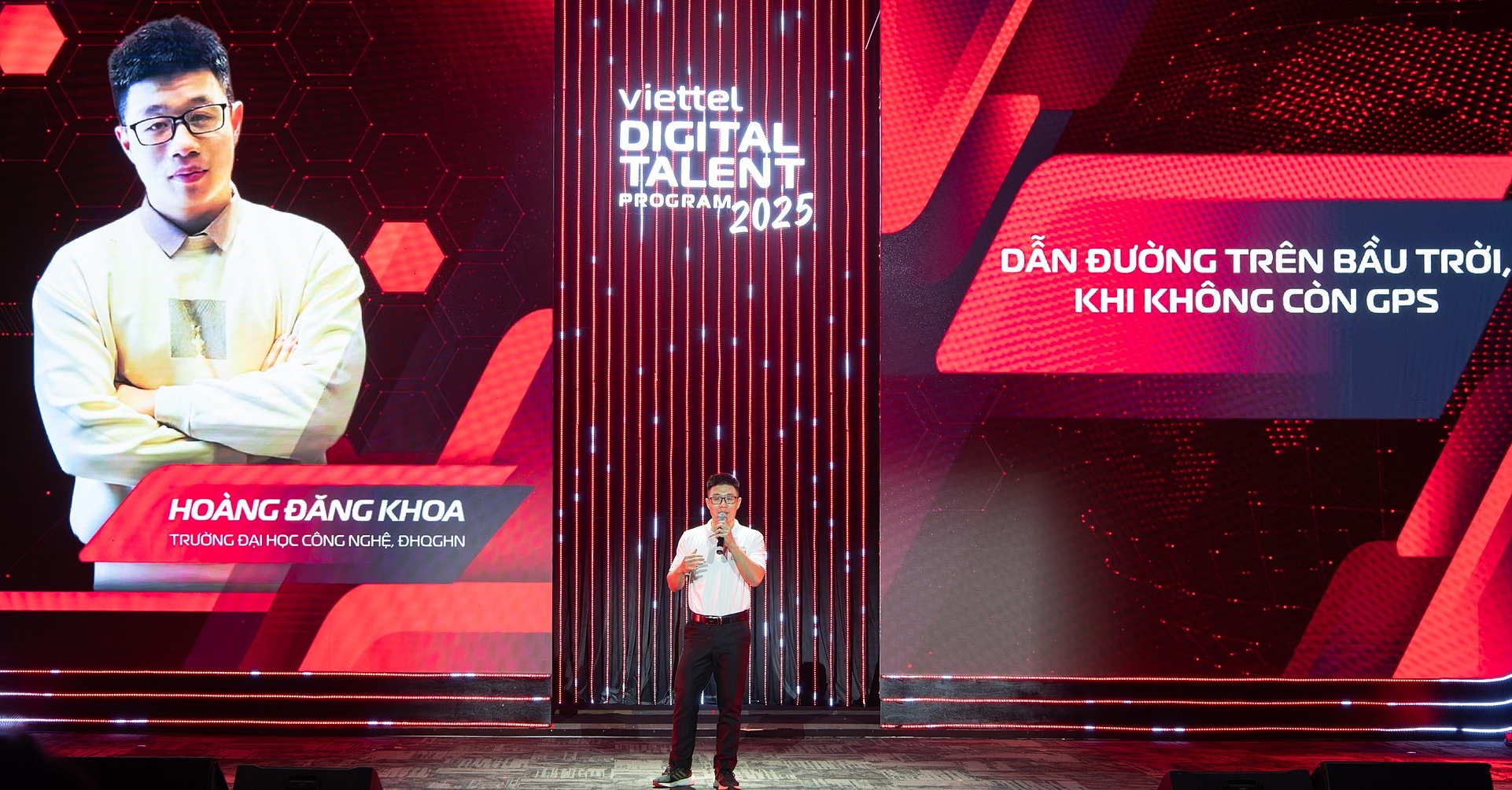 |
Khoa presenting at the closing ceremony of the talent internship program in November. Photo: Provided by interviewee |
Nguyen Hoang Tuan, an artificial intelligence engineer at VTX who mentored Khoa during the Viettel Digital Talent program, observed that Khoa possesses a strong knowledge base, learns quickly, is eager to improve, and actively connects with his mentors to find solutions.
"The project Khoa undertook was very difficult, involving a significant amount of work and knowledge," Tuan noted. "But Khoa remained persistent. Each time he reported, I was impressed by how quickly and accurately he researched and evaluated problems."
Khoa currently maintains a grade point average (GPA) of 3,67/4 and holds a TOEIC English certificate with a score of 960/990. The 21-year-old stated that he will continue to participate in projects at VTX while also seeking opportunities to study abroad in the coming years to pursue a research career in artificial intelligence.
Duong Tam