The chairman of Thanh Hoa provincial people's committee recently approved a development project for Lam Son high school for the gifted through 2030, with a vision to 2045.
The project aims to establish Lam Son high school for the gifted as the province's primary center for nurturing gifted students and developing talent. It seeks to maintain the school's position among the nation's top high schools for the gifted and gradually achieve regional and international standards.
By 2030, the school will expand its size from the current 35 classes to 50 classes, accommodating approximately 1,750 students. This expansion includes introducing new specialized classes in Chinese, Korean, Japanese, Russian, and French.
The project also aims to substantially complete the first phase of infrastructure investment by 2028. This will ensure modern and synchronous facilities to meet the demands of gifted student education and specialized academic development.
Furthermore, the school will accelerate digital transformation and integrate artificial intelligence (AI) into its administration and teaching. By 2030, 100% of teachers will effectively utilize information technology, digital learning materials, and AI in lesson design, assessment, and evaluation. All administrative operations, records, and reports will be processed on digital platforms, and 90% of lectures will be digitized.
Regarding educational quality, the school aims for at least 80% of its students to achieve national awards annually. It also strives for one to two students to win regional or international Olympic medals each year.
According to the project, the total estimated cost for implementation during the 2026-2030 period is nearly 546 billion Vietnamese dong.
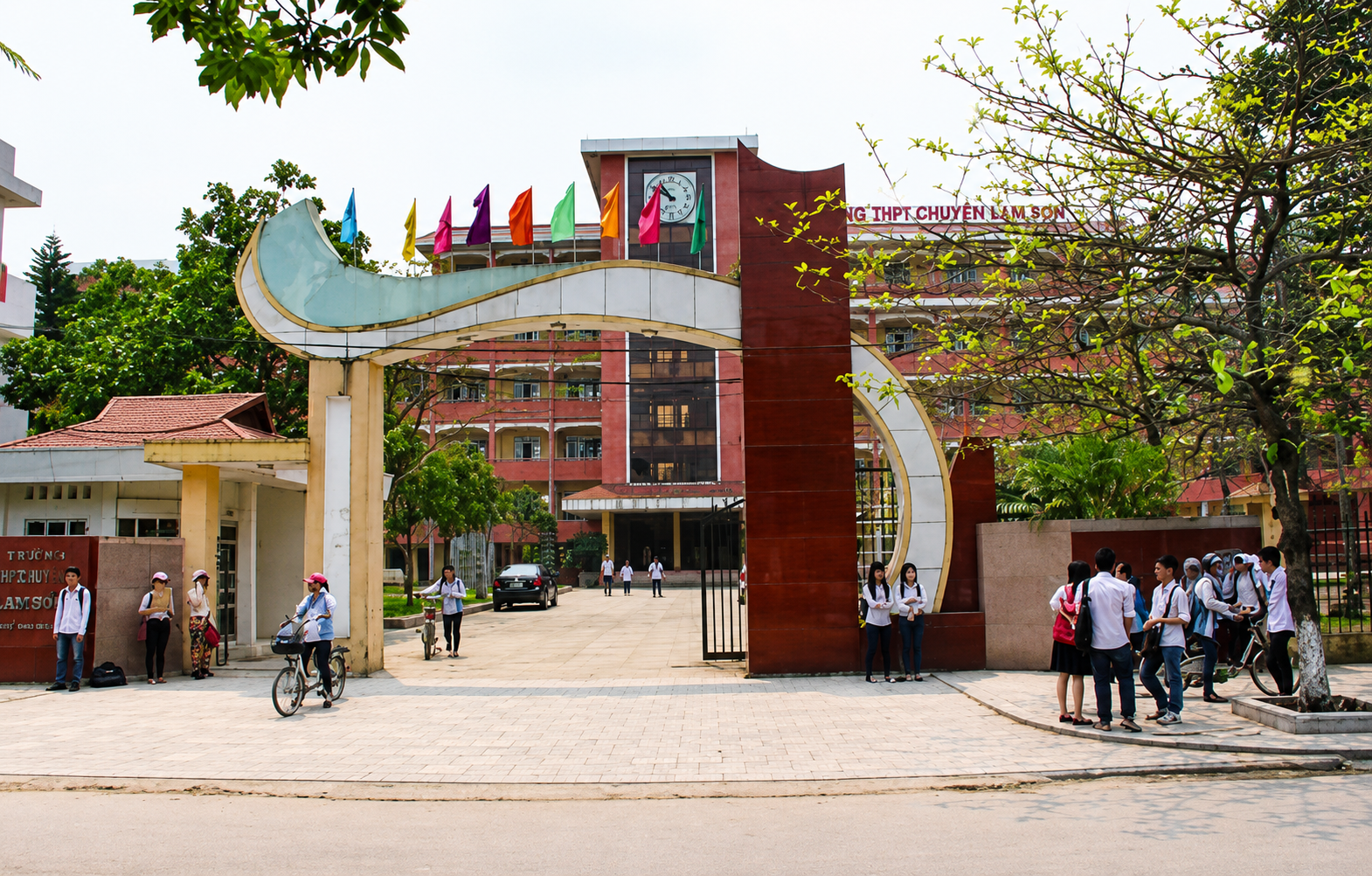 |
The gate of Lam Son high school for the gifted. Photo: Le Hoang |
Currently, Lam Son high school for the gifted has 35 classes with 1,225 students, specializing in nine subjects: mathematics, physics, chemistry, biology, informatics, literature, history, geography, and English. Thanh Hoa province considers this insufficient given its population size and the demand for gifted student education within the province.
Many facilities, constructed between the 1990s and 2000s, have deteriorated. Some structures no longer serve their intended function efficiently, requiring synchronous investment and upgrading.
Le Hoang