According to a report released earlier this week by Chinese recruitment platform Zhaopin, the number of job seekers with overseas degrees increased by 12% last year compared to the same period, marking the highest rate in eight years. While specific figures were not provided, Zhaopin stated that this rate is more than double that of 2018, when statistics began to be collected.
This data indicates a strong surge in the "homecoming" trend. Except for 2023, which was affected by the Covid-19 pandemic, the flow of returnees has shown almost continuous growth.
Data from the Ministry of Education also supports this trend. In 2024, approximately 495,000 international students returned to China, an increase of over 19% from the previous year. Statistics from the 1978-2024 period show that out of more than 7,4 million international students who graduated, 6,4 million returned, accounting for 86%. This number is projected to continue rising.
Most of those returning were educated in the United Kingdom (about 34%), Australia (22%), and the United States (8%).
"This indicates that talented individuals have strong confidence in development opportunities within China. It is a long-term trend, not a temporary phenomenon," a Zhaopin representative stated.
The internet, education, and consulting sectors attracted the most job applications. However, in terms of growth rate, information technology and advanced manufacturing industries led the way, particularly in new materials and optoelectronics.
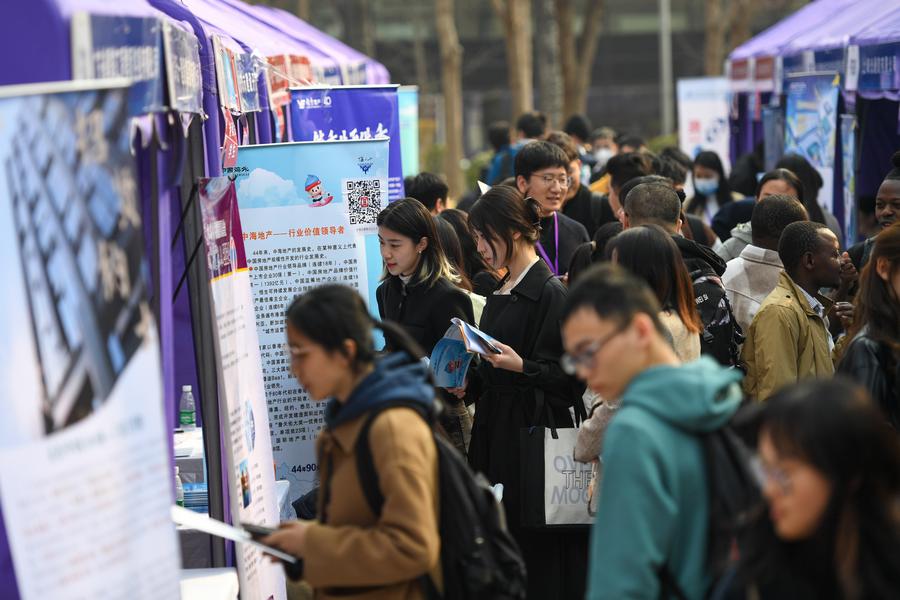 |
Job seekers at a job fair in China. Photo: Xinhua |
Sectors such as robotics, artificial intelligence, smart hardware, and aerospace also recorded strong growth. "These fields are characterized by high research and development intensity, significant technical barriers, and a strong international orientation," the Zhaopin report noted.
According to Zhaopin, this wave is driven by various government support policies and increased investment in new-generation industries. While Beijing, Shanghai, and Shenzhen remain top choices for returnees, the number of international students seeking jobs in second and third-tier cities increased by over 20%, and even by 30% in fifth-tier cities. Many talented individuals are moving to smaller urban centers to gain a pioneering advantage.
Additionally, the tightening of United States visa regulations for Chinese international students, coupled with a bleak overseas job market, has been a "push" factor compelling many to return home, according to Xiong Bingqi, director of the 21st Century Education Research Institute.
This influx will intensify competition in the domestic labor market. An estimated 12,7 million domestic students are expected to graduate from universities this summer, surpassing last year's record of 12,22 million. According to the China National Bureau of Statistics, the youth unemployment rate (for those aged 16 to 24) in December 2025 was 16,5%. This figure frequently fluctuated between 16-17% in 2023.
Notably, eight out of ten returnees hold master's degrees. In contrast, overseas positions in this group primarily required only a bachelor's degree (accounting for 83%).
Khanh Linh (According to Maeil Business Newspaper, SCMP, The Global Times)