As of 2024, nearly 34,300 individuals who came to South Korea for study have either overstayed their visas or worked beyond permitted hours, according to research by Associate Professor Kim Gyu-chan of Gangneung-Wonju National University. This number is five times higher than a decade ago. Among these, nearly 24,700 violations were by language program students (D-4 visa holders), with the remainder being university students (D-2 visa holders).
For D-4 visa holders, Vietnamese international students account for approximately 70% of all violators, a significant increase from 1,5% in 2014. The next largest groups are Uzbekistan (13%), Mongolia (6,9%), and China (3,4%).
Among D-2 visa holders, Vietnamese students represent 89% of the total violations, nearly a seven-fold increase compared to a decade ago.
Overall, the violation rate among all international students has climbed from 7,8% in 2014 to 11,6%, meaning that one in every 10 international students commits a violation.
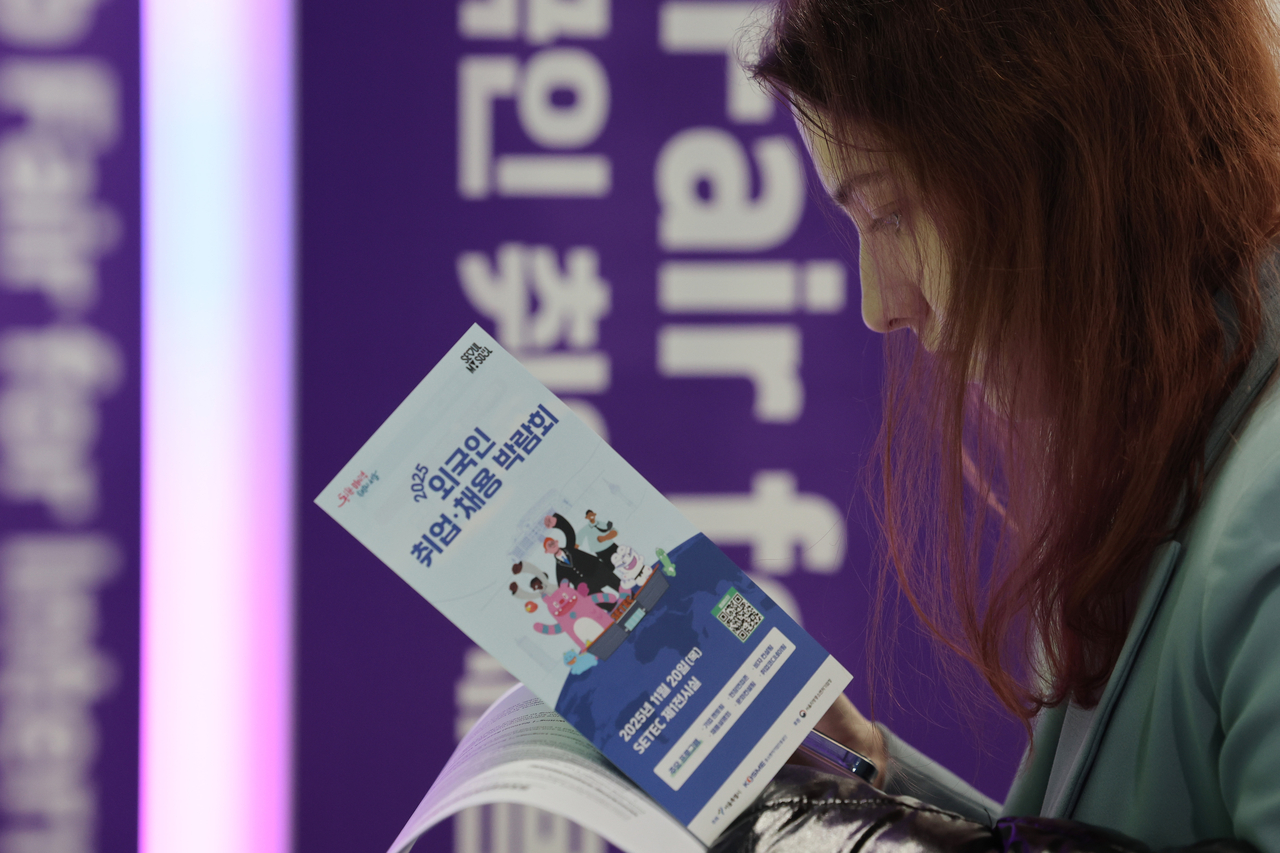 |
A job seeker attends a job fair for foreigners in Seoul. Photo: Yonhap
The research highlights that South Korea's greatest shortcoming in its approach to international students is the lack of connection between education, employment, and settlement. Despite actively recruiting students, the country lacks a sustainable pathway to help international students transition into the labor market.
"The current legal framework treats international students as temporary fillers for the labor market, not as potential long-term residents", Kim observed.
A primary barrier pushing international students into unauthorized work is the strict regulations on part-time employment for D-10 visa holders (international students post-graduation who have not yet secured employment), leading to financial exhaustion. Additionally, they face difficulties converting to official work visas (E-7) due to minimum salary requirements that are often higher than what small and medium-sized enterprises realistically pay.
In 2023, South Korea's Ministry of Education announced the "Study in Korea with 300,000 Students" initiative, aiming for 2027 but achieving its goal two years ahead of schedule. The Ministry of Justice's 4th Basic Plan for Immigration Policy (2023-2027) also designates international students as potential skilled labor that should be retained.
However, Kim notes a significant gap between policy objectives and reality, which contributes to the rise in illegal immigration.
Currently, the Ministry of Education's international education quality assessment system relies on the rate of international students residing illegally as a key indicator for school accreditation. Critics argue this metric incentivizes schools to focus on "monitoring" rather than enhancing educational quality and career support.
"International students should not be viewed as a temporary solution to demographic shortages or an administrative burden. They need to be recognized as valuable human resources and future residents of South Korea", Kim stated.
As of the end of 2025, approximately 305,000 international students are in South Korea. Vietnamese students, numbering nearly 108,000, constitute the largest and fastest-growing group since 2017.
Khanh Linh (According to The Korea Times, The Korea Herald, Yonhap)