* This article reveals film content
Directed by Lan Nguyen, who previously made "Mau co ua" (The Color of Withered Grass), "A brilliant horizon" explores the profound connection to one's homeland and cultural origins. The documentary, primarily set in Ninh Binh—Ha Anh Tuan's ancestral homeland—weaves together artistic creation and the search for roots. It draws inspiration from a 2023 concert of the same name, incorporating natural landscapes, historical relics from the Dinh and Le dynasties in the ancient capital of Hoa Lu, and the cultural tradition of 'hat xam' (blind busker singing).
The film delves into the personal experience of "belonging" amidst continuously evolving cultural life. Director Lan Nguyen emphasizes that this feeling is not necessarily tied to a specific geographical location. Structured into four distinct parts—Seed, Tree, Forest, and Root—the film consistently revolves around seeking, preserving, and perpetuating ancestral values in contemporary society.
The "Seed" section, which occupies a significant portion of the film, explores initial connections to one's roots. Following this, the "Tree" section utilizes excerpts from the program "As if there was no separation" (Nhu chua he co cuoc chia ly) to highlight themes of reunion and human connection. Through stories of individuals separated by social circumstances, the director celebrates the bonds and harmony among people. She features two notable cases, including a French woman's return to her ancestral home in Vietnam.
In "Forest", the documentary examines the musical collaboration and shared philosophies between Ha Anh Tuan and musician Kitaro. Both artists align on fundamental values of origin and human compassion. Beyond performance segments, the film dedicates time to their everyday interactions during a tree-planting trip, where Kitaro shares his perspectives on music and tranquility, finding inspiration in nature. The "Root" section concludes the film's narrative by returning to images of children singing 'hat xam', completing a cyclical motif from seedling to root, then regenerating into new seeds. This ending suggests the continuous flow of culture, passed from one generation to the next.
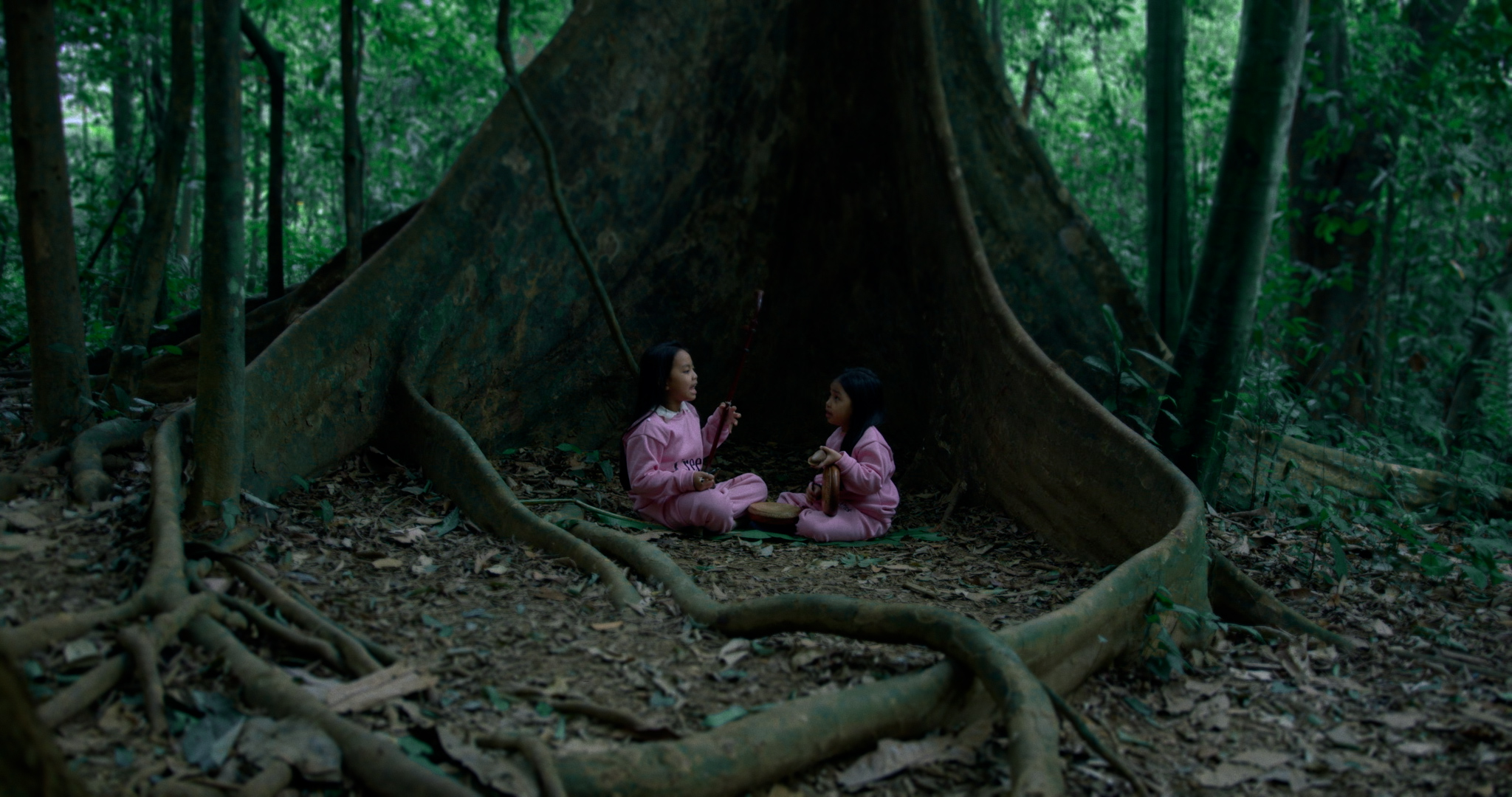 |
A scene from the documentary "A brilliant horizon". *Photo: Organizer provided |
Over two years, the filmmaking team extensively traveled through Ninh Binh. The director did not prioritize Ha Anh Tuan's screen time or the frequency of music use, instead focusing on the narrative. Some images were intentionally arranged, such as two children under a tree or a fallen tree stump, to create continuity in the storytelling and guide the film's flow.
The film is distinguished by its panoramic shots of Ninh Binh's diverse landscapes, including the ancient capital of Hoa Lu, Van Long Lagoon, Ma Yen Mountain, Tam Coc, the ancient Bai Dinh Pagoda, Cuc Phuong National Park, and a primary school in Yen Phong commune. The director meticulously uses ambient sound and silences to evoke a sacred atmosphere for these culturally significant landmarks. Music primarily supports the narrative, with songs like "Cong cha ngai me sinh thanh" (The merit of father, love of mother), "Nguoi Viet Nam" (Vietnamese people) by Vo Thien Thanh, "Koi", and "Silk Road" by Kitaro strategically placed to enhance the story's progression rather than to showcase technical prowess or stage grandeur.
Despite its strengths, the work has some limitations. The introductions to the four chapters are lengthy, and some details are repeated in later sections. The "Seed" section occupies a significant portion, while "Forest" and "Root" are explored quickly. Overall, the film's narrative prioritizes emotion and concept over drama. This pacing might feel slow to some viewers, but it aligns with the spirit of a heritage-focused work. The dense information and layers of meaning presented might make it challenging for viewers to fully grasp on a first watch.
Director Lan Nguyen stated that the work was inspired by her personal experiences of feeling lost within a community. These emotions were evoked when she heard the lyric "I hope my homeland welcomes me with open arms" from the song "Bonjour Vietnam" (Yvan Coriat, Guy Charles Willy Balbaert, Marc Lavoine).
 |
Singer Ha Anh Tuan at the film's premiere event in TP HCM. *Photo: Organizer provided |
At the film's premiere in TP HCM on 10/12, Ha Anh Tuan said he did not interfere with the content, granting the director creative freedom. The singer believes the film conveys a message: people can only stand firm when they have a connection to and awareness of where they live. Revenue generated from the project's release will be dedicated to the "As if there was no separation" (Nhu chua he co cuoc chia ly) program, supporting family reunification efforts.
Que Chi