With a budget of nearly 250 million USD, the film is directed by Phil Lord and Chris Miller, adapted from Andy Weir's novel of the same name. Actor Ryan Gosling stars as Ryland Grace, a science teacher tasked with saving Earth from destruction. His character embarks on an interstellar journey, where he encounters an alien creature named Rocky.
Trailer for "Project Hail Mary" (Escape from the Apocalypse), released domestically on 20/3. The film is rated 13+. Video: Galaxy Studio
According to Hollywood Reporter, the science fiction blockbuster garnered attention for being made entirely without green screen footage. This technique typically involves filming actors against a plain background, then compositing the setting using visual effects, with the background color removed in post-production to create special effects without actual filming.
Director Christopher Miller stated that green screens, if not handled carefully, can appear unconvincing, leading the team to avoid this method. They constructed the entire interior of the spaceship, along with a portion of the exterior, to capture scenes directly on set. The alien character Rocky was operated by puppeteer James Ortiz, performing live during filming.
"However, abandoning green screens does not mean the film lacks visual effects," he wrote on the social media platform X. In post-production, visual effects were used to address details such as removing cables, adjusting puppet controls, or replacing certain elements in the background. For scenes where Ryan Gosling stands outside the hull, the team used a black background to simulate space, or a changing colored background when the character was in front of an aurora.
Industrial Light & Magic handled the extensive space scenes and digitally created spaceships. "This is the result of the industry's top team," Miller noted.
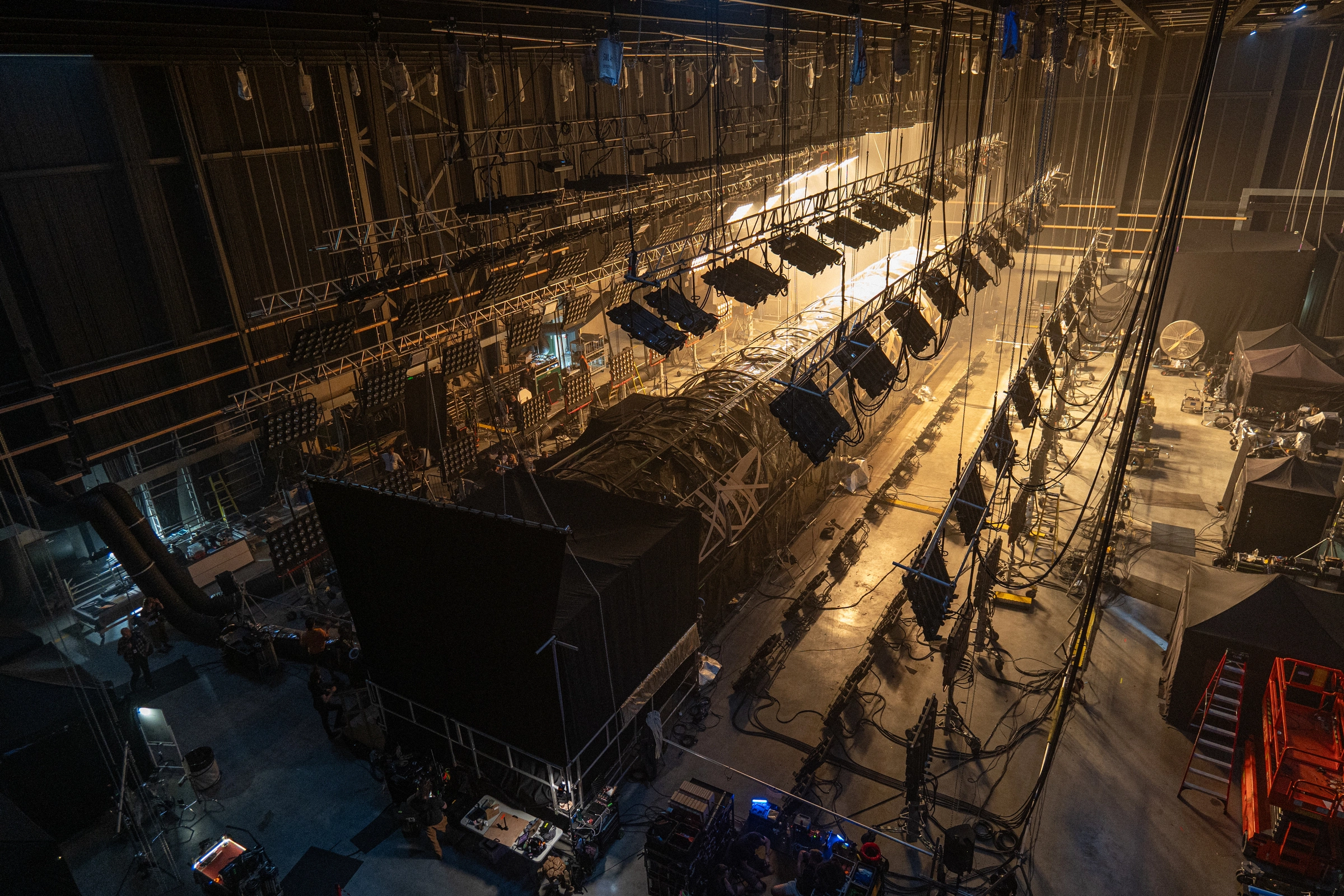 |
Lighting rig outside the tunnel in 'Project Hail Mary'. *Photo: Tamas Papps*
According to Variety, cinematographer Greig Fraser, known for works like The Batman, Dune, and Rogue One, called Project Hail Mary the most challenging project of his career. One visually striking sequence involves Ryland traversing a tunnel to meet Rocky. Fraser explained that the team had to determine how to represent the fictional "xenonite" material in the film. Additionally, the over 20 m long tunnel posed a challenge for uniform lighting.
"Previously, light was created by placing lights on a frame and moving them past windows or objects. But for this scene, we needed sunlight to cover the entire tunnel," Fraser said.
Production designer Charles Wood and his team adjusted the tunnel's interior surface to allow just enough light to pass through. If the coating was too dark, light would be blocked; if too bright, the surface would resemble plastic. They conducted multiple tests to find the right balance.
Unlike the cold, desolate imagery often seen in space films, this movie opted for warm tones like orange and yellow to help convey a story about friendship. The crew used numerous traditional tungsten lights instead of LEDs, combined with a programmed lighting control system, to create the effect of sunlight moving through space.
In the scene where Ryland first sees the tunnel, Fraser aimed to evoke a dark feeling, as if the character was descending into a deep well. He drew inspiration from footage of submersibles at the bottom of the ocean, where space is shrouded in darkness, with the only light coming from the vessel's lamps or divers' headlamps. For the multi-colored light effects that appear throughout the film, Fraser used a special filter that made light sources produce rainbow streaks, becoming a distinctive visual element of the movie.
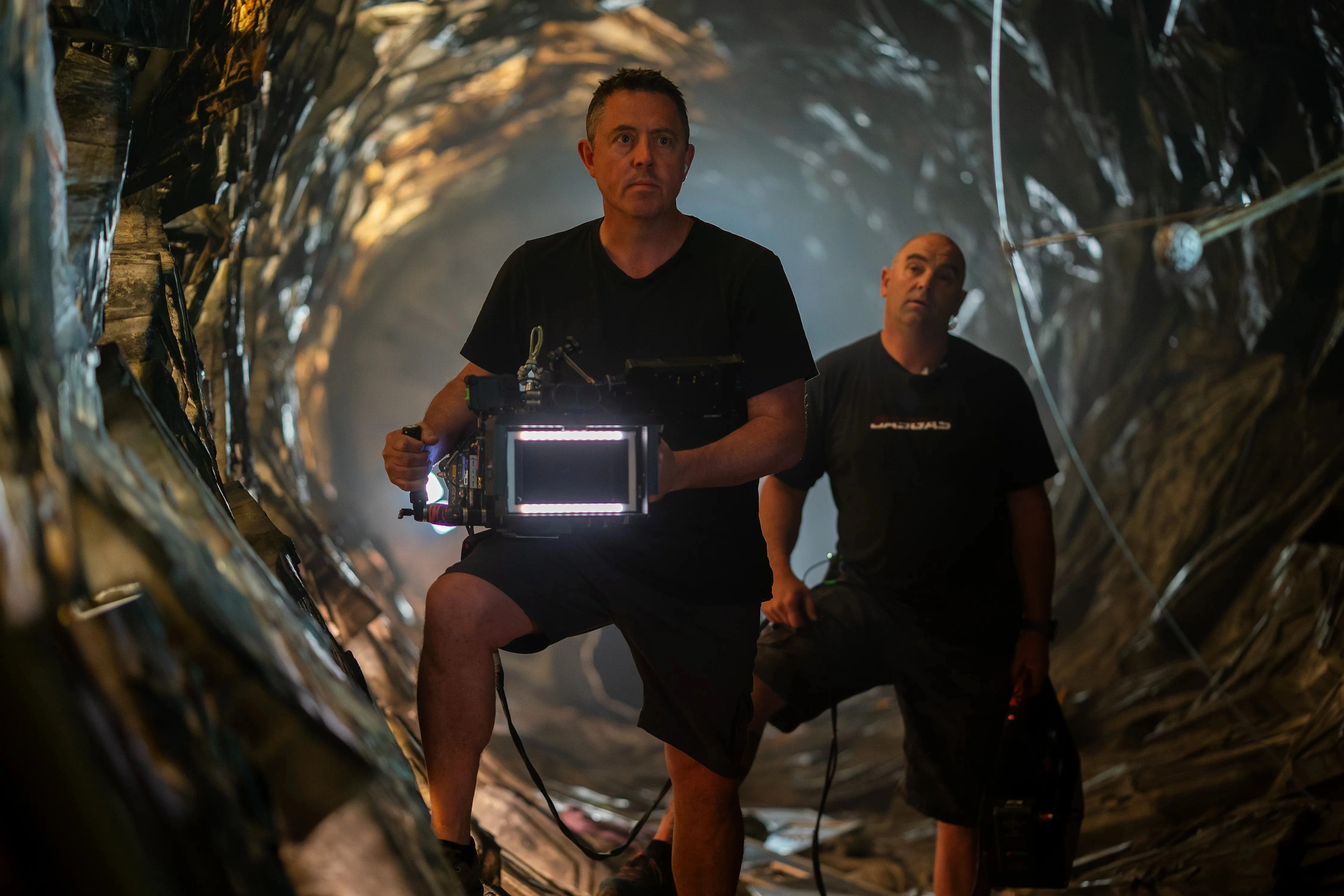 |
Cinematographer Greig Fraser (left) on the set of 'Project Hail Mary'. He won an Oscar for Best Cinematography for 'Dune: Part One' (2021). *Photo: Jonathan Olley*
After resolving the lighting challenges, Fraser experimented with lenses. Instead of the usual wide horizontal images, he adjusted the camera angle so that light streaks appeared vertically, creating a unique visual effect. He chose the Alexa 65 camera over IMAX to preserve a classic "analog" image quality, reminiscent of 1970s-1980s science fiction films such as Solaris, Alien, or 2001: A Space Odyssey.
Project Hail Mary is set against a backdrop where the sun's energy is being depleted by an alien microorganism. Ryland Grace, a molecular biologist who left research to teach, is drawn into a mission to save the world. He awakens on a spaceship with temporary amnesia, gradually regaining his memories through fragmented flashbacks.
The film employs a narrative structure that interweaves present and past, revealing the cause of the disaster while clarifying the character's psychological transformation. Ryan Gosling's performance stands out. With his charm and control over the pacing, he masters the character's emotions, maintaining a fluid cinematic flow.
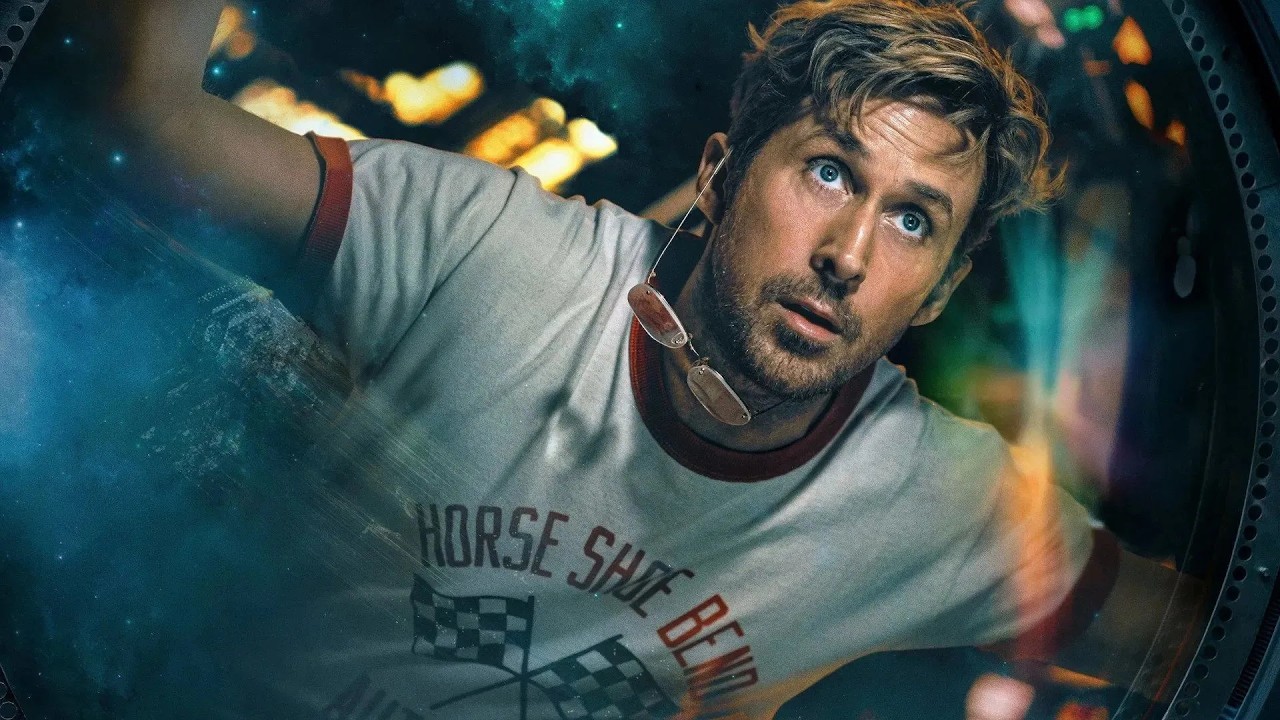 |
Actor Ryan Gosling stars in 'Project Hail Mary'. *Photo: Amazon MGM Studios*
Despite its dramatic subject matter, the work adopts an entertaining tone, aiming to appeal to a broad audience. USA Today noted that the film balances humor and drama, maintaining an engaging pace. However, according to Guardian, compared to Interstellar or The Martian, the film leans towards an optimistic tone, at times overusing humor, which diminishes the content's impact. Towards the end, the script extends, making the pacing less concise and the conclusion less impressive.
Cat Tien (according to Variety, Entertainment Weekly)