


This book by Associate Professor Doctor Nguyen Hoang Hai intertwines his research with Buddhist insights. It emerged after his many years of teaching Contemporary Science and Buddhism, and Philosophy of Natural Science courses at Vietnam National University, Hanoi.
The author believes that some Buddhist philosophies share common ground with modern science, offering mutual support and complementation. According to the domestic publisher, the author focuses on three core Buddhist concepts: dependent origination, suffering, and the middle way, to reflect on the material world and human consciousness.
"Dependent origination reveals that all phenomena exist in interdependent relationships; no entity is independent. From this, 'emptiness' is understood as the absence of a fixed nature, while suffering arises from the illusion of an unchanging self. The middle way and the eightfold path are presented as approaches to help humans escape extremes in perception and action", the book's introduction states.
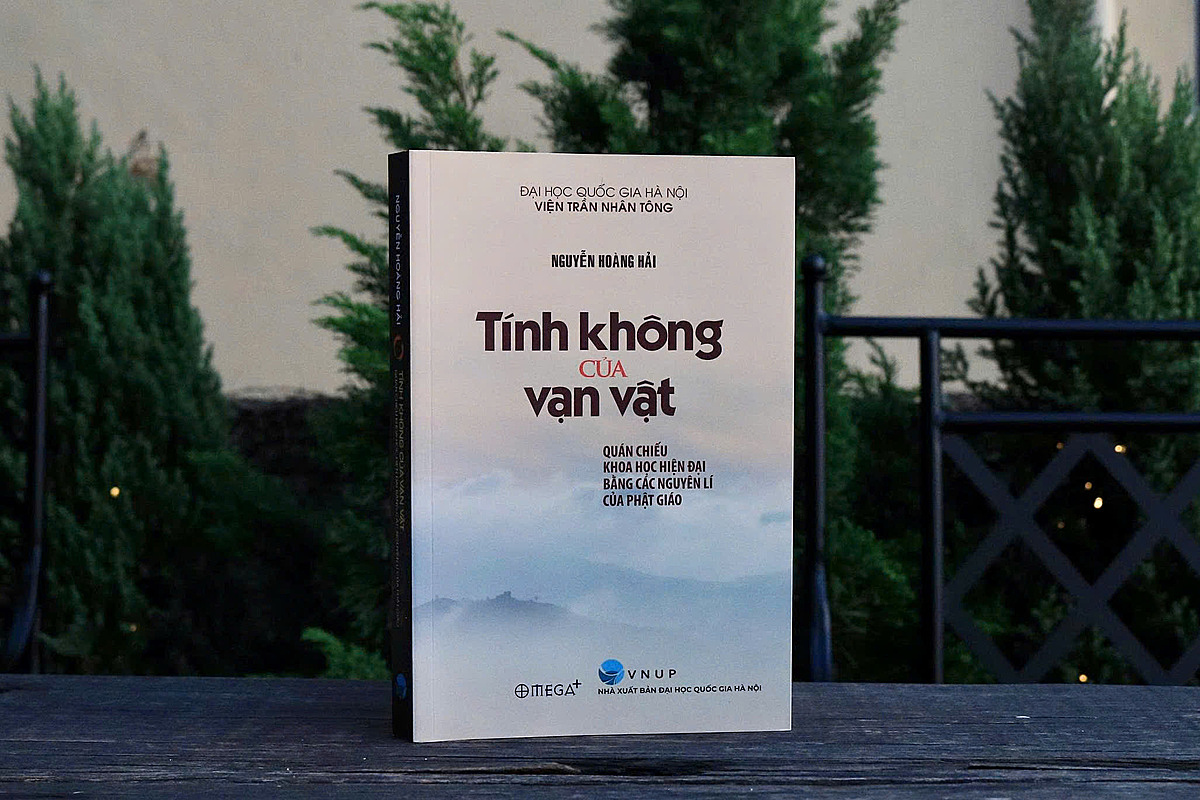 |
The book "Emptiness of All Phenomena" was released by Vietnam National University Press in collaboration with Omega+ in december 2025. *Photo: Omega+* |
To clarify this perspective, the author divides the book into five parts, beginning with an exploration of Indian civilization before Buddhism emerged. He also delves into the religion's development in its country of origin, then its spread to Vietnam and China. Interweaving Buddhist history, he discusses Buddhist doctrines, such as dependent origination.
In the remaining sections, the author discusses emptiness at four levels: matter, life, humans, and consciousness. For example, in chapter two, he uses physics knowledge such as atomic and subatomic theories, and many principles of quantum mechanics to demonstrate the close relationship of microscopic particles in forming matter.
When writing about emptiness in life and humans, the associate professor analyzes symbiosis and the interdependence among gene, cells, microorganisms, and the environment. For example, in the human body, microorganisms in the gut system help us digest and strengthen the immune system.
In the final section, he discusses consciousness, how the brain builds predictive models and adapts through very thin slices of reality collected by the senses. He also explains the body's mechanism for creating pain when humans are injured, the psychology of dissatisfaction after achieving goals, and the misfortunes caused by states of ignorance.
Nguyen Hoang Hai graduated with a bachelor's degree in physics from Hanoi University. He then defended his master's thesis in materials science at Hanoi University of Science and Technology and his doctoral dissertation in physics at the University of Grenoble, France. He has published many research papers while also teaching physics, philosophy, science, and Buddhism at various universities.
Phuong Thao


