According to Bj News, the artist's family announced he passed away on the afternoon of 8/2. In accordance with his wishes, the family held a simple, private funeral without public visitation, allowing him to "depart peacefully."
Ren Wangrui, producer of "Romance of the Three Kingdoms," remembered the director, stating: "Before the camera, he was a versatile artist, unique in style and deeply emotional. Off-screen, he was a generous and sincere brother." Ren Wangrui noted that director Zhang Zhongyi highlighted the tragic heroism of the Three Kingdoms figures, and his talent and passion for his craft earned the respect of his colleagues.
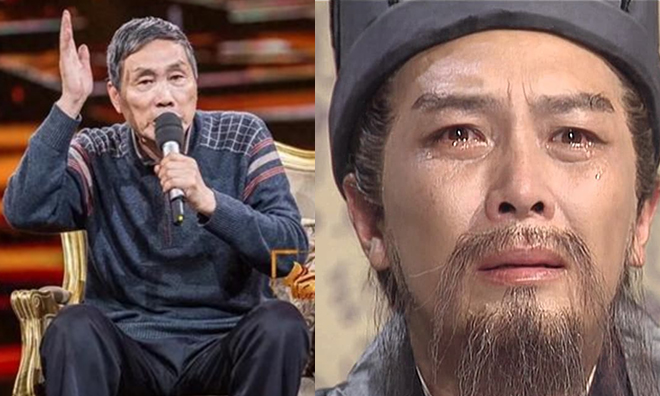 |
Director Zhang Zhongyi (left) on set during the filming of Zhuge Liang mourning Zhou Yu. *Photo: Mtime*
Filming for "Romance of the Three Kingdoms" began in 1990 and lasted three years, with Wang Fulin as chief director. Wang assigned five other directors to oversee specific sections of the work, with Zhang Zhongyi directing parts such as Wo Long Diao Xiao, The Death of Jiang Wei, and San Fen Gui Jin.
On Mtime, director Zhang Zhongyi once shared that he chose to break some conventions while directing the Wo Long Diao Xiao segment (depicting Kong Ming's risky journey to mourn Zhou Yu). According to Han dynasty rituals, mourners were not permitted to step onto the platform where the coffin rested. To heighten the drama and enhance the script's persuasiveness, Zhang Zhongyi directed Tang Guoqiang (who played Zhuge Liang) to stagger forward, weeping, and touch Zhou Yu's coffin.
The scene of Zhuge Liang mourning Zhou Yu in "Romance of the Three Kingdoms." *Video: Bilibili*
The film had the largest investment at the time, totaling 170 million yuan (23.8 million USD), with nearly 100 million yuan (14 million USD) dedicated to recreating the Three Kingdoms era settings. Actor salaries accounted for only 5% of the total investment. This monumental production was grand in both its settings and its cast, involving approximately 400,000 actor appearances.
"Romance of the Three Kingdoms" achieved great acclaim in Asian countries such as Japan, Malaysia, Thailand, Vietnam, India, and South Korea. Japanese broadcasters acquired the rights for over 15,000 USD per episode, in contrast to the over 1,000 USD per episode paid by Japan for the broadcasting rights of "Dream of the Red Chamber" (1987), also directed by Wang Fulin.
Nhu Anh (according to Bj News)