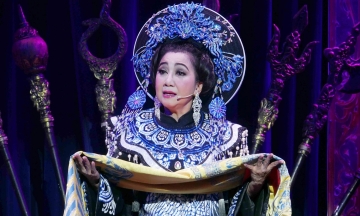
The skit was part of the "Cuoc hen voi thang 3" (Rendezvous with March) program, broadcast on the evening of 29/3. Actors Chi Trung, Tu Long, Van Dung, and Quang Thang played the roles of the Public Servant Kitchen God, Society Kitchen God, Education Kitchen God, and Economy Kitchen God, respectively. Artist Quoc Khanh portrayed the Jade Emperor, with Trung Ruoi as Nam Tao. The cast earned praise for their humor and coordinated performances. However, due to its short duration, the segment only touched upon issues rather than exploring them in depth.
At the beginning of the skit, the Jade Emperor expressed his desire to invite the Kitchen Gods to the Celestial Court for recreation, an invitation they readily accepted. Nam Tao prepared a tree adorned with questions for the Kitchen Gods to play a game of "democratic flower picking" (a traditional game where participants choose questions from a decorated tree).
During a consultation, Chi Trung, playing the Public Servant Kitchen God, asked the Education Kitchen God: "As digital transformation is underway, how do you apply big data and AI in life?". The Education Kitchen God replied: "We must download data from the Celestial Court to Thien Loi, then from Thien Loi, download it to our sector, transforming large data into big data."
After the Kitchen Gods struggled to answer the questions they picked, the Jade Emperor concluded: "Anyone who applies artificial intelligence will find these calculations simple, saving time for thought and focusing on more important tasks. Those who do not use artificial intelligence will fall behind, while those who do will advance faster and work better."
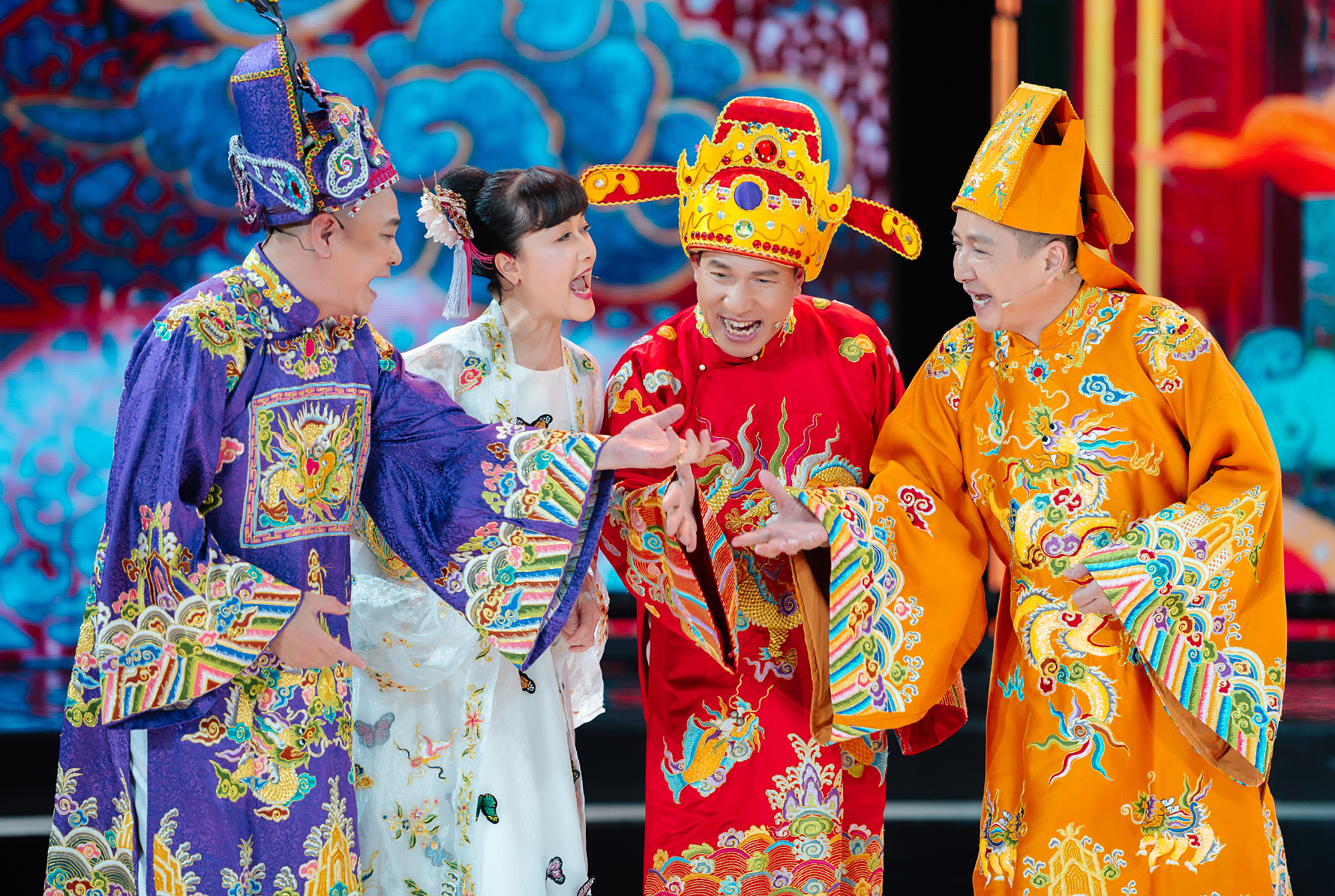 |
From left: Artists Tu Long, Van Dung, Quang Thang, Chi Trung in the segment. Photo: Organizers provided |
The skit also addressed the transformation and merger of various agencies and departments. The Jade Emperor outlined a work ethic based on the "6 Clears" motto: "Clear personnel, clear tasks, clear timelines, clear responsibilities, clear deliverables, clear authority."
Coinciding with VTV3's 30th anniversary of its first broadcast, the Kitchen Gods referenced popular past programs like "O nha chu nhat" (Home on Sunday) and "Hay chon gia dung" (The Price is Right).
Most viewers commented that the segment, though brief, maintained its characteristic humor. Many long-time followers recognized familiar lines that the Kitchen Gods had previously used in Tao Quan 2017.
On the producer's fanpage, many viewers expressed delight at watching the skit, especially after the absence of "Tao Quan" on Lunar New Year's Eve. Many said they were "happy to see the cast, especially artist Quoc Khanh." Before Tet, some sources suggested that the decision to halt "Tao Quan" might be related to his health, with reports of "actor Quoc Khanh having lung cancer that metastasized to the bone." The artist later stated that his condition was stable. Some friends mentioned he had experienced health issues but had since been discharged from the hospital.
Viewer Xuan Thuy, 48 years old, commented that the skit was decent but disappointing due to its short length. "I hope 'Tao Quan' returns with a complete, full program in 2027," she stated.
"Cuoc hen voi thang 3" is a variety show produced to commemorate the 30th anniversary of VTV3's first broadcast. The Kitchen Gods skit was the only sketch in the program. The rest featured musical performances by famous artists such as Trong Tan, Tung Duong, Ho Ngoc Ha, Phan Manh Quynh, Duc Phuc, and Duong Hoang Yen.
Before the Binh Ngo Lunar New Year, many viewers regretted the series' halt in production. The replacement program, "Quang truong mua xuan" (Spring Square), aired during the slot before Lunar New Year's Eve, was criticized by many as "less engaging than Tao Quan."
"Tao Quan - Gap nhau cuoi nam" (Kitchen Gods - Year-End Gathering) is a television comedy program, first produced in 2003 and traditionally broadcast annually on Lunar New Year's Eve. The skit draws upon the legend of the Kitchen Gods ascending to heaven to report to the Jade Emperor on a household's activities over the past year. Through this narrative, the skits reflect and satirize various economic, cultural, and educational issues. Over 22 years, "Tao Quan" has undergone many changes, capturing the spirit of the times with a humorous lens, and is considered a cultural staple for millions of viewers.
Ha Thu