The 71-year-old author delivered his speech at the Swedish Academy in Stockholm on 7 December. This mandatory procedure precedes the author receiving the 11 million Swedish krona (over 31 billion dong) prize. Through extensive prose, he discussed hope, science, civilization, religion, and human dignity.
Ladies and gentlemen!
Upon receiving the 2025 Nobel Prize in Literature, I initially intended to share my thoughts on hope. However, as my reservoir of hope has run dry, I will now speak of angels.
I have been pacing back and forth, contemplating angels. Even now, I am pacing. Do not trust your eyes; you may see me standing here, speaking into a microphone, but that is not the reality. In truth, I am circling, from one corner to another, returning to my starting point, over and over, contemplating angels. I can immediately reveal that these are new angels, without wings. Thus, we need not ponder what a celestial tailor would do if enormous wings sprouted from an angel's back, or what mysterious knowledge would drift into the workshop when dressing them. Wings, of course, lie outside the non-material body. But then, where do they place these wings outside the non-material body? How does the cloak sweetly wrap around and cover the wings, or vice versa, if the wings do not protrude? How does the celestial cloak encompass both their body and wings? Poor Botticelli, poor Leonardo, poor Michelangelo, and indeed, poor Giotto, and Fra Angelico too! But that no longer matters; such questions vanished with the angels of old.
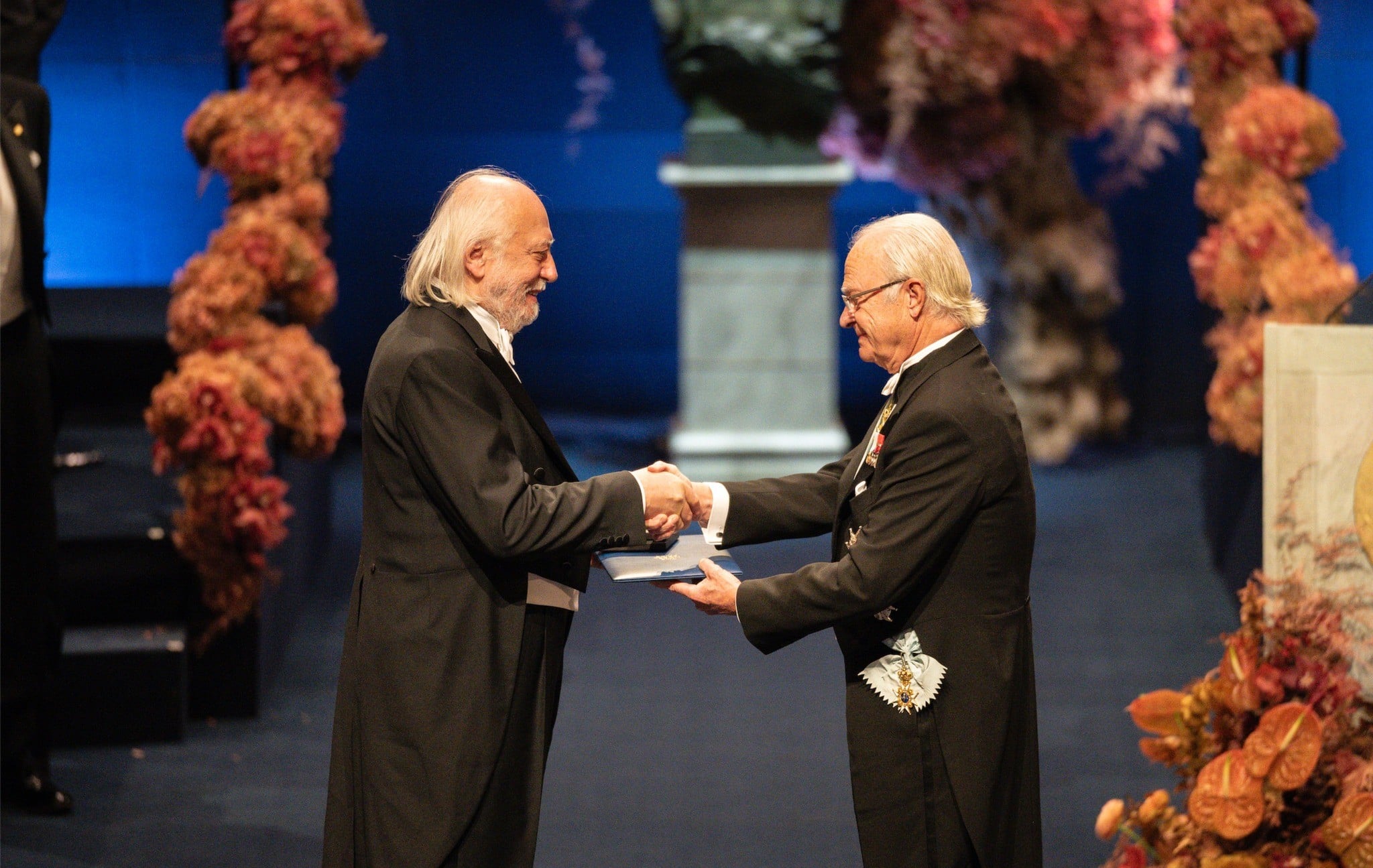 |
Laszlo Krasznahorkai at the discourse reading. Claudio Bresciani/AP |
The angels I speak of are new. This became clear as I began pacing my room, which you now only see me standing before a microphone, declaring my intention to speak of hope as this year's Nobel laureate. Yet, I will not speak of hope now; instead, I will speak of angels. I began with vague outlines forming in my mind as I settled into a meditative posture in my workspace. It is not very large, a tower room measuring only 4 by 4 meters in total, minus the area for the stairs leading to the ground floor. Of course, you should not imagine some romantic ivory tower. This tower room is constructed from the cheapest Norwegian spruce planks, located at the right corner of a single-story wooden house. It rises above everything because my plot of land sits on a slope, and the entire structure rests atop a hill. The land slopes steeply into the valley. If I needed to add a crucial extension to the ground floor rooms – which I had to, as books were consuming all available space – this task became unavoidable after a certain period. Due to the slope, the added room emerged like a tower above the ground floor, weighing upon it. But here, I only wish to speak of angels.
I am not speaking of hope.
Nor am I speaking of the old angels. The old angels, those with wings — consider the most famous ones in Annunciation paintings, created countless times throughout the Middle Ages and Renaissance — always brought a message. This message announced the imminent birth of the One Who Was To Be Born. These were the old angels, messengers constantly delivering one message or another. Angelology suggests they primarily conveyed these messages verbally to the recipient, or, as observed in 9th-10th century engravings, they directly read from a wavy strip of paper, a ribbon inscribed with one sentence, in images where "the word" received extraordinary significance. Even when performing other duties, these angels conveyed — or rather, had conveyed — the Supreme Being's message to His chosen ones, either shrouded in light or whispered into their ears. Despite their depiction, these angels were inseparable from the message they conveyed — or rather, from the message itself — to the extent that the old angels *were* the message. They were the message perpetually sent from the Unimplorable One, who dispatched messages and angels to us, those struggling in the dust, the wanderers, condemned by unforeseen consequences. Oh, that beautiful era! In short, every old angel embodied a message from someone to someone, a commanding announcement or report. But I do not intend to discuss this further here before you, while I pace my tower room, which, as you know, is built from inexpensive Norwegian spruce planks and is almost impossible to heat, called a "tower" solely due to the land's steep incline. No, I will not speak of the old angels, even though countless images of them live within us — thanks to the genius of the Middle Ages and early modern period, from Giotto to Giotto. Even though these old angels, with fitting descriptions such as splendid, noble, intimate, can touch our souls at any moment, even now, even if they can touch our faithless souls, they are certainly the only ones who, for centuries, through their rare appearances, allowed us to speculate about the existence of Heaven. Through them, we could deduce "direction," which shaped our understanding of the universe as having orientation. Where there is orientation, there is distance, meaning space. And where there is orientation, there is also distance between two points, meaning time. Thus, for centuries — oh! and for millennia! — the world believed to be created existed, where encounters with them, with those old angels, gave us a way to definitively perceive "above" and "below" as genuine and real. If I were to speak to you of the old angels, I would pace in circles from one corner and return to that same corner. But no, the old angels are gone; now there are only new angels. And for my part, I am not pacing from corner to corner thinking of them as I stand here before your attention, because as I may have already mentioned,
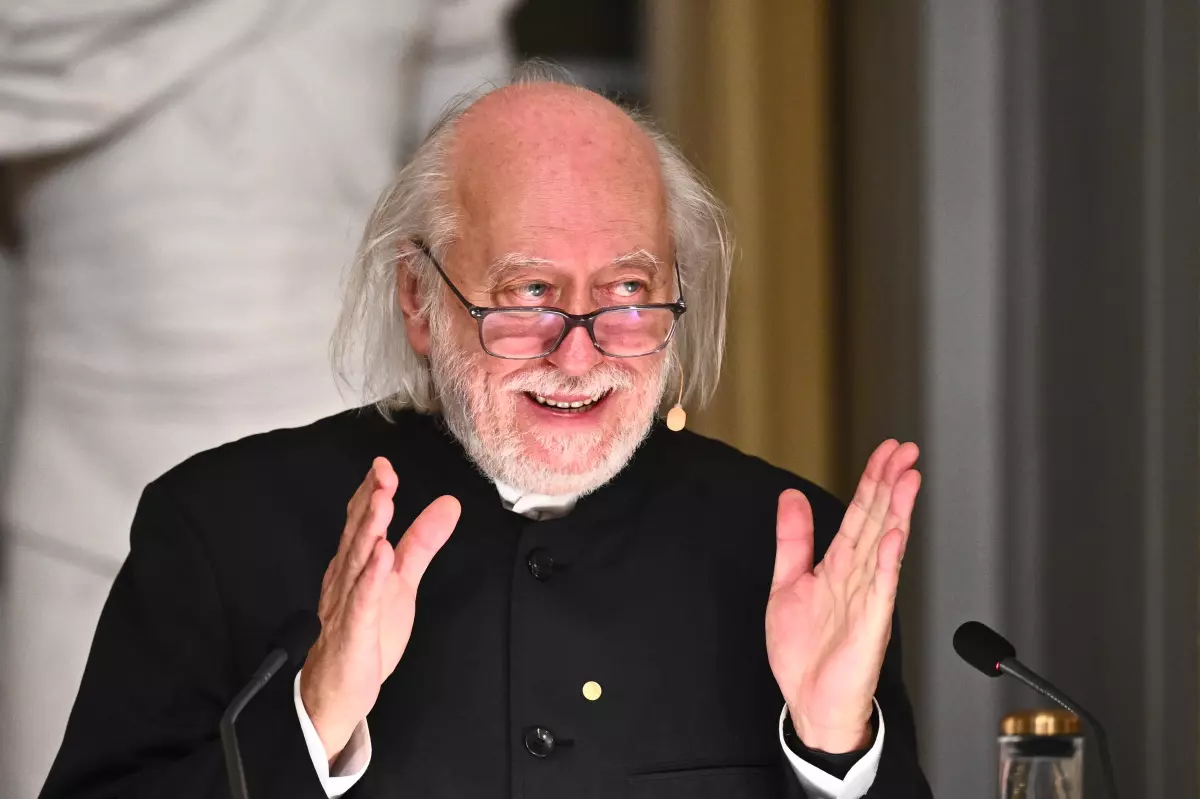 |
Laszlo Krasznahorkai at the discourse reading. Claudio Bresciani/AP
Our angels are new angels.
Having lost their wings, they no longer have cloaks sweetly wrapped around them; they walk among us in simple street clothes. We do not know how many angels there are, but some vague suggestion implies the number has not changed. Like the old angels of yesteryear, these new angels also appear strangely somewhere; they manifest before us in life situations just as the old angels did. In fact, they are easy to recognize if they wish us to recognize them, if they do not conceal what they carry within. It is easy because it is as if they enter our lives with a different pace, a different rhythm, a different melody from our own steps, we who wander in the dust of this earth. Moreover, we cannot even be certain that these new angels come from some "above" realm, for there seems to be no "above" anymore. It is as if that very concept — like the old angels — has given way to an eternal SOMEWHERE, where now only the insane structures of earthly Elon Musks arrange space and time. From this, one can infer that while you still see and hear the same old man standing before you, speaking in his incomprehensible native language on the occasion of receiving the Nobel Prize in Literature — an old man, of course, still pacing incessantly in that unheatable tower room, among the Norwegian spruce planks, circling endlessly — that person is me, now suddenly quickening my steps, as if to convey that my thoughts about the new angels demand a completely different kind of stride, a completely different velocity from the one contemplating angels. Indeed, as I quicken my pace, I suddenly realize that these new angels not only lack wings, but they also have no message at all, absolutely none. They are simply here among us, in their plain everyday clothes, unrecognizable if they wish to be, but if they desire recognition, they choose one of us, approach, and then suddenly, in a single moment, the mist dissipates before our eyes, the veil falls from our hearts. An encounter occurs; we stand there astonished, "my God, an angel stands before us," except... they give us nothing. No flowing sentences surround them, no stream of light helps them whisper into our ears. They utter no words, as if they have become mute. They simply stand there and look at us, seeking our gaze, and in that search is a plea for us to look into their eyes, so that
we ourselves
can convey a message to them. Unfortunately, we have no message to convey, for we can only respond to that imploring gaze with words spoken from ancient times, when questions still existed. But now there are neither questions nor answers. So, what kind of encounter is this? What kind of celestial and earthly scene is this? They just stand before us, looking at us, and we just stand there looking at them. If they understand anything from all this, we certainly do not understand what is happening: the mute with the deaf, the deaf with the mute. How can any dialogue arise from this? How can anything be understood, let alone a divine presence, when suddenly this scene appears before every lonely, tired, sorrowful, and sensitive person, as it is happening right now — if I may include myself among you — it appears before me, who seems to be standing here before you and speaking into a microphone, but in reality, I am up there, in the tower room, as you know, among the cheap Norwegian spruce planks and terrible insulation. In that moment, a realization flashes: these new angels, in their infinite silence, are perhaps no longer angels, but sacrifices. Sacrifices in the word's original sacred sense. I quickly pull out my stethoscope, as I always carry it, and so it is now, as I speak from the tower room, pacing back and forth. Gently, I place the diaphragm and bell against all your chests, and immediately I hear the sound of destiny. I hear your fate, and with this, I step into such a fate. I feel the pulse of such a fate instantly transforming this moment, but mainly the next moment that will appear before my eyes. Because no, the moment that seems like it should happen next is not the next moment; a completely different moment arrives, a moment of astonishment and collapse overwhelms me, for my stethoscope has detected the terrifying story of the new angels standing before me: the story that they are sacrifices. Sacrifices: And not sacrifices *for* us, but *because* of us, for each one of us, by each one of us, these wingless angels and message-less angels. And meanwhile, knowing that there is war, war and only war, war in nature, war in society, and this war is not waged only with weapons, not only with torture, not only with destruction. Of course, this is one extreme, but the war continues at the other extreme, because just one malicious word is enough, a malicious word thrown at one of these new angels. Just one unjust, thoughtless, undignified act is enough, a physical and spiritual wound. For when born, angels are not destined to endure this; they have no defense against being crushed, no defense against vileness, against the cynical ruthlessness directed at their harmlessness and innocence. Just one act is enough, even just one word is enough to wound them forever — a wound I cannot heal, even with ten thousand words, for that injury is beyond all remedy.