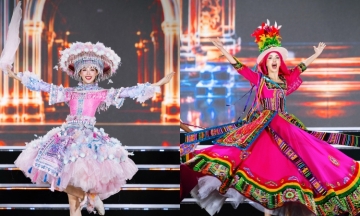
The controversy arose from a promotional photoshoot for her song "Chon mat gui vang", released on 27/8. In the images, Phuong My Chi wore a stylized dress featuring a Pieu scarf draped around her hip, resembling a skirt panel.
On various cultural forums, many voiced their disapproval of Phuong My Chi's styling. Lo Thi Kien, 30, from Muong Nha commune, Dien Bien province, explained that the Pieu scarf is integral to the spiritual life of the Thai people, traditionally worn on the head or around the neck. "Draping the scarf around the hip like a skirt is almost taboo," she stated.
A fan from Son La, who has followed Phuong My Chi since her days as a child star and supports her efforts to introduce folk music to younger generations, expressed disagreement. As a Thai individual, she found the scarf's usage in the photo "disrespectful to indigenous culture".
Following the backlash, Phuong My Chi's team promptly removed the images from all digital platforms. The singer issued an apology, stating: "I listen to all public feedback, especially from the Thai ethnic community, with an open mind. I extend my apologies, and my team will learn from this experience." She emphasized that her project's goal is to spread cultural beauty and preserve traditional musical values, a path she has pursued for many years.
Master Ha Trung, Deputy Head of the Department of Culture and Arts at Lao Cai College, highlighted that Phuong My Chi's team's use of the Pieu scarf sparked debate due to its deviation from the customs of the Thai people, a large community residing in provinces such as Lai Chau, Lao Cai, Son La, and Dien Bien.
According to Ha Trung, the Pieu scarf is a profound cultural symbol of the Black Thai people, far more than a mere beauty accessory. Women traditionally wear it on their heads to shield from sun and rain while enhancing their grace. The scarf is also associated with various customs: it can serve as a love token, a dowry, or a gift from a bride to her husband's family. In funerals, the item signifies affection and connection between the living and the deceased.
The scarf is woven from cotton, dyed indigo, and then embroidered with colorful patterns, as reported by Son La newspaper. Completing a Pieu scarf with its full array of motifs can take a Thai woman two to four weeks. The scarf typically measures 140-150 cm in length, roughly equivalent to an adult woman's arm span.
"While the singer's team aimed for creativity, this specific usage can easily be perceived as offensive, leading the Thai community to feel disrespected," Ha Trung remarked.
The expert advised that when artists draw upon traditional materials, they must consider three crucial factors: understanding the context before creating, respecting the cultural nuances, and consulting individuals knowledgeable about or directly connected to the community.
At a press conference on 25/8 introducing the project, Phuong My Chi explained her intention to blend contemporary music with traditional elements to spark curiosity, encouraging young people to actively explore culture. She acknowledged that innovation requires caution and that she was mentally prepared for differing opinions during her experimental approach.
Phuong My Chi's new album explores eight distinct art forms and traditional elements from various regions, including Thai xoe dance, Phu Tho xoan singing, xam singing, Hue folk songs, Ede folk songs, cai luong – classical opera, ly songs, and Southern Khmer music.
Phuong My Chi, 23, from TP HCM, rose to prominence in the music industry at age 10 after securing runner-up in The Voice Kids Vietnam 2013. She has since released many acclaimed music videos and albums. In 2025, Phuong My Chi actively participated in several competitions. Mid-year, she competed in Sing! Asia, an Asian regional music contest, winning 3rd place. By August, she won the Em xinh say hi competition. Beyond singing, she has acted in film projects such as Hai lua (2014), Nha gia tien (2025), and the web-drama Tiem hoa di ghe.
Tan Cao