On february 11, doctor Duong Duy Trang, a second-degree specialist and deputy medical director, who also heads the Department of Cardiology - Interventional Cardiology at Gia An 115 Hospital, stated that this was the first time in his decades-long career he had to use five stents in a single intervention.
The patient was admitted with dull abdominal pain. Imaging diagnostics revealed a spindle-shaped abdominal aortic aneurysm, measuring 6.3 cm in diameter, located below the renal arteries. Normally, the aorta has a diameter of about 18 mm. Dilation exceeding 3 cm is considered an aneurysm, and if it surpasses 5 cm, the risk of rupture increases by approximately 10%.
"This case was highly complex because of the large aneurysm, which had extended into both common iliac arteries, each dilated to 3 cm, with adherent blood clots on the vessel walls", doctor Trang explained.
The patient's pain signaled an acutely threatened rupture. If an aneurysm ruptures outside a hospital setting, 80-90% of patients die before receiving emergency care. If it ruptures into the free peritoneal cavity, the mortality rate approaches 100%.
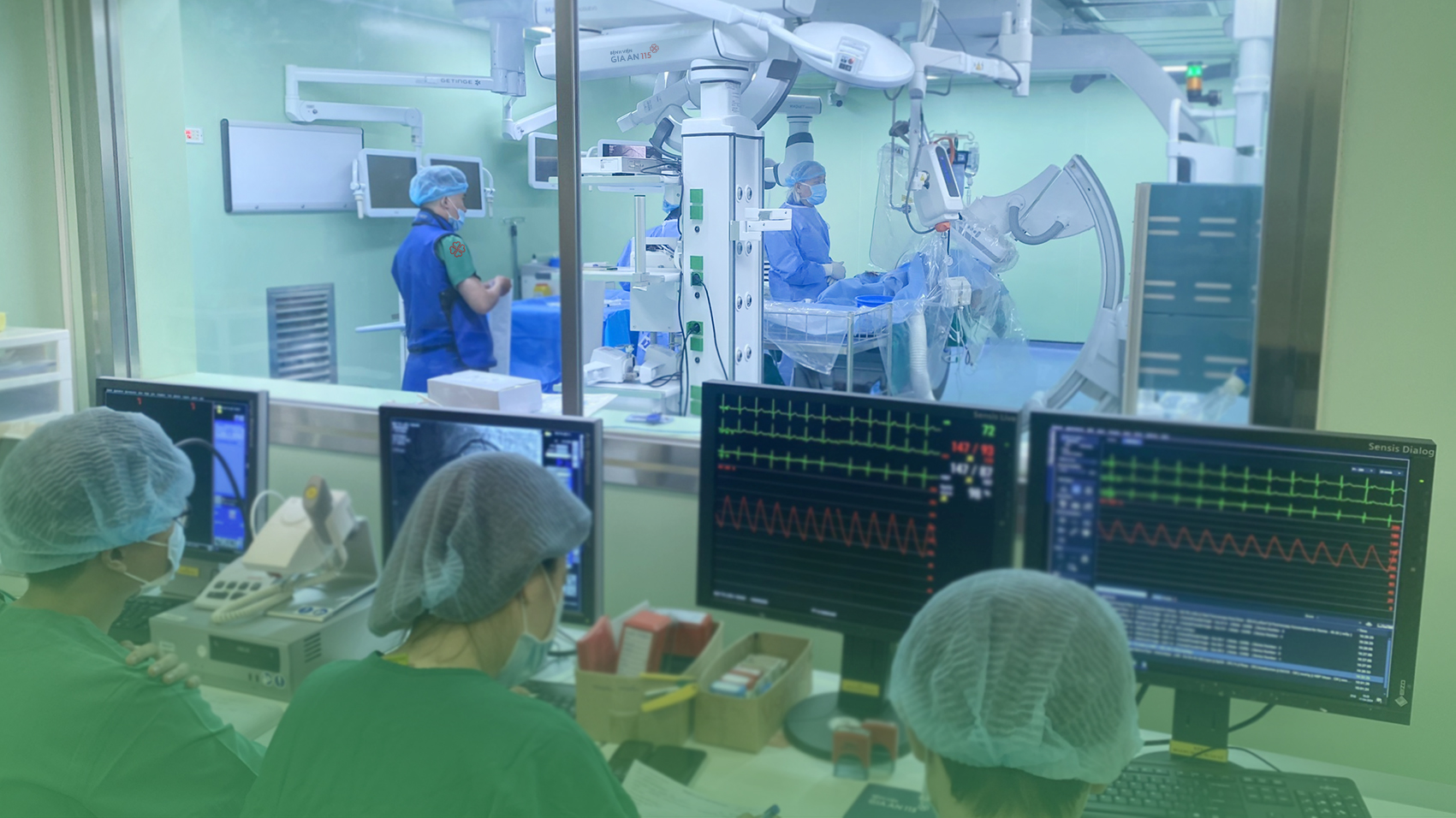 |
Medical staff performing the intervention on the patient. *Photo: Hospital provided* |
Doctors opted for endovascular intervention (stent graft placement) instead of open surgery. This technique involves inserting a synthetic graft with a metal frame into the vessel lumen via the femoral artery, creating a new blood flow channel to isolate the aneurysm from flow pressure and prevent rupture. This method reduces blood loss, pain, and recovery time for elderly patients with multiple underlying health conditions.
However, due to the extensive damage and complex anatomical structure, the team could not use a single stent. Doctors had to perform an "assembly" technique within the vessel, using a total of five stent grafts: one main body stent and four branch stents connecting to both iliac arteries.
The greatest challenge was deploying the stents with absolute millimeter precision. The placement site was close to crucial arteries supplying the kidneys and intestines; even a slight deviation could cause vascular occlusion or blood leakage around the stent. Additionally, the procedure required extreme dexterity to avoid dislodging blood clots that could cause leg artery blockage.
The intervention was successful, preserving blood flow to the kidneys and both lower limbs. During a follow-up appointment 20 days later, MSCT imaging showed the five-stent system was stable with no leakage, and the patient had recovered well.
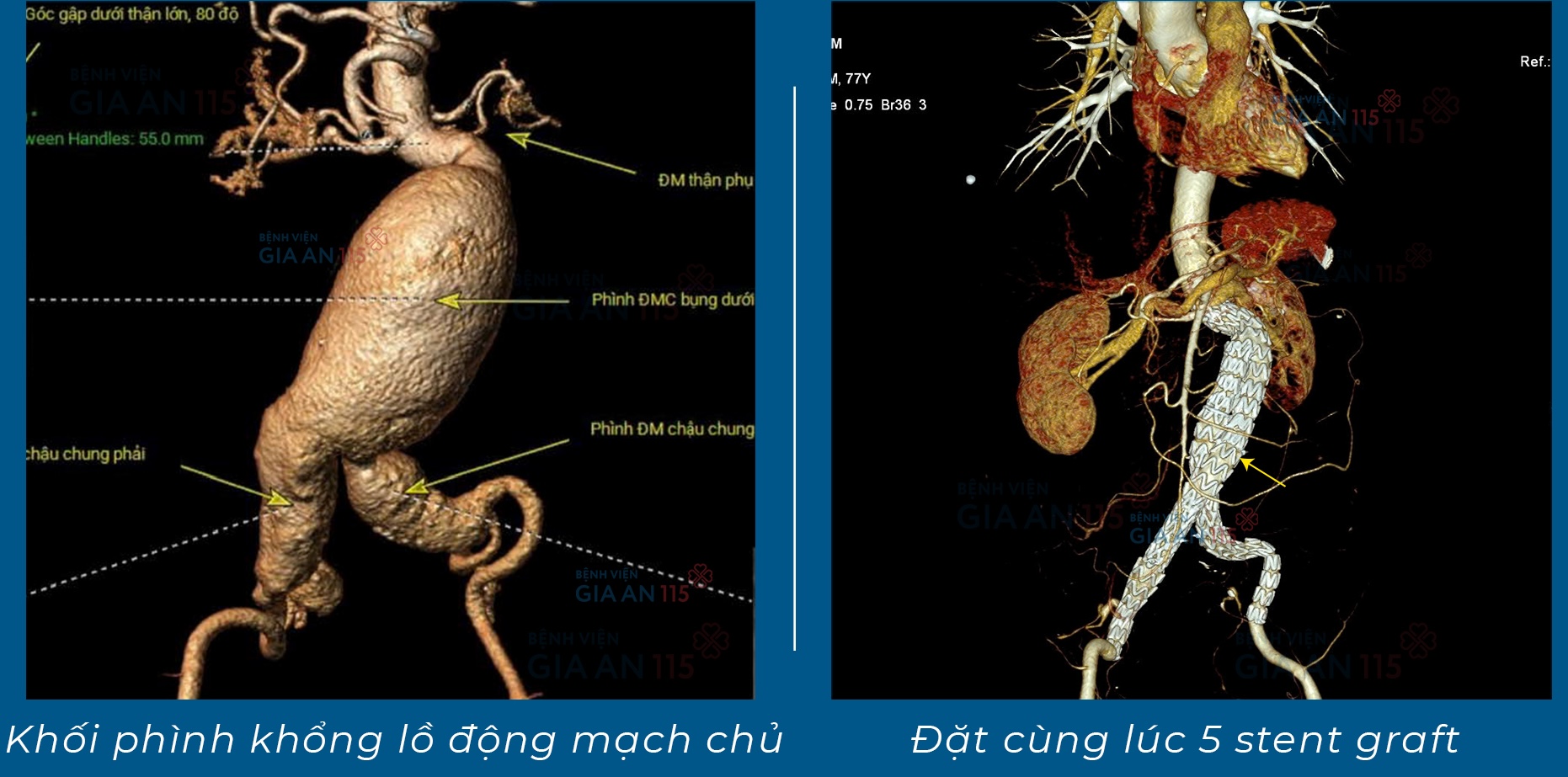 |
Images of the blood vessel with an aneurysm (left) and after stent placement (right). *Photo: Hospital provided* |
Abdominal aortic aneurysm is often called a "silent killer" because it typically progresses without symptoms until the aneurysm becomes too large or ruptures. High-risk groups include men over 65, smokers, individuals with hypertension, diabetes, and dyslipidemia.
Doctors recommend that individuals in high-risk groups undergo regular vascular screening. If symptoms such as abdominal pain, back pain, or a pulsating mass in the abdomen occur, immediate medical examination is crucial to prevent life-threatening complications.
Le Phuong