


The World Health Organization (WHO) on 6/5 confirmed the Andes variant (ANDV) caused the outbreak during a voyage to Antarctica. Argentine officials are racing against time to determine if the country is the origin of the pathogen.
Concerns are widespread as 23 passengers disembarked the ship at Saint Helena island on 21/4 and dispersed to various countries, potentially spreading the pathogen. Among them, a Swiss tourist tested positive. A Spanish passenger stated that this group traveled freely for the past half month. No agency contacted or medically screened them until WHO intervened three days ago.
Images from the ship recorded by a stranded passenger and posted on BBC. *Video: BBC*.
The voyage departed from Ushuaia city (southern Argentina) on 1/4, with the first death recorded on 11/4, a 70-year-old Dutch man. On 26/4, his 69-year-old wife flew from Saint Helena to South Africa, collapsed at Johannesburg airport, and died in a hospital. The third passenger, a German woman, died on 2/5. Currently, one patient is receiving intensive care in South Africa, and the Swiss tourist is hospitalized in their home country.
Argentine investigators are reviewing the complete tour itineraries of passengers in Ushuaia, as well as their journeys through Uruguay and Chile before boarding the ship. Authorities will quarantine close contacts to halt further spread. However, the incubation period, lasting from one to 8 weeks, makes it difficult for experts to pinpoint when patients contracted the virus: on land, at an island stop, or on board the vessel.
The Andes virus belongs to the Hantavirus family (comprising 38 species, 24 of which cause human disease), spread by rodents. It causes a severe pulmonary syndrome with a mortality rate of nearly 30%. This is the only strain capable of direct human-to-human transmission through close and prolonged contact with bodily fluids.
The health incident on the MV Hondius occurred as studies in Argentina indicate that climate change is accelerating the risk of Hantavirus spread. Experts explain that rising temperatures expand the virus's operational range. As ecosystems change, virus-carrying rodents have more favorable conditions to multiply in various locations.
Renowned Argentine infectious disease expert Hugo Pizzi noted that Argentina is becoming tropicalized due to climate change. This not only causes disruptions like dengue or yellow fever epidemics but also promotes the growth of tropical plants, providing abundant food sources for rodents. "Without a doubt, over time, hantavirus is spreading more widely", Pizzi said.
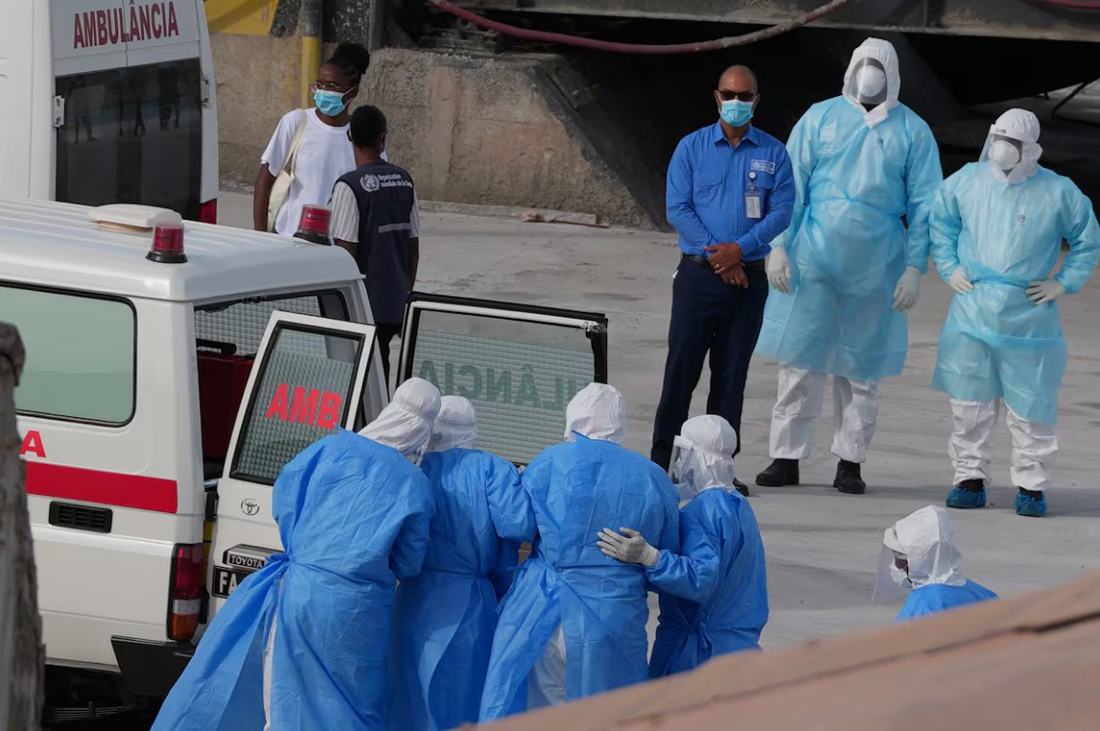 |
Medical personnel in protective gear transfer a patient from the MV Hondius cruise ship to an ambulance at Praia port, Cape Verde, on 6/5. *Photo: AP*.
Binh Minh (According to The Guardian, El Pais)


