Mrs. Lanh woke up at 3 a.m. to clean her house and tend to her plants. One hour later, she suddenly felt weakness on one side of her body. Two hours later, her family discovered her condition and rushed her to Tam Anh District 7 General Clinic for emergency care. Dr. Pham Duc Long, from the Emergency Department, stated that upon admission, Mrs. Lanh was conscious and responsive, experiencing mild dizziness, with left limb muscle strength rated 4/5. Her NIHSS score, which assesses stroke severity, was 3. These signs indicated a mild stroke, characterized by slight weakness and minor speech impairment.
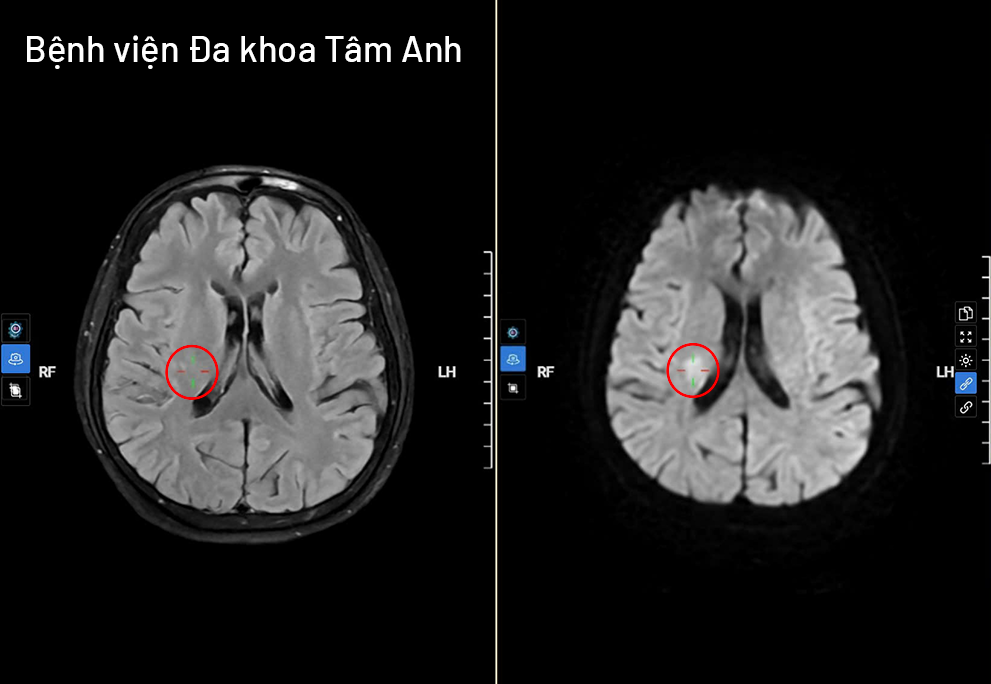
Dr. Long ordered a cranial magnetic resonance imaging (MRI) scan to determine the cause of the weakness. The MRI results confirmed that Mrs. Lanh was experiencing an acute cerebral infarction in its 3rd hour. Additionally, one of her brain blood vessels was completely narrowed and blocked, and she had a brain aneurysm.
 |
MRI images identifying the location of the acute cerebral infarction in the right cerebral hemisphere. Photo: Tam Anh General Hospital |
MRI images identifying the location of the acute cerebral infarction in the right cerebral hemisphere. Photo: Tam Anh General Hospital
Doctors administered a thrombolytic drug to dissolve the blood clot obstructing Mrs. Lanh's brain blood vessel. After 30 minutes, the patient responded well to the medication, and her muscle strength improved to 5/5. She was then transferred to Tam Anh General Hospital Ho Chi Minh City (TP HCM) for post-thrombolytic drug monitoring.
According to Dr. Long, thrombolytic drugs for treating acute ischemic stroke are only effective when patients arrive at the hospital within the initial 4,5 hours, considered the "golden hour" for treatment. The medication works to revascularize the blood vessels, which is critical for the patient's survival and recovery. Restoring blood flow promptly can save brain tissue that has not yet necrosed, limit the spread of damage, and thus reduce the risk of mortality and severe disability. Conversely, if treatment is delayed, brain cells will suffer irreversible necrosis, significantly reducing treatment effectiveness and leading to long-term paralysis sequelae.
Nhat Thanh
*Patient's name has been changed
| Readers can submit questions about neurological diseases here for doctors to answer |