"Continuous renal replacement therapy (CRRT) plays an important role in treating critically ill patients, especially those with acute kidney injury, septic shock, and multi-organ failure," stated Associate Professor, Doctor Do Ngoc Son, Director of the Intensive Care Center, Bach Mai Hospital, at the training program "Updating New Trends in Continuous Renal Replacement Therapy (CRRT) and Treatment Optimization Solutions" on 25/4.
CRRT is a renal replacement therapy technique used in intensive care, performed slowly and continuously for 24 hours a day (typically two to seven days). This method removes toxins and inflammatory mediators, and balances fluids and electrolytes for patients with acute kidney injury, multi-organ failure, or hemodynamic instability.
Associate Professor Son noted that acute kidney injury is a concern for doctors treating intensive care patients. Without an early strategy from the outset, kidneys can be affected, leading to chronic damage. Many patients who recover from the critical phase often face chronic kidney complications.
Previously, continuous blood purification was indicated as a method to replace kidney function. Today, it is prescribed for intensive care patients without kidney damage, or those at risk. This method not only allows the kidneys to "rest" but also supports and protects other organs such as the lungs, heart, and liver.
This represents a new strategy and trend in treating intensive care patients. Focusing on preventing this risk through the early detection of acute kidney injury is crucial, according to Associate Professor Son. If an intensive care unit lacks a blood purification system, it is difficult to claim comprehensive intensive care. Many patients will lose the chance to survive without this facility.
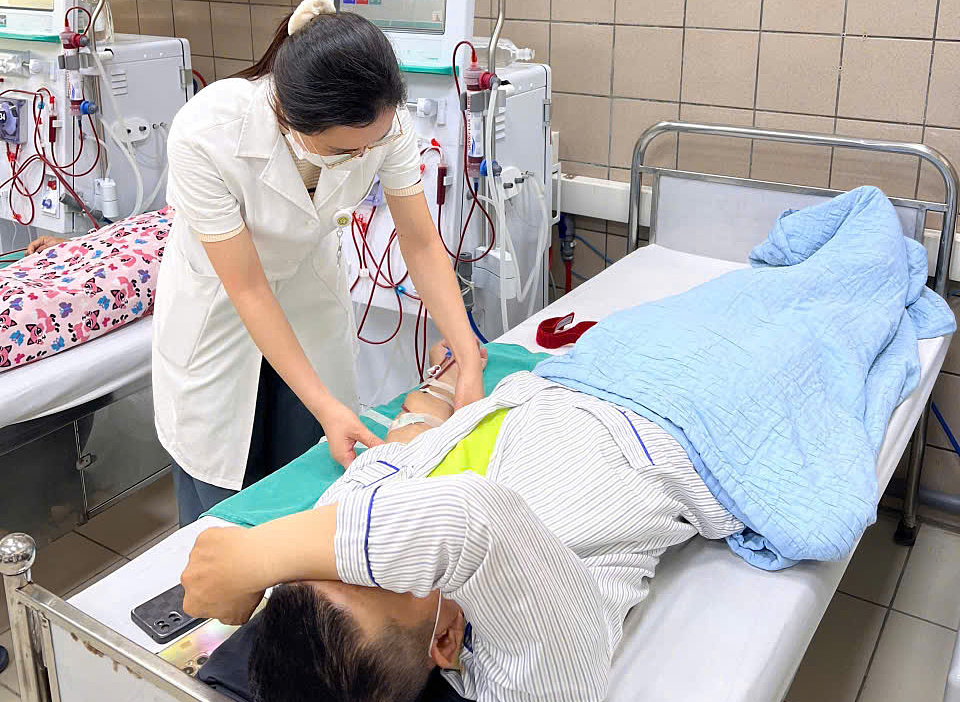 |
A patient undergoing blood purification at Bach Mai Hospital. Photo: Dieu Hien |
Experts recognize that with the development of modern technology, continuous blood purification systems today not only address kidney dysfunction but also help manage fluid balance, acid-base balance, and remove toxic substances. They also support cardiovascular, respiratory, hepatic, and neurological systems in various complex pathological conditions. This is considered a significant advancement in intensive care, as treatment no longer focuses on a single organ but aims for comprehensive protection of the patient's body.
Master, Resident Doctor Khuong Quoc Dai from the A9 Emergency Center, Bach Mai Hospital, stated that CRRT plays an increasingly important role in treating critically ill patients. However, selecting an appropriate anticoagulation strategy to ensure both treatment effectiveness and patient safety remains a major challenge in daily clinical practice. Therefore, experts discussed and updated regional citrate anticoagulation (RCA) strategies and the OMNI system in continuous blood purification.
Professor Antoine G. Schneider, Head of the Acute Kidney Injury Section of the European Society of Intensive Care Medicine, emphasized that RCA is considered an effective anticoagulation strategy. It helps prolong filter lifespan, reduces bleeding risk, and improves treatment quality in complex intensive care patients. Systematic and safe integration of RCA on modern systems offers practical benefits for both doctors and patients.
At the event, doctors received in-depth practice in blood purification techniques and managing common complications to improve treatment quality for critically ill patients in Vietnam.
Le Nga