Ngan, a 51-year-old woman, discovered a suspicious lesion during a routine health check-up at Tam Anh General Hospital Hanoi. Mammography and breast computed tomography revealed a 5,9x5,4 mm lesion in her left breast, classified as BIRADS 4B, indicating an intermediate suspicion of malignancy.
Given the small tumor size, Doctor Tran Hai Binh, Deputy Head of the Oncology Department, performed a vacuum-assisted breast biopsy (VABB). This advanced technique involves making a 2 mm incision to insert a negative-pressure suction needle, guided by ultrasound, to remove the tumor in small fragments. This method minimizes damage to healthy breast tissue and prevents scarring. Pathological results confirmed Ngan had grade three ductal carcinoma in situ (DCIS), a very early stage of breast cancer.
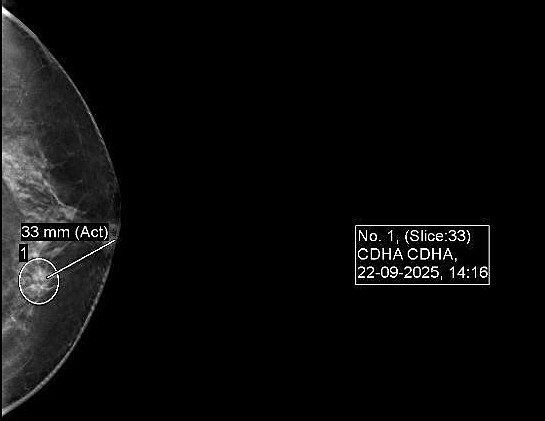 |
Image of a lesion with intermediate suspicion of malignancy. Photo: Tam Anh General Hospital
Ngan opted for a total mastectomy to avoid post-operative radiation therapy, combined with a sentinel lymph node biopsy and immediate breast reconstruction using an implant. Doctors carefully dissected the left breast tissue from the skin and pectoral muscles. The sentinel lymph node biopsy returned negative results. A durable, non-irritating, teardrop-shaped breast implant was then placed.
Following the procedure, Ngan remained alert with stable vital signs, maintaining a balanced breast shape. She was discharged after 6 days, highlighting the positive outcomes of early intervention and combined surgery.
Doctor Binh emphasized that early-detected breast cancer typically responds well to treatment, boasting a cure rate exceeding 90% and a high potential for recovery with few complications. Patients in such early stages often do not require adjuvant radiation or chemotherapy, significantly improving their quality of life.
In Vietnam, breast cancer is the most prevalent cancer among women, with over 24,000 new cases reported in 2022, according to Globocan. To mitigate risk, doctors advise maintaining a healthy weight, exercising regularly, limiting alcohol, avoiding smoking, increasing intake of green vegetables and fruits, and reducing processed foods.
Women aged 40 and above should undergo regular breast cancer screenings, including ultrasound, mammography, or MRI, for early detection of suspicious lesions. Individuals with genetic risk factors are encouraged to undergo BRCA1 and BRCA2 gene mutation testing annually, alongside regular screenings, to enhance early disease detection.
Vacuum-assisted breast biopsy is a precise diagnostic tool that minimizes tissue damage and scarring. For older women who have completed childbearing and are diagnosed with early-stage cancer, the "2-in-1" surgery – combining mastectomy with immediate breast reconstruction – is often recommended. This approach offers both time efficiency and aesthetic benefits.
By Thuan Le
*Patient's name has been changed
| Readers can submit questions about cancer here for doctors to answer. |