Associate Professor, Doctor Vu Le Chuyen, Director of the Center for Urology, Nephrology, and Andrology at Tam Anh General Hospital, Ho Chi Minh City, stated that the Müllerian duct cyst (paramesonephric duct) develops from the 6th week of embryonic growth. In male fetuses, the Müllerian duct typically regresses, leaving the prostatic utricle at its distal end and forming the prostatic sac proximally. However, if the duct does not regress or regresses incompletely, the Müllerian duct persists, leading to an accumulation of prostatic secretions that cause cystic dilation.
Müllerian duct cysts are more commonly found in middle-aged individuals, often presenting with complications such as irritation or bladder outlet obstruction. However, it is a rare congenital anomaly in children. Medical literature records approximately 3-4 pediatric cases of Müllerian duct cysts in Vietnam, and this marks the first case identified at Tam Anh General Hospital, Ho Chi Minh City, Associate Professor Chuyen noted.
Thien had experienced left kidney hydronephrosis for about two years. Upon admission, it had progressed to grade 3, accompanied by an enlarged abdomen and mild pain. Ultrasound results revealed dilated renal calyces and pelvis, with the upper ureter segment dilated down to near the bladder. The portion of the ureter entering the bladder was narrowed, leading to a megaureter. Additionally, the boy had a Müllerian duct cyst, measuring about 8-10 cm, which was compressing the bladder posteriorly. Failure to address this promptly could result in recurrent urinary tract infections and declining kidney function.
 |
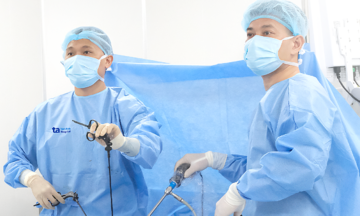
Associate Professor Chuyen (second from right) with the surgical team treating Thien. Photo: Tam Anh General Hospital
Master, Doctor Nguyen Tan Cuong, Deputy Head of the Urology Department, explained that due to the patient's young age and complex urinary tract malformations, open surgery offered advantages over conventional laparoscopic surgery. The surgical team chose an incision along the abdominal skin crease, specifically a horizontal incision below the navel. They then separated the muscles, exposed the pre-bladder space, identified the abnormal structures, resected the large Müllerian duct cyst, and reimplanted the ureter into the patient's bladder.
During the surgery, doctors observed a large cyst situated close to the left bladder wall, containing clear fluid and having thick walls. The entire ureter was dilated, with a diameter of about 1 cm, while the intramural segment of the ureter within the bladder wall was narrowed. Following the surgery, the boy recovered well and his health remained stable. He is scheduled for follow-up appointments to monitor and assess the recovery of his left kidney.
Müllerian duct cysts are definitively diagnosed through imaging such as ultrasound, computed tomography (CT), or MRI, which helps assess the cyst's location, size, and nature. In children, small cysts typically do not cause symptoms. However, large cysts, like the one found in Thien, can cause lower abdominal pain, compression leading to bladder outlet obstruction, and urinary tract infections, necessitating surgical removal of the cyst.
Ha Thanh
*Patient's name has been changed.