Doctor Kim Thi Be Diep, from the Department of Oncology at Tam Anh General Hospital, Ho Chi Minh City, explains that while immunotherapy is a key treatment option for esophageal cancer, its suitability for stage two depends on a thorough medical evaluation.
Doctors select the optimal treatment method after evaluating the tumor's location, cancer cell type, disease stage, the patient's overall health, and their preferences. Key treatment methods for esophageal cancer include: surgery, radiation therapy, chemotherapy, and immunotherapy. These therapies may be combined in a multi-modal approach, tailored to each patient's specific needs. For your mother's stage two diagnosis, a comprehensive examination is essential for the doctor to assess her condition and determine the most appropriate treatment plan, which may include immunotherapy.
The outcome of esophageal cancer treatment largely depends on the disease stage, the patient's health, and their response to therapy. Early detection significantly increases the success rate. However, when esophageal cancer progresses to a late stage or metastasizes, the possibility of a complete cure becomes limited. At these advanced stages, the primary goals shift to extending the patient's life and alleviating symptoms.
 |
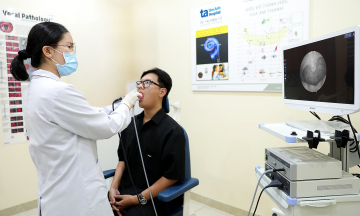
Doctor Diep examines a patient. Illustration: Tam Anh General Hospital |
Esophageal cancer rarely shows symptoms in its early stages, which often leads to diagnosis at later stages, typically 3 or 4, when symptoms become severe. This late detection often results in lower treatment effectiveness and a poorer prognosis.
The esophagus is a tubular part of the digestive tract, about 25 cm long with an average diameter of 2-3 cm. It is located behind the trachea and in front of the spine, functioning to transport food from the throat to the stomach. Esophageal cancer occurs when cells in the esophagus grow abnormally and uncontrollably. The disease primarily manifests as two main forms: squamous cell carcinoma and adenocarcinoma. Less common types include sarcoma, lymphoma, small cell carcinoma, and melanoma.
Given the challenges of early detection, everyone should undergo regular health check-ups. If you experience symptoms such as a sensation of food getting stuck, difficulty swallowing, unexplained weight loss, or chest pain behind the breastbone when swallowing, you should visit a hospital with an Oncology department for examination to determine the cause promptly.
Doctor Kim Thi Be Diep
Department of Oncology, Oncology Center
Tam Anh General Hospital, Ho Chi Minh City
| Readers can submit questions about cancer here for doctors to answer. |