Anti-Müllerian hormone (AMH) is an indicator used to assess ovarian reserve, reflecting the number of remaining ovarian follicles. While it shows the quantity of eggs, it does not precisely indicate the exact number or directly evaluate pregnancy chances. Women are born with a fixed number of oocytes and cannot produce new ones. This number gradually decreases over time, causing AMH levels to decline with age.
Currently, no proven method can genuinely increase AMH or restore lost oocytes. Variations in AMH test results at different times are primarily due to differences between laboratories or technical errors, not an actual increase in ovarian reserve.
 |
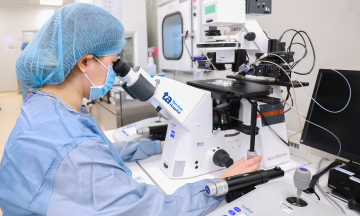
IVF Tam Anh doctors perform egg retrieval for a patient. Illustration: Nguyet Nhi |
In your situation, an AMH level of 0.8 ng/mL indicates a significantly reduced ovarian reserve. However, low AMH does not necessarily mean infertility if you still have menstrual periods and ovulate. The ability to conceive depends on many other factors, including age, oocyte quality, fallopian tube and uterine conditions, and your husband's sperm quality.
At the Center for Reproductive Assistance, Tam Anh General Hospital (IVF Tam Anh), doctors assess factors from both partners to select an appropriate treatment strategy. If fallopian tubes are clear, sperm is normal, and the number of antral follicles at the beginning of the cycle is relatively good, doctors may consider less invasive methods such as ovulation tracking or intrauterine insemination (IUI). If ovarian reserve is significantly diminished, the number of follicles is low, or infertility has persisted for a long time, doctors often advise early treatment to utilize the remaining oocytes.
Women under 40 can undergo multiple cycles to collect and freeze oocytes, accumulating a sufficient number of eggs for embryo creation. For older women, oocyte quality declines over time, so doctors often prioritize collecting embryos over multiple cycles to increase the chance of obtaining good quality embryos.
IVF Tam Anh applies vitrification technology for oocyte and embryo freezing. Samples are rapidly super-cooled and stored in liquid nitrogen at approximately -196 degrees Celsius. At this temperature, cellular metabolic activities almost completely cease, preserving oocytes and embryos for extended periods while maintaining quality after thawing.
Given your circumstances, it is important to seek an early consultation. This allows doctors to develop a suitable treatment strategy, maximizing your remaining reproductive opportunities.
Master, Doctor Nguyen Ha Minh Hanh
Center for Reproductive Assistance
Tam Anh General Hospital - District 8