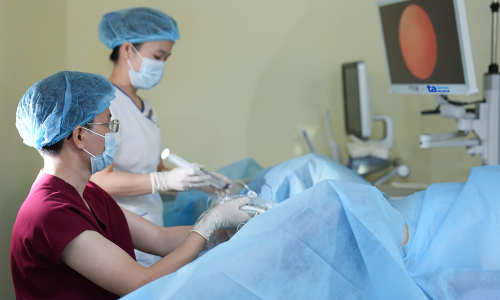
Hai, 38, who had multiple uterine polyps hindering conception, successfully underwent hysteroscopic polypectomy and in vitro fertilization to give birth to two children.
A 32-year-old woman from Long An, who underwent surgery three years ago to remove an endometrial cyst, asks if her endometriosis can recur and affect her ability to conceive after 12 months of trying.
After two years of infertility, Hoang, who was considering sperm donation for in-vitro fertilization, discovered a genetic anomaly that was successfully treated, restoring his ability to produce sperm and enabling him to conceive.
Ms. Hue, 35, who experienced six failed infertility treatments, achieved successful in vitro fertilization after doctors addressed her C-section scar defect and chronic endometritis.
Hoan, 32, seeking treatment for obesity, unexpectedly discovered premature ovarian aging caused by an autoimmune disorder where her immune system produced antibodies attacking ovarian tissue.
Ly, 31, experienced a miscarriage and then struggled to conceive again for four years; examinations revealed both she and her husband had medical conditions causing infertility.
Phi, 38, underwent a pre-remarriage check-up and discovered he had azoospermia, necessitating surgery to retrieve and freeze sperm to preserve his chance of having children.
Many people have advised me to take supplements to thicken the uterine lining before embryo transfer. Is this true, and how should I supplement? (Thanh Ha, TP HCM)
After two early miscarriages and three failed embryo transfers, 37-year-old Phuong Anh had to undergo multiple cycles of egg collection for in vitro fertilization to conceive her second child.