On 25/12, Associate Professor, Doctor Pham Ngoc Thach, Deputy Director of Nhi Dong 2 Hospital, reported that a 14-year-old patient presented with sudden pain in his right testicle. His family initially took him to a local medical facility where he received medication. However, after more than two days, the swelling and pain worsened. Approximately 55 hours after symptom onset, the boy was transferred to Nhi Dong 2 Hospital.
Upon arrival, doctors quickly identified a suspected case of testicular torsion and ordered emergency surgery. Doctor Phan Nguyen Ngoc Tu, Master of Science, Doctor Dinh Nguyen Hoai Thanh, and the surgical team found the right testicle twisted 1.5 turns. The prolonged torsion, lasting over two days, had completely blocked the blood supply, causing the testicle to turn dark purple and severely necrotize. Despite efforts to detorse and warm it, the testicle showed no signs of recovery and had to be removed.
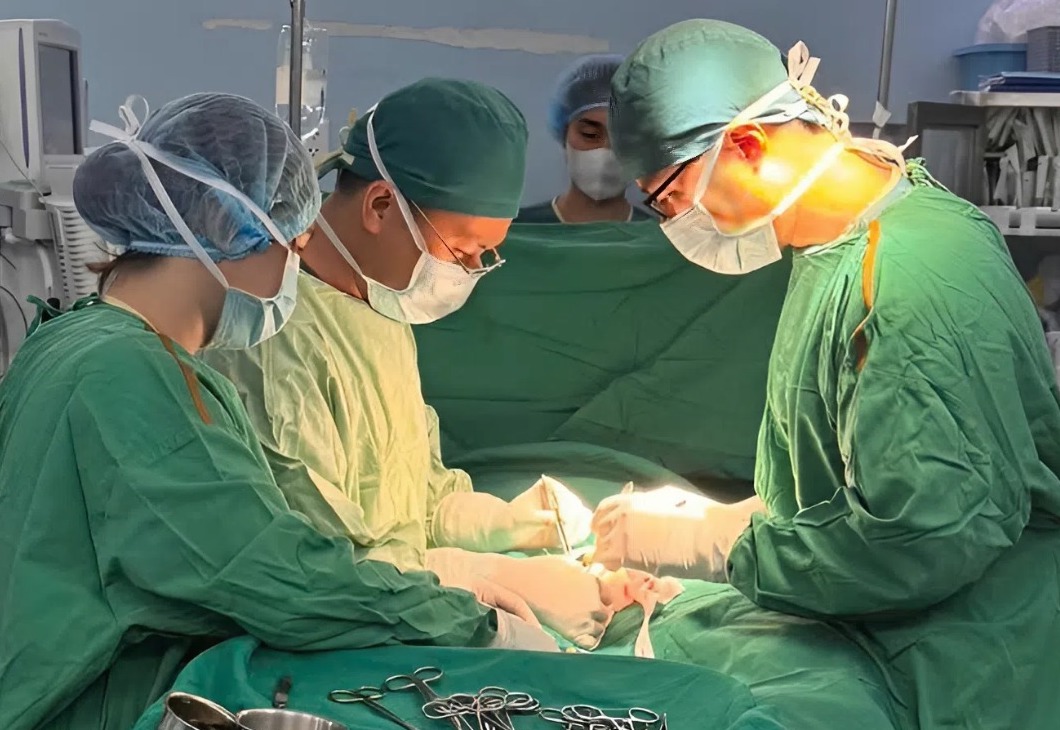 |
Doctors performing surgery on the patient. *Photo: Hospital provided* |
Associate Professor Thach highlighted the severity of the condition, noting that Nhi Dong 2 Hospital admits about 30 cases of testicular torsion annually. Approximately two-thirds of these cases result in testicle removal due to delayed medical intervention. Testicular torsion is a critical pediatric surgical emergency where the spermatic cord twists, interrupting blood flow to the testicle. Without prompt treatment, the testicle will necrotize irreversibly.
Doctors emphasize the critical time window for treatment. "Within the first 6 hours of symptom onset, the chances of preserving the testicle can be nearly 100%; after 24 hours, the possibility of saving the testicle is almost zero", a doctor explained.
Common mistakes include misdiagnosing testicular torsion as orchitis, or delays caused by adolescent complacency and embarrassment. While losing one testicle may still allow for endocrine and reproductive functions to be maintained by the remaining one, it significantly impacts the child's psychology and aesthetics as they grow older.
Doctors advise parents to be especially vigilant about sudden, severe pain in the scrotum or groin, particularly in adolescents. This pain may be accompanied by nausea or vomiting. If any abnormal signs appear, children should be taken immediately to a medical facility with a pediatric surgery department. Parents should absolutely not self-medicate with painkillers or anti-inflammatory drugs without a definitive diagnosis.
Le Phuong