


For your 9-year-old child who still presents with bow legs, early medical consultation is advisable. A direct assessment by a doctor is crucial to determine the appropriate treatment and prevent potential complications that could affect the child's development if the condition is prolonged.
Bow legs, clinically known as genu varum, describes a condition where one or both knee joints deviate outwards from the body's weight-bearing axis. This can lead to difficulties in walking or running, often accompanied by knee instability and pain in the knee or groin, unrelated to injury. This condition can affect both children and adults.
In young children, bow legs are frequently physiological, meaning they are a normal part of development. This is most noticeable between 12 and 18 months of age, when children begin to walk. The legs typically correct themselves, gradually transitioning to a knock-kneed (valgus) alignment by 3 to 4 years old. However, if bow legs persist after 7 or 8 years old, or if other symptoms like pain or impaired mobility emerge, parents should seek medical evaluation for treatment.
Severe bow legs, or those caused by underlying medical conditions, can lead to limb deformities, significant difficulty with walking and running, and an increased risk of developing arthritis in adulthood. Given your child's age, a thorough assessment is important to rule out pathological causes and initiate timely intervention.
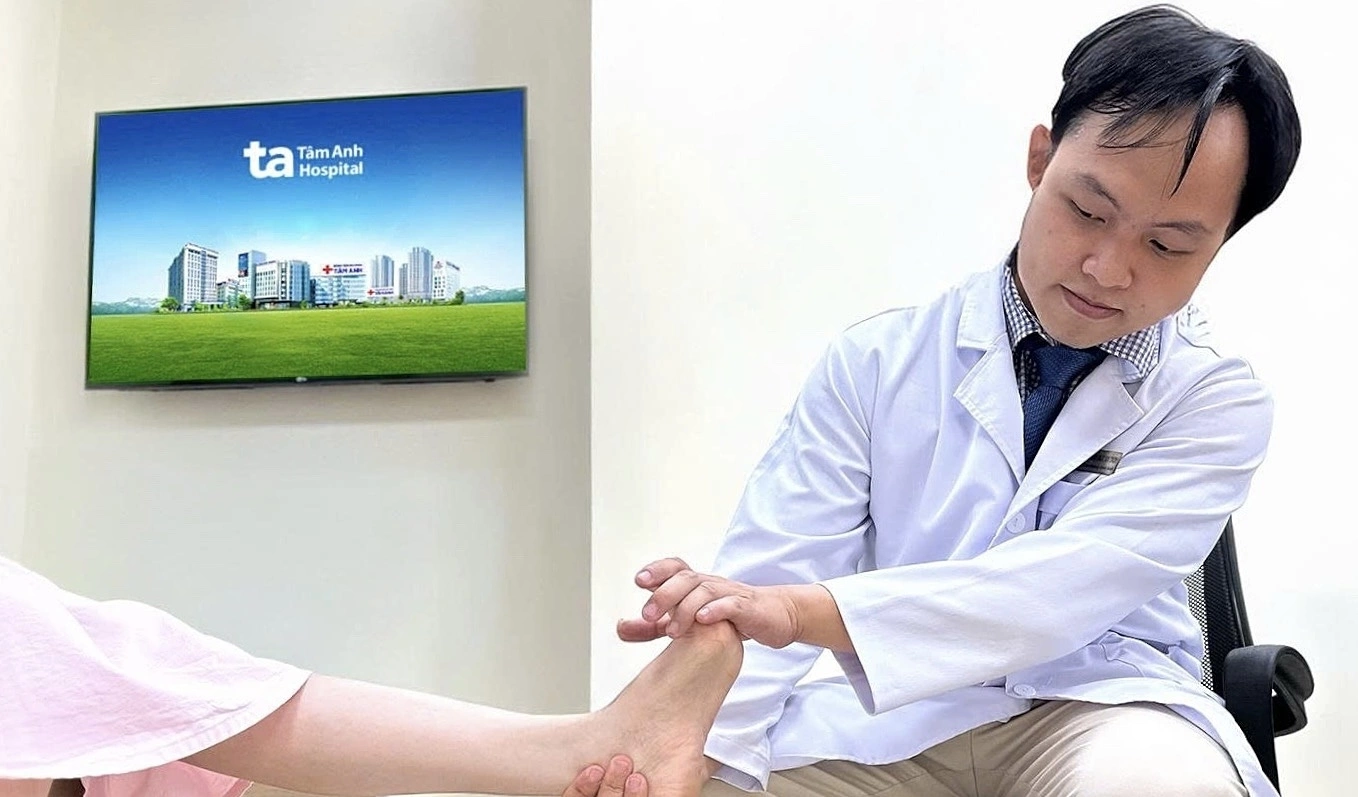 |
Doctor Truong assessing a child's leg condition. Photo: Tam Anh General Hospital |
Depending on the child's specific condition, a doctor may recommend various treatment approaches:
Bracing is often prescribed for children whose bow legs are caused by Blount's disease (tibia vara). In this condition, the leg deformity tends to worsen as the child starts walking.
Nutritional intervention is advised if bow legs result from rickets or prolonged vitamin D deficiency. A doctor may recommend increasing the child's vitamin D and calcium intake through diet and supplemental medication.
Guided growth surgery involves implanting a small metal plate on one side of the normally developing leg to slow its growth. This allows the affected leg time to catch up in development. Over time, the child's leg gradually straightens as they grow naturally. Once both legs are aligned, the doctor removes the metal plate.
Tibial osteotomy is a surgical procedure for severe cases of bow legs. It involves cutting and reshaping the proximal part of the shin bone, just below the knee joint, to guide bone growth along a physiological axis. The bone is then stabilized with internal plates and screws or an external fixation frame.
It is important to note that treating bow legs does not negatively impact a child's future mobility. After full recovery, children can participate in daily activities and sports without limitations.
Dr. Nguyen Xuan Truong, a Master of Science and Level I Specialist in the Department of Orthopedic Trauma at Tam Anh General Hospital, Ho Chi Minh City.
| Readers can submit questions about musculoskeletal conditions here for a doctor's response. |


