Individuals diagnosed with chronic pancreatitis, like Hoang Dung from TP HCM, often wonder about their risk for pancreatic cancer and the necessity of regular screening. According to Doctor Kim Thi Be Diep, cancer screening is indeed considered for high-risk groups, which includes those with chronic pancreatitis.
Screening helps doctors detect abnormal changes in the pancreas as early as possible. This early detection significantly increases the chance of successful treatment and improves the overall prognosis for patients.
Beyond chronic pancreatitis, other high-risk factors for pancreatic cancer include a strong family history. Specifically, screening is recommended for individuals with two or more first-degree relatives who have had pancreatic cancer, or one first-degree relative with the disease and an associated inherited gene mutation. Chronic pancreatitis often leads to structural damage within the pancreas, which can create conditions for genetic mutations that contribute to the development of malignant cells. Therefore, these patients also require screening as directed by their doctor.
 |
Doctor Diep advises a patient. Illustration: Tam Anh General Hospital |
Several methods are used for pancreatic cancer screening. Blood tests can check liver function by measuring the levels of enzymes and metabolites produced or excreted by the liver. Abnormally elevated levels of indicators such as bilirubin, alkaline phosphatase (ALP), or gamma-glutamyl transferase (GGT) may suggest bile duct obstruction, potentially caused by a tumor in the pancreatic region. However, blood tests alone are not sufficient to definitively diagnose pancreatic cancer. Doctors combine these tests with imaging diagnostics and biopsy for an accurate diagnosis.
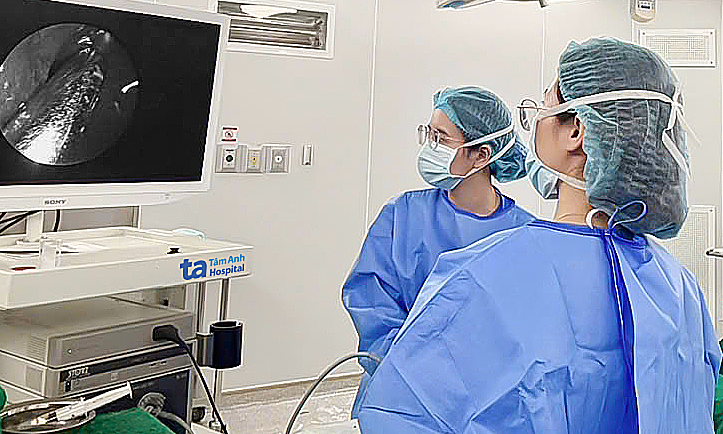
Advanced imaging techniques play a crucial role. Magnetic resonance imaging (MRI), particularly magnetic resonance cholangiopancreatography (MRCP), offers high sensitivity in detecting lesions within the pancreas. It also provides a clearer view of surrounding structures without the use of X-rays. Endoscopic ultrasound (EUS) allows doctors to observe the pancreas with high resolution from inside the body, via the stomach or duodenum wall, enabling the detection of even small lesions. During EUS, doctors can also take biopsy samples directly from any suspicious mass for cytological testing, which yields the most precise diagnosis.
Pancreatic cancer typically originates from either the endocrine or exocrine cells of the pancreas. Endocrine cells produce hormones released directly into the bloodstream, while exocrine cells create pancreatic enzymes that are secreted into the small intestine for food digestion. Approximately 90% of pancreatic cancer cases develop from exocrine cells, specifically a type known as ductal adenocarcinoma.
For individuals like Hoang Dung, it is important to consistently take prescribed medication and attend regular check-ups as advised by your doctor. This proactive approach helps in the early detection of any abnormalities. If there is any suspicion of pancreatic cancer, your doctor will then determine and prescribe the most appropriate screening methods.
Doctor Kim Thi Be Diep
Department of Oncology, Oncology Center
Tam Anh General Hospital TP HCM
| Readers can ask questions about cancer here for doctors to answer. |