Every year on 2/4, the United Nations designates it as World Autism Awareness Day. This initiative aims to enhance community understanding, facilitating early detection and intervention for children, and promoting their integration into society. According to the World Health Organization, one in 100 children has autism, a neurodevelopmental disorder affecting communication, language, and social relationships.
Doctor Dinh Thac, Head of Psychology Department at Children's Hospital 1, explained that autism is a disorder, not a disease, and is not contagious. A correct understanding of autism helps families detect and intervene early, preserving the "golden window" for children, which is before 3 years old, or 5 years old at the latest. Beyond the age of 5, the intervention process becomes more time-consuming and less effective.
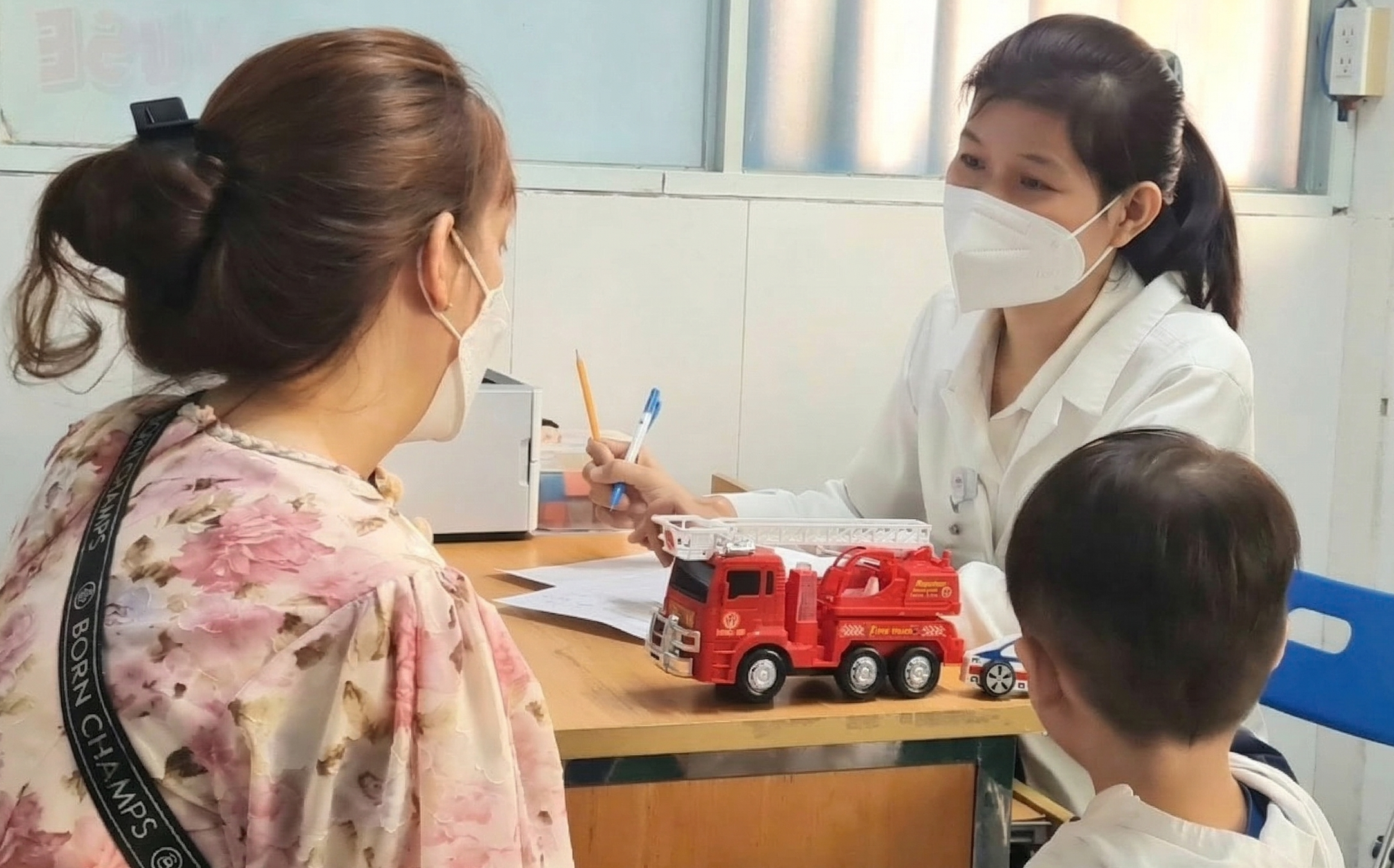 |
Parents bring children for psychological examination at Children's Hospital 1. Photo: Hospital provided |
Doctor Thac noted that parents should pay special attention if children exhibit unusual signs falling into three main groups:
Language: Delayed speech or language regression (already able to speak but then stops).
Social interaction: Poor interaction, limited eye contact, not responding when called by name, preferring to play alone.
Behavior: Repetitive actions (stereotypical) such as walking on tiptoes, arm and leg movements resembling dancing, spinning wheels, or tearing paper. Children may also have unusual restricted interests, like being engrossed in watching a spinning fan.
Doctor Nguyen Thanh Sang, Head of Clinical Psychology - Rehabilitation - Traditional Medicine Interdisciplinary Department at Children's Hospital 2, emphasized that parents should pay special attention to age-appropriate language and communication developmental milestones. These serve as early indicators to identify the risk of autism. According to the doctor, if a child is delayed or deviates from these milestones, a professional evaluation is needed as early as possible.
Specifically, parents should have their child checked if they exhibit one or more signs such as: not babbling or communicating with gestures by 12 months, not speaking single words by 16 months, not speaking meaningful phrases by 24 months, possessing skills that later regress, showing little interaction with others, or having repetitive behaviors and restricted interests.
Currently, many barriers in the treatment process stem from community misconceptions. Doctor Thac pointed out some common misunderstandings, such as believing that children with autism lack emotions, do not want to make friends, or are unable to learn or communicate. Some even mistakenly believe autism is caused by vaccinations or that children should not study in a normal environment for fear of affecting others.
These prejudices not only increase stigma but also cause psychological pressure, leading parents to blame themselves. More importantly, this hesitation delays the process of early assessment and intervention, inadvertently creating barriers that make it increasingly difficult for children to develop.
At the Psychology Department of Children's Hospital 1, statistics show that 3-4 children out of every 100 examined are diagnosed with autism spectrum disorder. This indicates that alongside raising community awareness, psychological support for the children's families also plays a crucial role. Parents are indeed the first and most important therapists for children with autism.
Doctor Sang advised that no single factor determines the progress of a child with autism; rather, it requires a combination of medical intervention, psychological support, special education, and especially family companionship. Among these, the family plays a crucial role as long-term companions, creating a loving, patient, and consistent environment for the child.
Le Phuong