A thumb-sized, painless lump appeared on his right neck. He applied burning incense directly to the skin over the lump. The lump did not resolve; instead, the skin on his neck became severely burned, leaving numerous pockmarks and scars. As the lump continued to swell and deform his neck, he sought examination at Ho Chi Minh City Oncology Hospital.
According to Doctor Lam Duc Hoang, Head of Head and Neck Radiation Therapy at Ho Chi Minh City Oncology Hospital, an endoscopic examination of the patient's nasopharynx revealed a large, easily bleeding tumor that had completely obstructed his left nostril. Neck lymph nodes were present on both sides, with the left side being larger, fused into a single mass measuring 6-7 cm.
Advanced imaging diagnostics confirmed the disease had progressed severely. A CT scan revealed a mass in the nasopharynx that had invaded the middle cranial base. A bone scan detected bone lesions in the cranial base. Quantitative testing for the EBV virus, a factor closely linked to nasopharyngeal cancer, showed a significant increase.
Doctors diagnosed the patient with late-stage nasopharyngeal cancer. Given the tumor's size and complex invasion, the patient underwent initial chemotherapy to control the disease and reduce the tumor's mass.
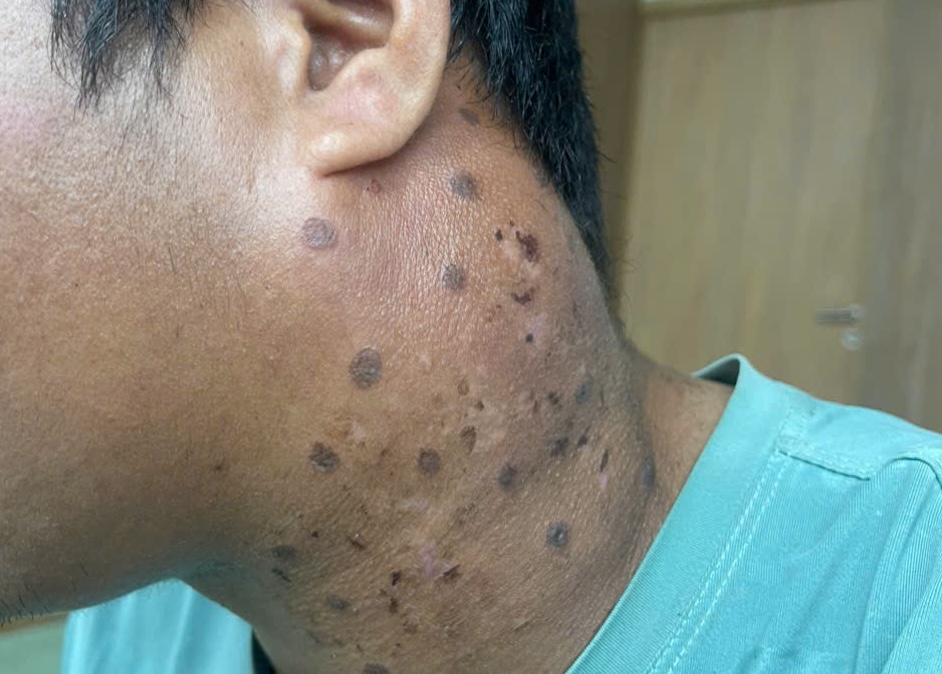 |
The patient's neck was swollen and heavily scarred after using burning incense to treat the cancer. *Photo: Provided by doctor* |
Doctor Hoang emphasized that nasopharyngeal cancer symptoms are often non-specific and easily confused with common ear, nose, and throat conditions, causing many individuals to overlook the critical "golden time" for early intervention.
Head and neck cancers exhibit a rapid doubling and growth rate compared to many other conditions, potentially progressing locally, regionally, and metastasizing distantly within a short period. Early detection and intervention offer a high chance of effective treatment and potential cure. Conversely, delaying treatment or employing unscientific methods, such as burning herbs or applying poultices, can stimulate rapid tumor growth and elevate the risk of metastasis.
Tinnitus is often the earliest and most common sign of nasopharyngeal cancer, frequently accompanied by hearing loss in one or both ears. The disease can also cause nasal congestion, bloody nasal discharge, headaches, and facial pain similar to sinusitis. Furthermore, patients may experience recurrent nosebleeds, occasionally leading to chronic anemia.
Doctors strongly advise against applying unproven scientific methods, such as poultices, acupuncture, or "burning incense", directly to tumors or abnormal lymph nodes on the body. Such practices can stimulate cancer cells to grow more rapidly, spread into surrounding healthy tissue, and even facilitate distant metastasis through the bloodstream.
Prompt medical examination is crucial if symptoms like tinnitus, persistent nasal congestion, nosebleeds, or gradually enlarging, slightly painful neck lumps appear. Lymph nodes suspected of being cancerous are typically over one cm, firm, painless, and poorly mobile, requiring immediate assessment.
Le Phuong