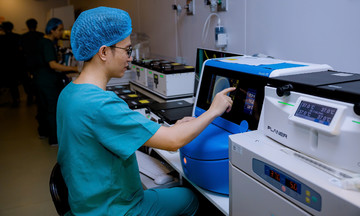
The WHO announced this information on its official website on 27/2, based on the results of a health data assessment for the 2021-2024 period. To achieve this public health milestone, Denmark tested and treated over 95% of pregnant women, while also maintaining the rate of new infant infections below 50 cases per 100,000 births for many consecutive years.
 |
Illustrative photo: *The Star*. |
WHO Director-General Tedros Adhanom Ghebreyesus stated that this achievement stems from strong political commitment and consistent investment in the primary healthcare system. WHO Regional Director for Europe Hans Henri P. Kluge also commended Denmark for exceeding stringent standards through its reliable data system, superior screening capabilities, and human-centered healthcare policy.
Danish Minister of Interior and Health Sophie Løhde affirmed that the foundation of this success is a universal healthcare network, ensuring equal access for all citizens. The minister expressed hope that Denmark's milestone will inspire other nations, adding that the country is currently working to eliminate Hepatitis B to complete the eradication of all three birth-transmitted pathogens.
Current statistics show that Denmark has approximately 5,950 people living with HIV, but the rate of pregnant women carrying the virus is below 0,1%. Regular testing and treatment programs have reduced the transmission rate to fetuses to zero. Similarly, strict prenatal screening processes have made congenital syphilis extremely rare. This achievement places Denmark among 22 countries and territories globally (including Thailand, Malaysia, Brazil, Oman) that have successfully protected infants from these two dangerous diseases.
Binh Minh (According to WHO)