Both hearts transplanted into the patient came from brain-dead donors. The two heart transplants were performed only three days apart. This marks the first time in Vietnam that a patient has undergone two heart transplants within such a short period, according to major general Pham Thai Giang, deputy director of hospital 108.
The patient suffered from end-stage heart failure due to dilated cardiomyopathy, with a left ventricular ejection fraction of only 22%, and experienced recurrent acute heart failure episodes. On 25/7, he received a heart transplant from a brain-dead donor at Central Military Hospital 108.
The first hours post-transplant were relatively favorable. The transplanted heart resumed beating with good contractility, hemodynamics were stable, and no circulatory support with ecmo was needed. However, less than 24 hours later, the transplanted heart's function severely declined, almost completely losing its ability to contract.
The patient required support with ecmo (extracorporeal membrane oxygenation) and left ventricular drainage. Doctors performed coronary angiography and myocardial biopsy to find the cause but found no coronary artery blockages or acute rejection. The patient was diagnosed with primary graft dysfunction (pgd), indicating a very poor prognosis.
After 72 hours, the transplanted heart still showed no recovery, leading to multi-organ failure and a very high risk of death.
At that critical moment, hospital 108 received another brain-dead multi-organ donor. This donor heart was classified under extended criteria, making it unsuitable for other waiting heart transplant candidates. It carried several risk factors, including a thickened left ventricle due to the donor's history of hypertension and kidney failure.
Meanwhile, the patient had just undergone one heart transplant, was on ecmo, suffered from multi-organ failure, and required continuous dialysis, severely limiting his capacity to withstand another major surgery.
"The donor heart was not truly ideal, and the patient's condition was severe, but if we did not act, the patient would certainly die," stated colonel Ngo Vi Hai, head of the thoracic surgery department and leader of the heart transplant team.
After comprehensive consultation, experts weighed the risks and opportunities, deciding to use this heart from the second brain-dead donor for a re-transplant for the patient.
"The second transplant was infinitely more difficult than the first, but our choice was to seek a chance at life rather than accept the patient's death," explained major general Giang.
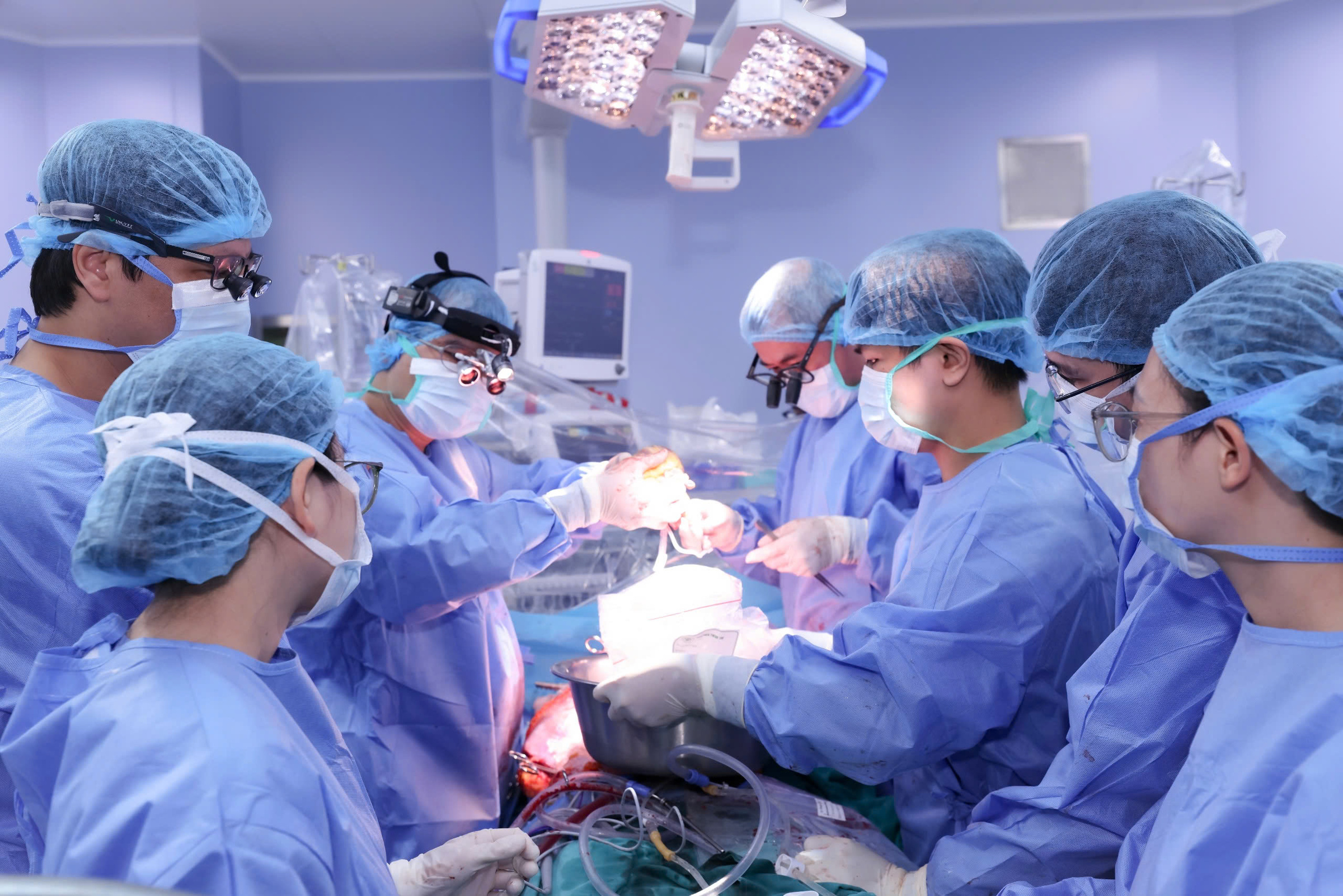 |
Doctors performing the second heart transplant for the patient. Photo: Quang Huy
the battle in the operating room
On 28/7, just three days after the first transplant, the patient underwent a re-transplant. The challenges for the anesthesia and resuscitation team were immense. The patient had been in a coma for three days, anuric, on continuous dialysis, suffering from coagulation disorders and acid-base imbalance, diffuse pneumonia with collapsed lung, and was dependent on ecmo.
According to colonel Nguyen Minh Ly, head of the anesthesia and resuscitation department, the patient's cerebral perfusion pressure was very low, with brain oxygen saturation around 25-30%, posing a risk of irreversible brain damage. The surgical team had to continuously adjust hemodynamics, cerebral and organ perfusion, control coagulation, balance fluids, and reduce pulmonary vascular resistance.
Surgically, the patient's heart tissues had changed after the previous operation, making dissection and anastomosis far more complex. The surgical team had to coordinate closely with anesthesia and resuscitation and the extracorporeal circulation system to minimize risks.
When the second heart began to beat and hemodynamics gradually stabilized, the team could finally breathe a sigh of relief. However, the battle for life was far from over. Post-surgery, the transplanted heart remained weak and could not independently ensure circulation. The patient continued to receive ecmo support, followed by the combination of an intra-aortic balloon pump (iabp), continuous dialysis, and mechanical ventilation.
Day by day, the transplanted heart's function improved. By the 8th day post-transplant, the patient was successfully weaned off ecmo. On the 10th day, he was extubated. On the 11th postoperative day, the iabp was also discontinued. These were important milestones, indicating that the second heart was gradually recovering and capable of ensuring the body's circulation.
Currently, the patient is awake, communicative, and cooperative. He has begun rehabilitation exercises, including standing, sitting in a chair, and cycling. Organ functions are gradually recovering, demonstrating the body's adaptation to the new heart.
However, having undergone two heart transplants in a short period, coupled with numerous severe complications and an extended recovery time, the patient still requires close monitoring for transplanted heart function, infection, and overall organ recovery.
According to doctors, the success of this case resulted from multiple factors: the timely availability of donor organs, the medical team's swift decisions in a life-or-death situation, the coordination of various specialties, and prolonged post-surgical resuscitation efforts. Crucially, the patient's chance at life began with the altruism of two brain-dead donors and their families. The second heart, despite not being an ideal organ, became the patient's last opportunity.
"This is a rare case; I am fortunate to have received a second heart. I thank and appreciate the donors who gave me the opportunity to live," the patient shared.
Le Nga