


Mr. Sang suffered an accident 10 years ago that damaged his spine. Despite undergoing two previous surgeries, his condition worsened, leaving both his legs almost immobile, numb, and with muscle atrophy. Imaging results, including X-rays, CT scans, and MRI of his lumbar spine at Tam Anh General Hospital, Ho Chi Minh City, revealed severe disc herniation, hypertrophied ligamentum flavum, and a fractured facet joint. These issues caused nearly complete spinal stenosis and severe nerve compression, particularly at the L3-L4 and L4-L5 lumbar vertebrae.
Second-Degree Specialist Doctor Nguyen Dinh Quang, from the Spinal Surgery Department, Orthopedic Trauma Center, stated that surgery was the only solution to restore Mr. Sang's mobility and prevent the risk of permanent paralysis in both legs and involuntary bowel or bladder function. However, this case presented a highly complex surgical challenge. Previous operations had led to the formation of fibrous scar tissue, causing the spine, nerves, blood vessels, and surrounding organs to adhere together. This made dissection difficult and increased the risk of damage during access to the anatomical structures.
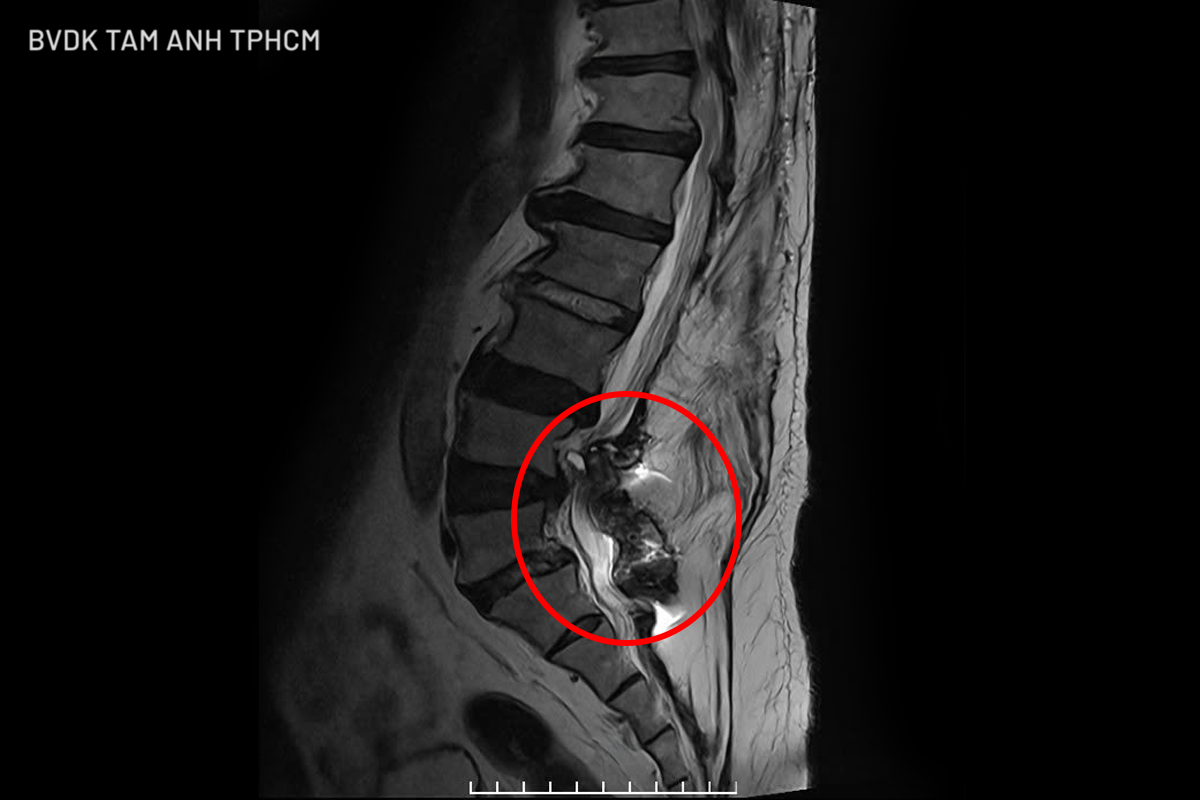 |
MRI results showed severe compression of the patient's spinal canal. Photo: Tam Anh General Hospital |
MRI results showed severe compression of the patient's spinal canal. Photo: Tam Anh General Hospital
Following a consultation, Doctor Quang decided to operate on Mr. Sang using the transforaminal lumbar interbody fusion (TLIF) method. This surgical technique is commonly applied in spinal surgery to decompress and stabilize the lumbar vertebrae. It involves replacing the damaged disc with an artificial disc and an autologous bone graft. The patient's spinal canal was widened, freeing the nerve roots from compression. Subsequently, pedicle screws were used to stabilize the spine. The surgery lasted for nearly 8 hours.
On the first day after surgery, Mr. Sang experienced a significant reduction in numbness and could move his thighs. He began rehabilitation, starting to walk and leaving his wheelchair on the third day. Doctor Quang predicted that within 3-6 months, the patient could make a full recovery and walk normally. During this period, he needs to actively engage in physical therapy to improve muscle atrophy resulting from prolonged limited mobility.
 |
Mr. Sang walked independently three days after surgery. Photo: Tam Anh General Hospital |
Mr. Sang walked independently three days after surgery. Photo: Tam Anh General Hospital
Spinal injuries, whether due to age or trauma, are quite common. When such an injury occurs, patients should seek early treatment at medical facilities with specialized spinal departments. This ensures timely intervention, prevents complications, promotes rapid recovery, and saves both time and cost. Doctor Quang noted that thanks to investments in equipment, techniques, and the expertise of surgeons, the success rate for treating spinal conditions in Vietnam is very high, attracting many international patients for treatment.
Phi Hong
| Readers can submit questions about musculoskeletal diseases here for doctors to answer. |


