As of 30/11, nearly two weeks after the major surgery, the patient's health is stable, and both fetuses are developing well. Her fingers have begun to show slight movement as she performs guided physical therapy exercises.
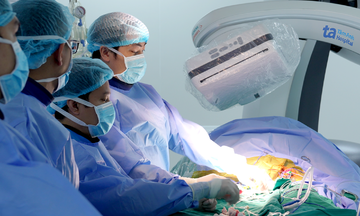
The surgery to reattach the hand to its original position took place on 17/11. The medical team performed a series of complex microsurgical techniques. These included detaching the hand along with a 15 cm segment of the posterior tibial artery from the leg, managing the arm stump, and fixing the radius with plates and screws. Surgeons connected one artery and three veins to restore circulation, and used the peroneus longus tendon and superficial peroneal nerve branch to graft the missing tendon and nerve sections.
 |
Medical staff operating on the patient. *Photo: Quynh Tran*.
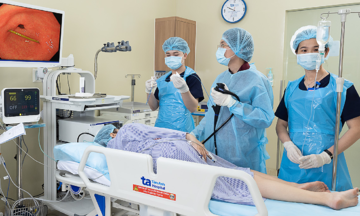
To ensure maximum safety, the hospital conducted inter-departmental consultations and online consultations with experts from the Orthopedic and Traumatology Hospital and Tu Du Hospital. Throughout the many hours of surgery, doctors continuously monitored the heart rates of both fetuses via obstetric monitoring systems.
The decision to temporarily attach the hand to the leg was an interim solution made in September, when the pregnant woman was hospitalized following a workplace accident. At that time, the patient was 23 weeks pregnant and had suffered a crushed lower one-third of her forearm, a severed right hand, and contaminated injuries.
Doctors assessed that immediate reattachment carried risks of necrosis and sepsis, threatening the lives of both mother and fetuses. Furthermore, a 7-8 hour surgery involving a large amount of anesthetic could easily lead to miscarriage. If the hand were amputated, the patient would face permanent disability. Therefore, the medical team opted to graft the hand onto her right lower leg. This allowed the local blood vessels to nourish the tissue, buying time until the pregnancy was more advanced for reattachment. The temporary grafting procedure took only 2-3 hours, helping to remove crushed tissue and minimize risks to the pregnancy.
Tang Chi Thuong, Director of the Ho Chi Minh City Department of Health, hailed the successful surgery as a professional advancement in the field of microsurgery and reconstructive surgery for a provincial-level hospital. He added that this effort carries significant humanitarian meaning, helping the mother retain functional hands to care for her soon-to-be-born children.
According to medical literature, the technique of temporarily grafting a hand onto the lower leg has previously been performed in China. Binh Duong General Hospital itself has a history of successful reattachments, having previously grafted a severed lower leg onto a healthy leg for temporary nourishment before reattaching it, enabling the patient to walk again.
Le Phuong