On monday, 3/12, Hanoi was blanketed in a thick layer of fine dust. Hien, an environmental sanitation worker in Nam Tu Liem district, pulled down her blue mask, coughed a few dry times, then quickly covered her mouth with her sleeve. A rattling sound came from her chest. Each time she coughed, she bent over, her left hand gripping her broom handle for balance. The woman pulled her cloth mask higher, knowing it would do little to block the fine dust.
"Just one deep breath, and my throat immediately burns, my chest tightens slightly, and I feel incredibly breathless," she said, before continuing her work amidst road dust, vehicle exhaust fumes, and mixed waste.
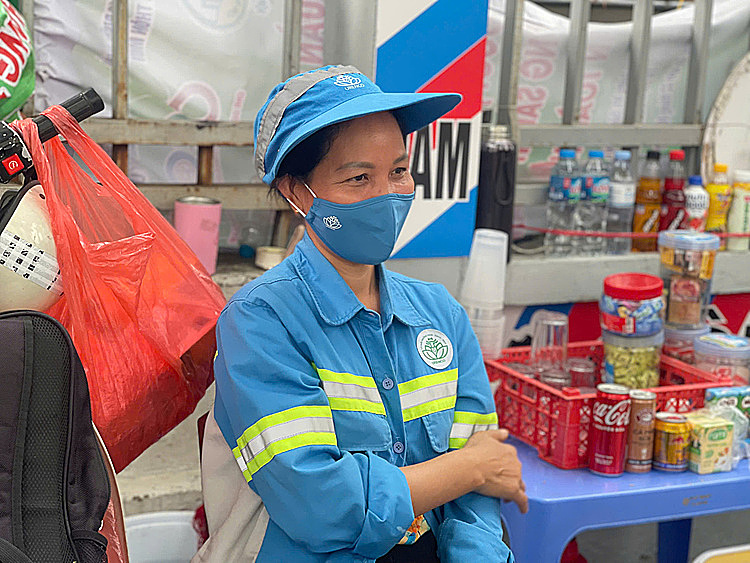 |
Hien said she feels more unwell due to air pollution. Photo: Thuy Quynh |
Hien said she feels more unwell due to air pollution. Photo: Thuy Quynh
On the sidewalk, Mai Van Thien, 50, had just stopped his taxi to drink iced tea while waiting for a passenger. After about 10 minutes, dust had covered his car. The man held his phone; an air quality monitoring application warned that the air quality index (AQI) and PM2.5 concentration had reached a very unhealthy level, exceeding 200. After a few coughs, he said that for three days he had felt more breathless and had chest tightness, necessitating the installation of an air purifier in his taxi.
A ride-hailing motorbike driver sitting nearby mentioned he was accustomed to heat, rain, and traffic jams, but air pollution was what exhausted him most. His first delivery of the day was an air purifier to a luxury apartment. He thought, "I'm delivering 'clean air' to the wealthy, while my own lungs are filtering dust to earn 35,000 VND for the delivery fee."
For three days, he has left home at 6:00 a.m., when the streets are still covered in a thick, gray haze. Despite pulling his mask up to the bridge of his nose, a coughing fit still arrived as soon as the engine started. Each time he stopped at a red light, he quickly unhooked one strap of his mask to catch his breath, but the inhaled air only brought road dust and gasoline fumes, leaving his chest aching and his eyes stinging.
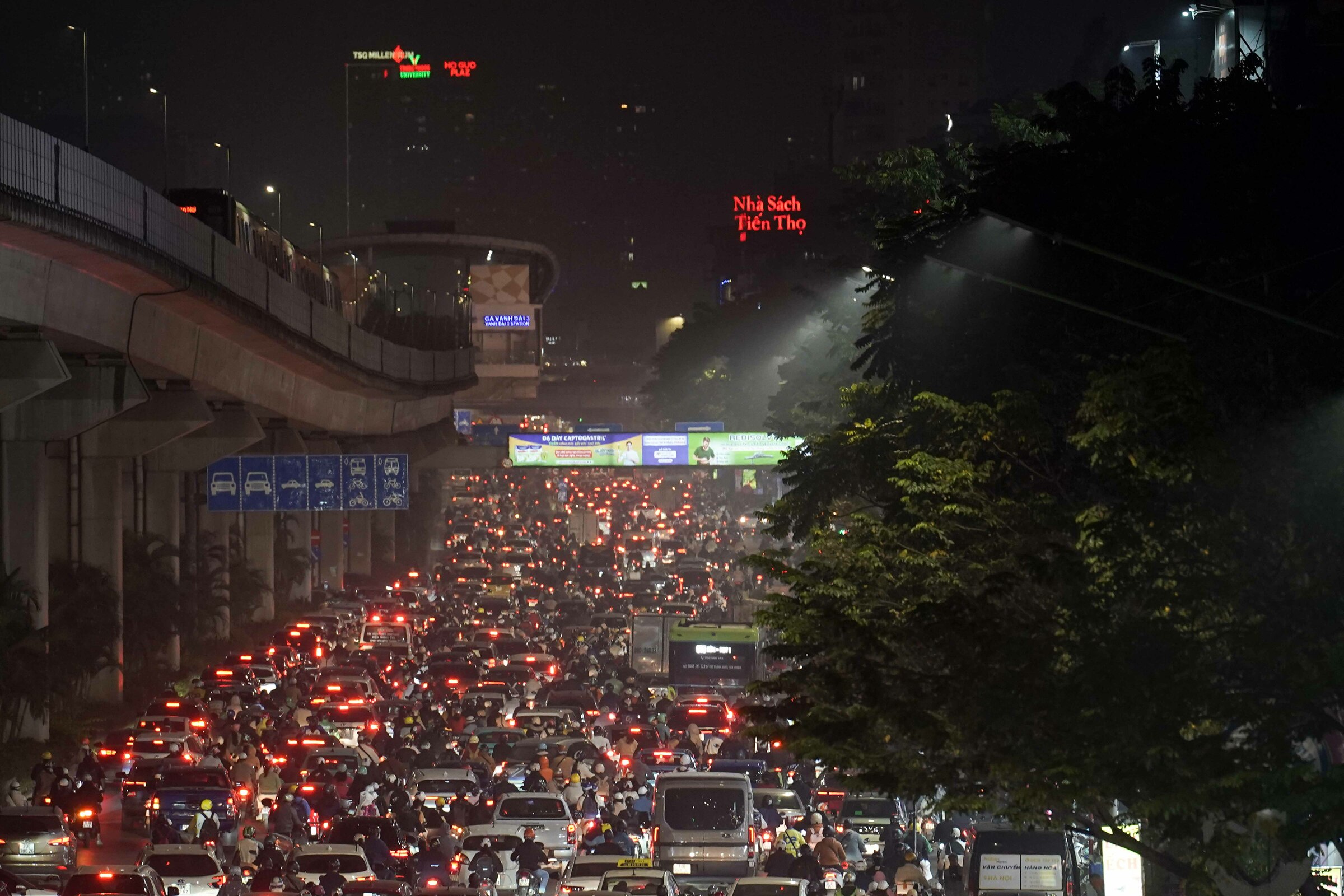 |
Nguyen Trai street on 1/12. Photo: Hoang Giang |
Nguyen Trai street on 1/12. Photo: Hoang Giang
For nearly a week, Hanoi has consistently ranked among the top 10 most polluted cities globally, according to IQAir. On the morning of 3/12, monitoring stations in Tay Ho, Gia Lam, and Ha Dong all recorded air quality index (AQI) readings exceeding 200 – a "very unhealthy" level, signaling health hazards. The city of Hanoi issued a warning advising residents, especially the elderly, children, and those with respiratory illnesses, to limit outdoor activities and use masks.
Experts identify three primary sources of Hanoi's air pollution: endogenous emissions (traffic, industry, construction), long-range transport from neighboring provinces or across borders, and unfavorable meteorological factors. This situation worsens in winter when the basin topography, combined with the northeast monsoon and temperature inversion, causes air to stagnate, trapping pollutants close to the ground instead of allowing them to disperse upwards.
According to the World Health Organization (WHO), air pollution is a "silent killer." Statistics from the World Bank in 2021 showed that 40% of Hanoi's population, equivalent to 3.5 million people, was affected by dust concentrations exceeding 45 μg/m³, nine times the current WHO standard. Deaths from causes linked to PM2.5 fine dust – particles with a diameter of 2.5 micrometers or less – in Hanoi accounted for 32% of the national total, approximately 5,800 cases. Data from the World Air Quality Organization (AirVisual) and GEOI from 2019 to present consistently indicate that during pollution seasons, capital residents breathe air equivalent to smoking three to four cigarettes daily.
Doctor Nguyen Huy Hoang, from the Vietnam Association of Underwater and Hyperbaric Medicine, stated that each PM2.5 particle often carries heavy metals such as lead and cadmium, toxic organic compounds, and bacterial toxins, silently infiltrating various organs in the body. These particles activate oxidative stress, damaging mitochondria and DNA. The body reacts by releasing inflammatory substances, causing the condition to spread from the lungs to the cardiovascular system and other parts. Additionally, they increase the risk of cardiovascular diseases such as atherosclerosis, blood clot formation, myocardial infarction, and stroke, while also affecting the brain, kidneys, and nervous system as toxins spread through the blood.
Doctor Doan Du Manh, from the Vietnam Vascular Association, assessed that the impact on groups of people who work outdoors regularly is many times more severe. Motorbike taxi drivers, sanitation workers, street vendors, and laborers must breathe polluted air for many hours, leading to persistent coughing, allergic rhinitis, shortness of breath, and wheezing. The risk of bronchitis and pneumonia is significantly higher than normal. Fine dust penetrates deep into the alveoli, damaging lung tissue, and prolonged exposure leads to chronic diseases that are difficult to recover from.
Most PM10 particles – with a diameter of 2.5-10 micrometers – settle in the nasal cavity and upper respiratory tract. However, PM2.5 particles can penetrate into the lung alveoli and enter the bloodstream. Research by the U.S. Environmental Protection Agency (EPA) and other organizations shows that exposure to elevated PM2.5 concentrations for several hours to several weeks can cause heart attacks related to cardiovascular disease and increase the risk of death.
Occupations like motorbike taxi driving or environmental sanitation already involve continuous physical activity, making rest difficult. Fatigue and chest pain are increasingly common, leading to easy physical overload and faster health deterioration. Fine dust also causes dry eyes, red eyes, and conjunctivitis. Skin is also prone to irritation, itching, and contact dermatitis. These workers also face psychological issues such as stress, fatigue, and irritability.
 |
Fine dust covers Hanoi city. Photo: Thuy Quynh |
Fine dust covers Hanoi city. Photo: Thuy Quynh
Experts recommend that people who frequently work outdoors use standard masks, such as N95 or equivalent, and replace them daily. Breaks should be taken in enclosed spaces like cafes, shops, or waiting stations. Avoid prolonged standing at points with dense traffic. Wearing dust-proof glasses can reduce eye irritation, while long-sleeved shirts and brimmed hats limit dust accumulation on skin and hair. Showering and cleaning the nose and throat after returning home help remove accumulated dust.
To boost immunity, it is important to: supplement water, increase nutrition, and consume protein-rich foods, green vegetables, and fruits high in vitamin C like oranges and grapefruits. Lung detoxification support measures include practicing diaphragmatic breathing to increase oxygen intake and hot steam inhalation with essential oils to humidify the airways. If symptoms of prolonged respiratory inflammation, chest pain, or difficulty breathing appear, patients should seek immediate medical attention.
Use reliable applications to check if your work area has severe pollution. If you feel dizzy, experience chest tightness, or have difficulty breathing, these could be warning signs that your body is overloaded by pollution, and you should rest for a few minutes before continuing.
Thuy Quynh