Scalp cancer involves the uncontrolled growth of epithelial cells on the head. It frequently manifests as nodules or rough patches, often accompanied by skin discoloration or ulceration. The most common types of skin cancer include basal cell carcinoma, squamous cell carcinoma, and melanoma.
Treating scalp cancer with radiation therapy presents more challenges than other cancer types. The scalp's shallow tissue layer, directly above the skull, makes precise targeting difficult. Radiation beams possess deep penetration, capable of passing several centimeters through the treatment area. If not meticulously controlled, there is a risk of cerebral cortex necrosis and cognitive decline for the patient. Conversely, an insufficient radiation dose may prevent the diseased tissue from receiving adequate treatment.
 |
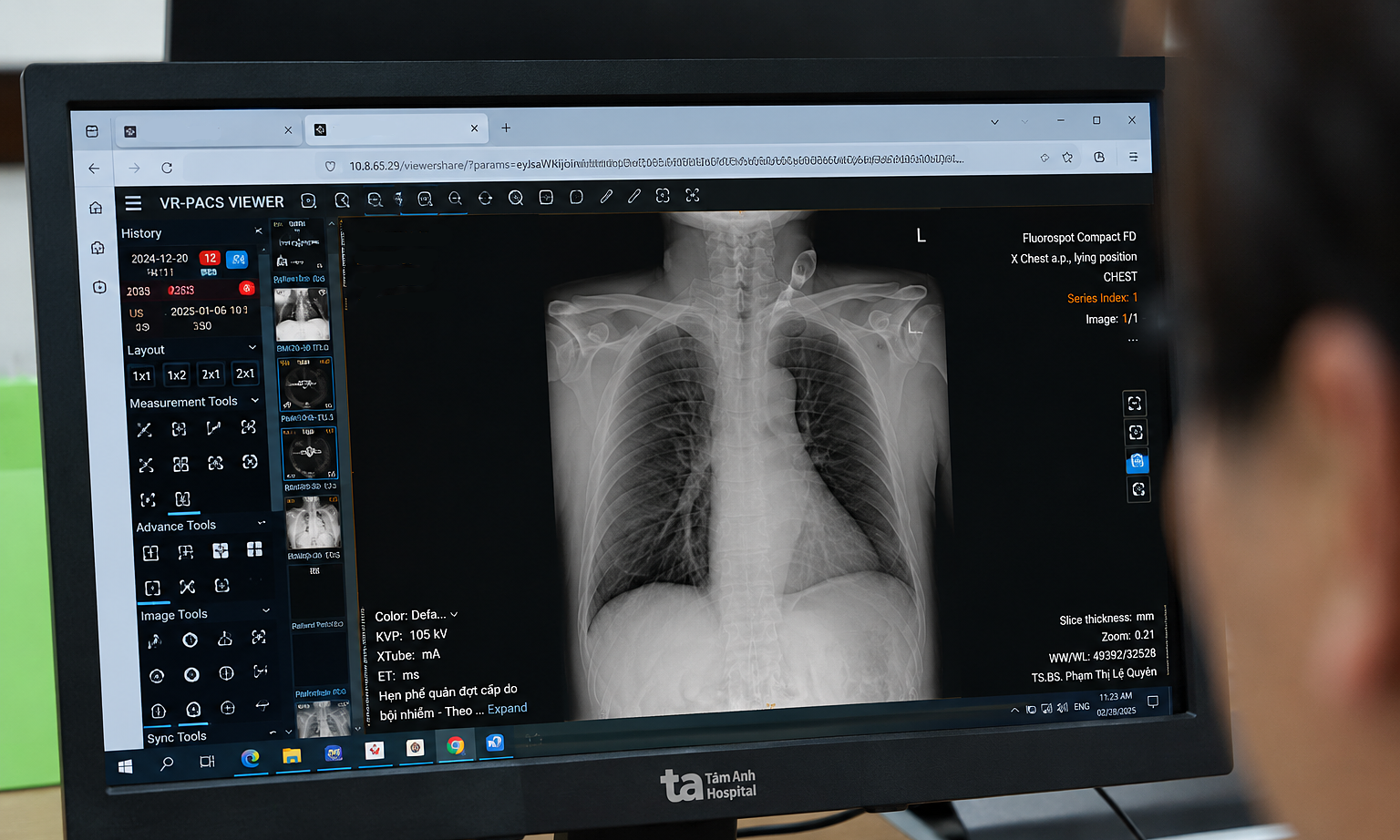
Doctor Hien advises a patient. Illustration: Tam Anh General Hospital.
The skull's spherical shape poses a challenge because radiation beams travel in straight lines. When radiation targets the scalp, beams at the crown receive sufficient dosage. However, areas such as the temples, nape, and the contoured regions around the earlobes or bridge of the nose often receive inadequate doses due to air gaps. This diminishes radiation interaction, lowering treatment effectiveness and increasing the risk of side effects.
To effectively perform radiation therapy for scalp cancer and ensure uniform dose distribution across its complex curved surface, doctors utilize intensity-modulated radiation therapy (IMRT). This is combined with a 3D personalized bolus and a custom immobilization mask for each patient.
A bolus is a flexible, tissue-equivalent material that naturally conforms to the skin surface. It avoids causing further damage to the already compromised skin.
Using computed tomography (CT) data, engineers and technicians create a 3D model to produce a customized bolus for each patient. This ensures it precisely fits every curve and contour of the scalp.
When placed on the scalp, the bolus completely fills any air gaps, effectively transforming the curved and uneven surface into a more uniform target for radiation beams. Patients wear a personalized mask, which ensures stable positioning throughout each treatment session. This combined approach allows radiation to concentrate efficiently on the superficial tissue layer containing cancer cells, while significantly limiting unnecessary doses from penetrating deep into the skull.
It is advisable to take your relative to a hospital that utilizes modern radiation therapy technology, specifically one that employs 3D personalized bolus during scalp radiation therapy. This approach enhances treatment effectiveness and reduces side effects.
Dr. Nguyen The Hien, Specialist Level II
Department of Radiation Oncology, Oncology Center
Tam Anh General Hospital, Ho Chi Minh City
| Readers can submit questions about cancer here for doctors to answer. |