Hoang Nam, 30, who underwent anterior cruciate ligament (ACL) reconstruction, can generally expect to return to playing football safely between nine and twelve months post-surgery. This timeframe, however, is highly dependent on rigorous rehabilitation and individual progress, as explained by Master Tran Van Dan from the Department of Physical Therapy and Rehabilitation at Tam Anh General Hospital Hanoi.
The anterior cruciate ligament is a vital structure that stabilizes the knee joint, controlling rotation, changes in direction, and sudden speed alterations. Injuries to this ligament commonly occur in sports like football, basketball, or badminton, which involve quick pivots, jumps, and rapid landings.
When the anterior cruciate ligament tears, the knee loses stability. Patients often experience pain, swelling, and a sensation of the knee giving way or slipping during movement. Without prompt treatment, prolonged instability can significantly increase the risk of meniscal tears, cartilage damage, and early onset of knee osteoarthritis.
Anterior cruciate ligament reconstruction surgery is the standard treatment for young, active individuals or those with high-intensity physical demands. During the procedure, surgeons use an autograft—a piece of the patient's own tendon—to create a new ligament, securing it to the anatomical positions within the femur and tibia where the original ligament was torn. Post-surgery, patients regain knee stability, which helps protect the meniscus and reduce the risk of osteoarthritis.
The journey back to playing football hinges significantly on a structured post-operative rehabilitation program, which is meticulously divided into several progressive stages.
The initial two weeks focus on pain and swelling management, restoring full knee extension, and preventing joint stiffness and thigh muscle atrophy. Patients learn isometric exercises, leg raises, crutch walking, and gradually increase their joint's range of motion under the guidance of physical therapists.
From week two to week six, the emphasis shifts to improving knee range of motion, progressively bearing weight on the operated leg, and strengthening the quadriceps, hamstrings, glutes, and core muscles. By six weeks post-anterior cruciate ligament reconstruction, most patients can walk relatively normally.
Between month two and month four, the rehabilitation program targets enhancements in muscle strength, balance, and motor control. Physical therapists introduce specialized exercises, including training on unstable surfaces, single-leg balance drills, and functional movements that mimic daily activities. Many individuals can engage in cycling, swimming, or light aerobic exercises during this period.
From month four to month six, the autograft undergoes a biological restructuring process known as "ligamentization." While patients observe noticeably improved knee stability and freedom from pain, the newly formed ligament has not yet attained its maximal strength. Physical therapists guide patients through straight-line running, slow acceleration, controlled change-of-direction drills, and advanced strength training.
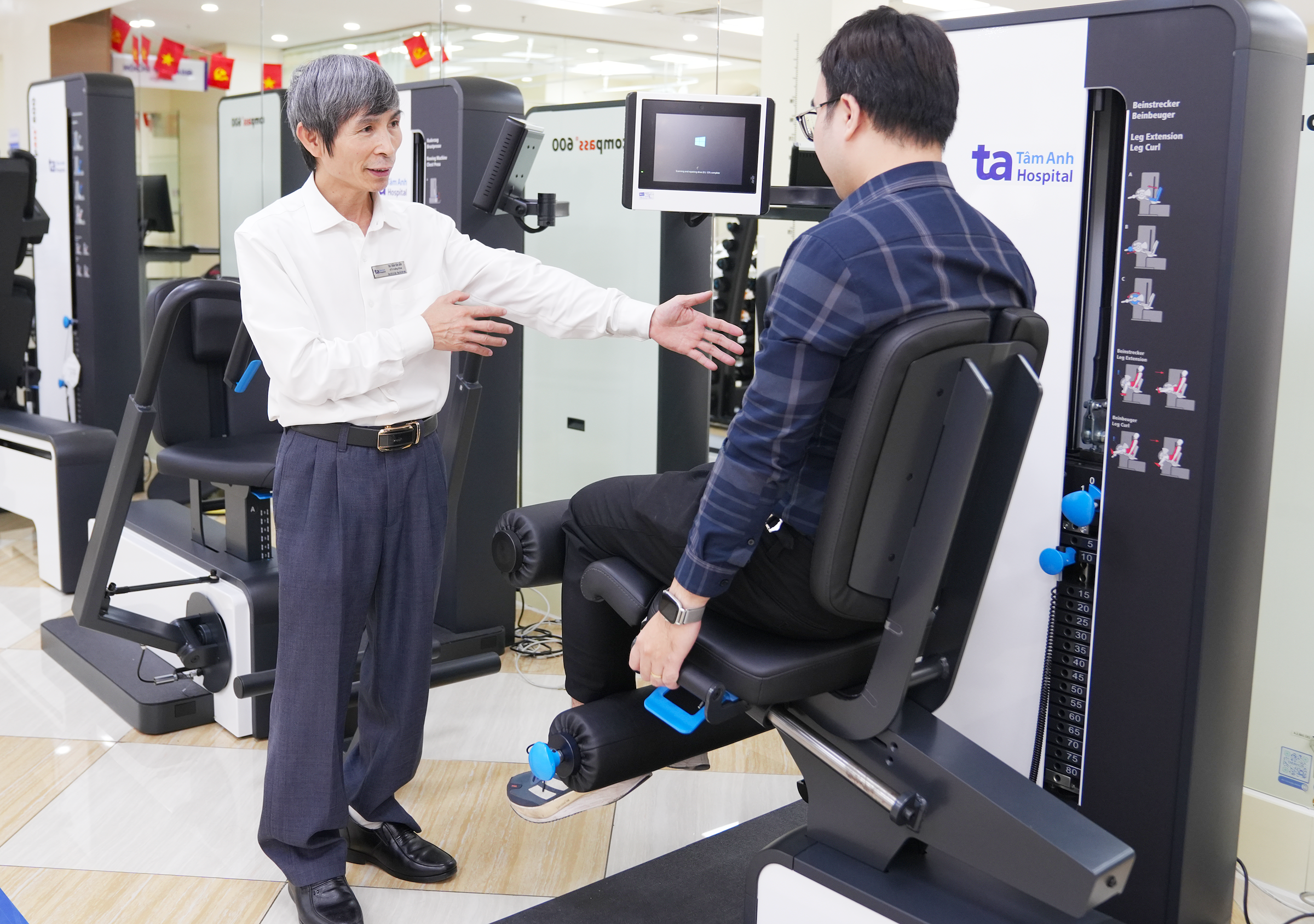 |
Master Tran Van Dan assesses muscle strength for a patient with a ligament rupture using specialized equipment. Illustration: Tam Anh General Hospital.
Between month six and month nine, doctors and physical therapists conduct comprehensive assessments using specialized tests and equipment. These evaluations gauge thigh muscle strength in both legs, jumping and landing capabilities, balance, and overall movement control. If these criteria surpass 90% compared to the uninjured leg, patients are cleared to commence field training in preparation for returning to football.
The period from month nine to month twelve marks the time when most patients can safely return to playing football. For professional athletes, physical therapists continue to provide specialized, individualized sports medicine exercises, tailored to specific muscle group strength assessments, aiming to restore peak athletic performance. Some athletes may require over one year to achieve optimal physical condition and ligament function following reconstruction surgery.
For Hoang Nam, having undergone anterior cruciate ligament reconstruction, it is crucial to attend scheduled follow-up appointments at a specialized hospital and strictly adhere to the prescribed physical therapy and rehabilitation protocol. Discontinuing exercises prematurely is not advisable. Furthermore, avoiding overtraining or rushing back to football too soon is paramount, as such actions can significantly elevate the risk of re-injury or re-rupture of the ligament.
Master Tran Van Dan
Department of Physical Therapy and Rehabilitation
Tam Anh General Hospital Hanoi
| Readers can submit questions about musculoskeletal diseases here for doctors to answer. |