Following two interventions a decade ago to remove kidney stones, Mr. Xuan's right kidney atrophied and lost function, leaving his left kidney to filter blood for his entire body. A month ago, he developed a dull ache in his left flank. A CT scan at the Urology - Nephrology - Andrology Center, Tam Anh General Hospital Ho Chi Minh City, revealed a recurring 4 cm stone in his left kidney.
Dr. Nguyen Tan Cuong, Master of Science, Head of Urology B Department and Head of Urological Oncology Unit, explained that while small, non-obstructive stones can be monitored periodically, Mr. Xuan's large, painful stone in his only functioning kidney presented significant risks. Delaying treatment could lead to obstruction, prolonged infection, and further damage to his remaining kidney.
 |
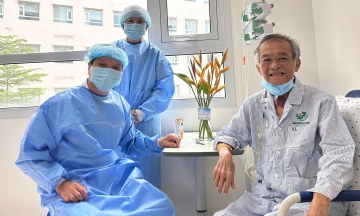
Dr. Cuong (far left) and Dr. Phan Truong Nam, Specialist Level I, perform retrograde flexible ureteroscopy lithotripsy on Mr. Xuan. *Tam Anh General Hospital*. |
Patients like Mr. Xuan, with only one functioning kidney, are considered high-risk. According to Dr. Cuong, any complications to this sole kidney during intervention could directly impact the patient's overall kidney function, potentially leading to long-term dialysis.
Lab tests and CT scans confirmed Mr. Xuan's left kidney was still functioning well, with preserved renal parenchyma and no infectious complications. The medical team opted for retrograde flexible ureteroscopy, using laser energy to fragment the stone. This approach avoids skin incisions or creating a tunnel through the kidney tissue, making it an optimal method to minimize parenchymal damage, reduce bleeding risk, and maximally preserve the remaining kidney's function.
The team inserted a flexible ureteroscope with a maneuverable tip, advancing it retrograde from the urethra, through the bladder, up the ureter, and navigating the renal calyces and pelvis to reach the stone. Laser energy then fragmented the stone into small pieces, which were irrigated and extracted through natural pathways. As no incision was made through the kidney tissue, the patient experienced less pain, resulting in a shorter recovery and hospital stay. Mr. Xuan recovered quickly, without fever or significant pain, and was discharged after just two days.
One month later, Mr. Xuan had a follow-up appointment, his condition was stable, and he began implementing preventive measures as advised by his doctor.
Urinary tract stones are common in Vietnam. Dr. Cuong noted that approximately 50% of kidney stone cases recur within the first 5-10 years after treatment if patients do not adhere to preventive measures.
To reduce recurrence risk, post-procedure patients should undergo stone composition analysis and metabolic evaluation, including 24-hour urine tests. These tests detect disorders such as hypercalciuria, hyperoxaluria, or hypocitraturia, which may necessitate appropriate prophylactic medication. Additionally, patients should drink sufficient water, limit salty foods, and maintain regular physical activity to promote overall health.
Individuals with a history of kidney stones, especially those with only one functioning kidney, should have follow-up examinations every 6-12 months. This allows for early detection of recurrent stones and prevents long-term impact on kidney function.
Ha Thanh
*Patient's name has been changed
| Readers can submit questions about kidney and urological diseases here for doctors to answer. |