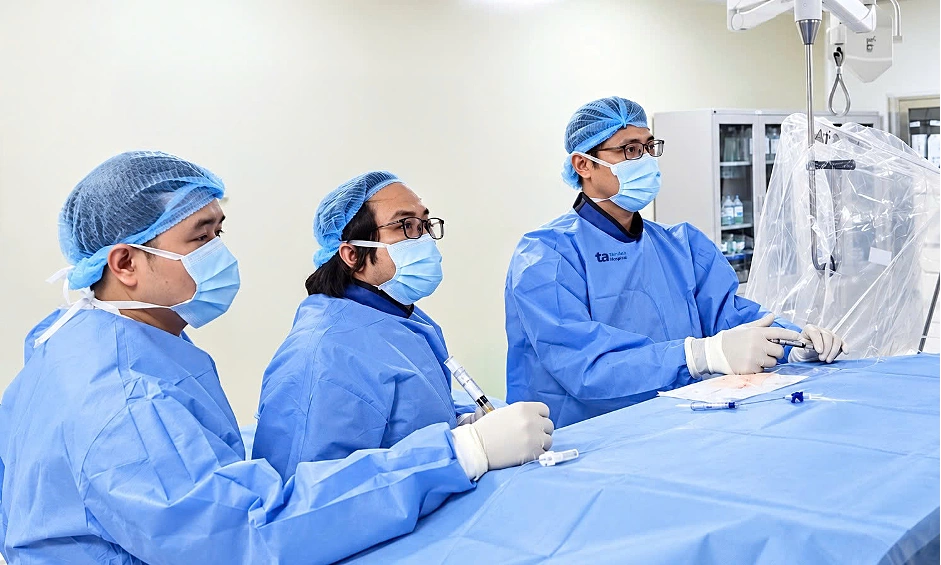
Ms. Phuong was diagnosed with adenomyosis five years ago and had undergone hormonal intrauterine device treatment without success. Two weeks before her admission, she sought examination at Tam Anh General Hospital, TP HCM, for abdominal pain following treatment for menorrhagia at another hospital. MRI results indicated uterine endometriosis, a large, fluid-filled mass occupying the left pelvic region, and significant fluid in the abdominal cavity.
Master, Doctor Nguyen Thi Quy Khoa, Deputy Head of the Obstetrics Department at the Center for Obstetrics and Gynecology, diagnosed adenomyosis and a large, infected ovarian endometrioma, recommending surgery to prevent rupture. During the operation, the surgical team found a large cyst in the left pelvic region containing 500 ml of clotted and fresh blood, which had spread throughout the abdomen. The uterus contained large fibroids and rupturing endometriotic lesions, actively bleeding and adhering tightly to the surrounding tissues.
Near the left fallopian tube, tightly adhered to the uterine wall, was a 4x4x15 cm vascular tissue mass actively bleeding bright red blood. Doctor Khoa noted that this finding was not typical of an endometriotic cyst, contrary to preoperative predictions. The vascular lesion's tight adherence to the uterus complicated identifying the bleeding source and controlling the vessels.
 |
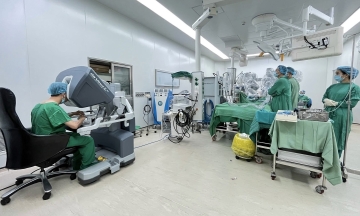
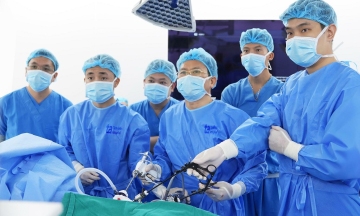
Doctor Quy Khoa (right) and the surgical team perform emergency surgery on Ms. Phuong. *Photo: Tam Anh General Hospital* |
The doctors performed a total hysterectomy, preserving both ovaries. However, blood continued to ooze from the vascular lesion. The team then removed the left genital vascular mass to achieve complete control over the bleeding source.
Following surgery, the patient received a 900 ml blood transfusion. A pelvic ultrasound showed no fluid accumulation, and her health significantly improved.
 |
Ms. Phuong recovers and begins walking one day after surgery. *Photo: Tam Anh General Hospital* |
Doctor Khoa explained that spontaneous abdominal bleeding, meaning not caused by trauma, can stem from vascular damage such as ruptured aneurysms, vascular dilation, or malformations, as well as liver diseases like ruptured liver tumors. For women of reproductive age, gynecological causes can include ruptured ectopic pregnancies or ruptured ovarian cysts or tumors. Ms. Phuong's history of endometriosis meant her initial symptoms of abdominal pain and menorrhagia were easily mistaken for her pre-existing gynecological condition. However, during surgery, doctors discovered an additional venous malformation that was the true cause of the abdominal hemorrhage.
Pelvic venous malformations can be congenital abnormalities, forming during the embryonic stage. Patients may remain asymptomatic for many years, with the condition only discovered when vessels significantly dilate, bleed, or lead to complications. Spontaneous abdominal bleeding caused by pelvic vascular damage can manifest as lower abdominal pain, which is often mistaken for endometriosis or ovarian cysts.
Tue Diem
| Readers can submit questions about obstetrics and gynecology here for doctors to answer |