When Ms. Hong developed red spots all over her body and skin ulcers, she sought dermatology care and was diagnosed with allergic dermatitis. However, her condition did not improve. Around the same time, she experienced a more frequent dry cough and shortness of breath.
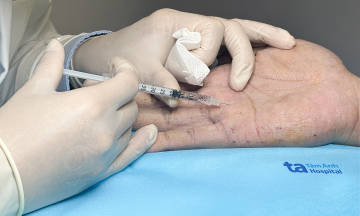
A skin lesion biopsy at Tam Anh General Clinic District 7 revealed Ms. Hong had sarcoidosis, a chronic inflammatory disease linked to immune system dysregulation. Doctors prescribed chest X-rays or CT scans to examine her lungs and mediastinal lymph nodes, which are often the most affected organs in sarcoidosis. Respiratory function tests were also ordered to assess lung ventilation and the disease's impact on lung activity.
Master, Doctor, Second Degree Specialist Nguyen Thi My Hanh from the Respiratory Unit, General Internal Medicine Department, prescribed immunosuppressants and anti-inflammatory medication for Ms. Hong, with a follow-up period of one to two years. During this time, doctors will evaluate the patient's drug response and side effects for timely adjustments. If the patient responds well, skin and lung symptoms may decrease; severe cases may require lifelong treatment, according to Doctor Hanh.
 |
Doctor My Hanh consults with a patient. *Photo: Tam Anh General Clinic District 7* |
"Normally, the immune system helps the body fight foreign agents like bacteria and virus. In sarcoidosis patients, however, the immune response becomes excessive and prolonged," explained Doctor Hong. Inflammatory cells accumulate in tissues, forming small structures called granulomas. These granulomas can appear in many organs, disrupting their function. A characteristic feature of sarcoidosis granulomas is that they are non-necrotizing, meaning there is no area of dead tissue at their center.
Sarcoidosis is difficult to diagnose due to its diverse manifestations, which are easily mistaken for other conditions. When it affects the skin, patients may notice erythema, raised papules, or discolored skin patches. If it appears in lymph nodes, the disease is often incidentally discovered during chest X-rays. When affecting the eyes, patients experience dry eyes and blurred vision. In rarer cases, the heart or liver can also be impacted, leading to serious complications, including sudden death.
The lungs are the most commonly affected organ. When granulomas form in lung tissue, they can alter the structure of alveolar walls, where oxygen exchange occurs. Prolonged inflammation causes lung tissue to thicken and become less elastic. Patients develop a dry cough, shortness of breath, or difficulty breathing during exertion. These symptoms often progress slowly, making them easy to overlook.
According to a study published in the U.S. National Library of Medicine, the incidence of sarcoidosis is approximately one to 15 per 100,000 people. Sarcoidosis is not common compared to many other respiratory diseases and is often missed due to its non-specific initial symptoms. However, Doctor Hanh noted that not all sarcoidosis cases require aggressive treatment. In some individuals, the disease may stabilize or spontaneously resolve. Regular monitoring is crucial to assess disease progression over time.
Persistent skin lesions, a prolonged dry cough, or progressively worsening shortness of breath are abnormal signs that warrant examination, doctors stated. Early detection helps control symptoms and limits the risk of long-term organ damage.
Nhat Thanh
*Patient's name has been changed
| Readers can submit questions about respiratory diseases here for doctors to answer |