Post-operative pathology results for Mr. Nhan confirmed squamous cell carcinoma in situ. Two months later, experiencing mouth and throat pain, he visited Benh vien Da khoa Tam Anh TP HCM for a check-up. An MRI scan revealed the lesion had aggressively spread across the midline of the floor of the mouth (the area beneath the tongue, within the oral cavity) on both sides. Invasion of the genioglossus muscle and sublingual space on both sides was suspected, along with numerous cervical lymph nodes in groups I, II, and III.
Professor, Doctor Tran Phan Chung Thuy, Director of the Ear, Nose, and Throat Center, stated that Mr. Nhan was suffering from recurrent floor of mouth cancer. This type of squamous cell carcinoma originates from the stratified epithelial lining of the oral cavity mucosa. It has a high proliferation rate, making it prone to invasion. Cancer cells can spread beyond previous resection margins or develop on already altered mucosal tissue, leading to a high risk of recurrence.
Mr. Nhan was scheduled for tumor resection, lymph node dissection, and tongue reconstruction to preserve speech, chewing, and swallowing functions. The surgical team performed a tracheostomy on the patient, then resected the floor of mouth tumor in the sublingual region and its surrounding margins, along with a partial glossectomy. Frozen section biopsies confirmed negative margins, indicating no remaining cancer cells. Pathological results showed the resected tumor was an infiltrating squamous cell carcinoma of grade two.
 |
Professor Chung Thuy (far right) performing surgery to remove cancer and reconstruct Mr. Nhan's tongue. Photo: Benh vien Da khoa Tam Anh.
Surgeons harvested a supraclavicular muscle flap (between the neck and shoulder) measuring approximately 10x25 cm. The keratinized layer was removed to match the oral mucosa, while the skin layer was preserved to cover the tongue's defect. The flap was dissected down to the muscle layer, maintaining its vascular pedicle, then rotated and transferred to the tongue, shaped, and sutured into place. Finally, the team performed a cervical lymph node dissection, and pathology confirmed no metastatic tumors in the lymph nodes.
Mr. Nhan received a nasogastric feeding tube to avoid impacting the floor of the mouth area and minimize infection risk. After 7 days, the patient recovered well, was discharged, and maintained monthly follow-up appointments to monitor the disease. Professor Chung Thuy stated that the surgery helped the patient remove the malignant tumor, dissect lymph nodes to prevent recurrence, and simultaneously restore speech and swallowing functions.
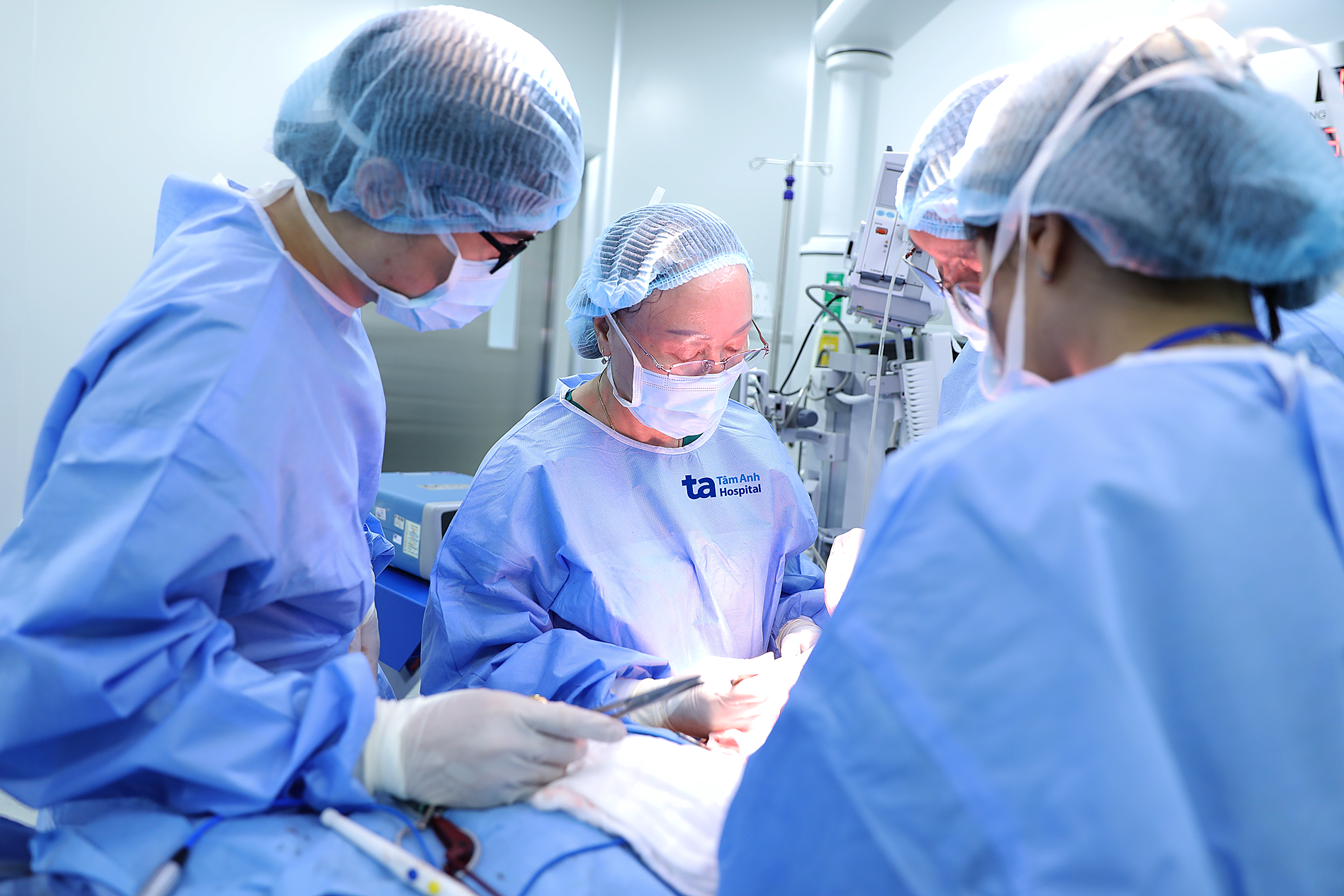 |
Professor Chung Thuy (center) operating on Mr. Nhan. Photo: Benh vien Da khoa Tam Anh.
Floor of mouth cancer originates from the mucosa of the floor of the mouth, located between the inner surface of the dental arch and the underside of the tongue. The most common type is squamous cell carcinoma, accounting for over 90% of all oral cancers. Floor of mouth cancer grows rapidly and invades surrounding tissues.
Stage 0 cancer, if detected and surgically removed early, is often effectively controlled. However, the disease can still recur and invade if microscopic malignant cells or the oral cavity mucosa continue to change. Patients should not be complacent; instead, they need close monitoring and regular follow-up examinations.
The disease is often linked to smoking, alcohol consumption, betel nut chewing, and HPV infection, as well as frequent exposure to chemicals, radiation, dioxin, and herbicides. Key symptoms include persistent ulcers lasting over two weeks, which may or may not be painful; these can be accompanied by tumors, bleeding, trismus (lockjaw), or difficulty swallowing. Patients experiencing symptoms such as sore throat, difficulty swallowing, or ulcers that do not respond to two weeks of treatment should seek medical attention for diagnosis, biopsy (if necessary), and timely treatment.
Uyen Trinh