The deployment plan for automated external defibrillators (AEDs) was unveiled this morning at the launch of a community first aid training program, organized by the Department of Health.
Under the initiative, Khanh Hoa aims to equip 80 AEDs across key locations in 2026, including schools, supermarkets, residential complexes, tourist sites, and airports. Specifically, 25 devices will be allocated to Nha Trang's coastline.
These devices will be strategically placed in visible and easily accessible locations for both emergency use and proper maintenance. The Khanh Hoa 115 Emergency Center will oversee the training and guidance of non-medical personnel in cardiopulmonary resuscitation and defibrillator operation, ensuring all equipment remains ready for use.
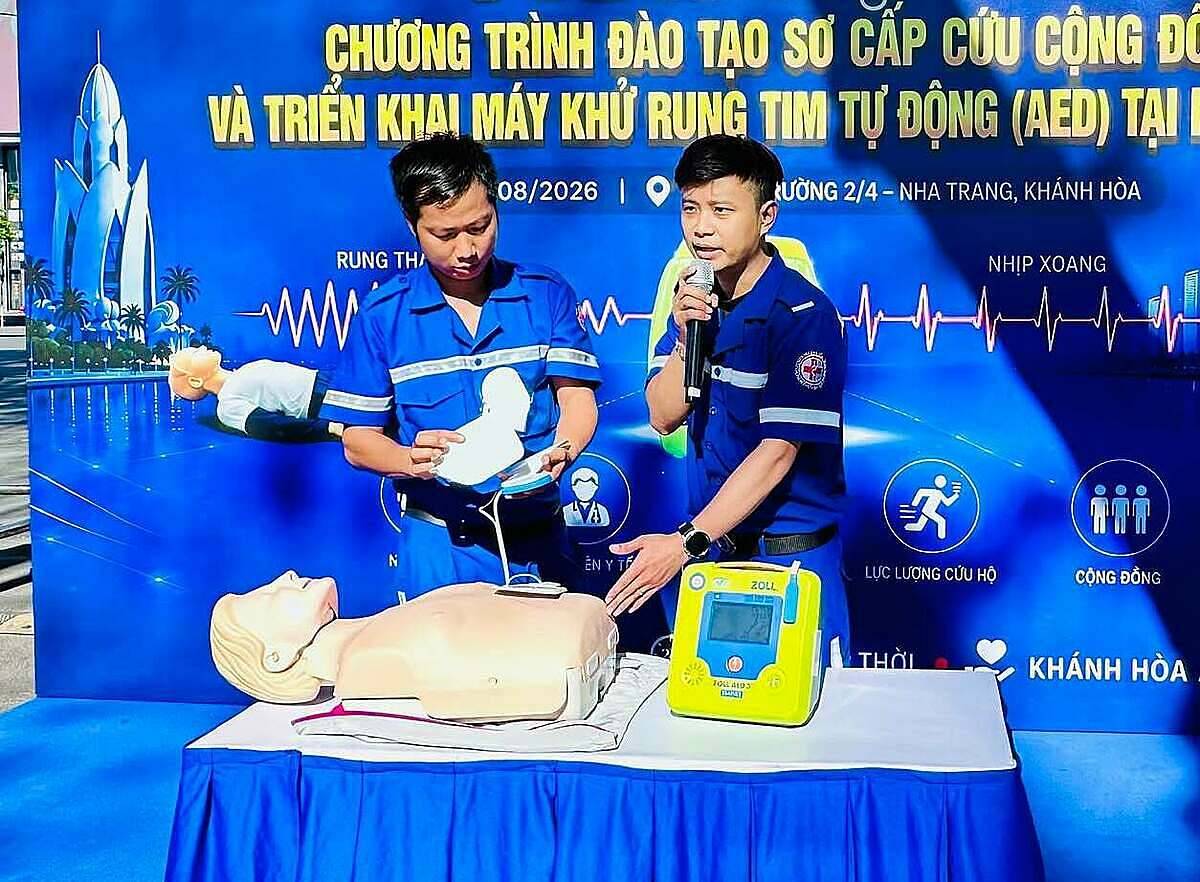 |
Medical staff demonstrating automated external defibrillator use at the launch ceremony. *Photo: Khanh Hoa General Hospital* |
Le Van Khoa, Director of the Provincial Department of Health, highlighted the critical need for these devices, noting that 70% of cardiac arrest incidents in the province occur outside hospitals. He added that 75% of these cases involve ventricular fibrillation before cardiac arrest, necessitating immediate defibrillation.
An automated external defibrillator is a simple emergency device, designed for safe operation by non-medical professionals following its built-in voice instructions. Timely intervention within the first few minutes is paramount for improving the survival rates of cardiac arrest victims.
"Our health sector will organize extensive community training programs, ensuring that everyone can confidently use an AED in an emergency," Khoa stated.
Both the American Heart Association (AHA) and the World Health Organization (WHO) emphasize that the "golden window" for saving a cardiac arrest victim is typically within the first 3 to 5 minutes. This is a critical period, as professional medical teams often require more time to arrive at the scene. AEDs are designed to bridge this gap by automatically analyzing heart rhythms and providing clear voice instructions, enabling non-medical individuals to administer vital emergency care while awaiting an ambulance.
Nguyen Long Bien, Vice Chairman of the Provincial People's Committee (UBND), further proposed digitalizing each automated external defibrillator. These devices would become smart points on the province's digital health map, offering real-time location data to enable the Khanh Hoa 115 Emergency Center to precisely command and coordinate emergency resources.
Bien also urged the health sector to move beyond mere certification training and establish on-site rapid response teams. These teams would comprise diverse personnel, including railway station and airport staff, hotel receptionists, and security personnel. Additionally, tourism businesses are encouraged to integrate into the community emergency network, recognizing it as a key component of their strategy to enhance the destination's appeal.
The Provincial Department of Culture, Sports and Tourism reported that in the first seven months of the year, Khanh Hoa welcomed over 15 million visitors, marking a nearly 39% increase compared to the same period in 2025. International arrivals accounted for approximately 5.5 million of these, a rise of over 67%. Total tourism revenue is estimated to exceed 82 trillion VND, with average accommodation occupancy reaching over 63%.
Bui Toan