Associate Professor, Doctor Dang Hong Hoa, Head of the Musculoskeletal Department at Tam Anh General Hospital Hanoi, explains that multiple myeloma occurs when plasmocytes in the bone marrow mutate, develop abnormally, and proliferate excessively. The disease leads to anemia as cancerous cells overwhelm other healthy blood cells, subsequently producing too many antibodies that clog kidney tubules, leading to kidney failure. It also causes bone lesions in multiple locations, resulting in pain and pathological fractures, which can be mistaken for fractures due to osteoporosis.
Vietnam recorded 607 cases of multiple myeloma and 562 deaths, with an incidence rate of 1,7 per 100,000 people, according to Globocan 2022. Multiple myeloma develops silently and is easily misdiagnosed or overlooked because many symptoms overlap with common musculoskeletal conditions such as back pain from degeneration or herniated discs.
For instance, Mr. Thinh, 81, experienced lower back pain for three months. He was diagnosed with osteoarthritis, finding it difficult to change posture or move. He visited Tam Anh General Clinic Cau Giay (Hanoi) for magnetic resonance imaging (MRI) and computed tomography (CT) scans, which revealed multiple osteolytic lesions and cortical bone destruction in his thoracic spine, ribs, and lumbar spine. A bone marrow biopsy confirmed his diagnosis of multiple myeloma.
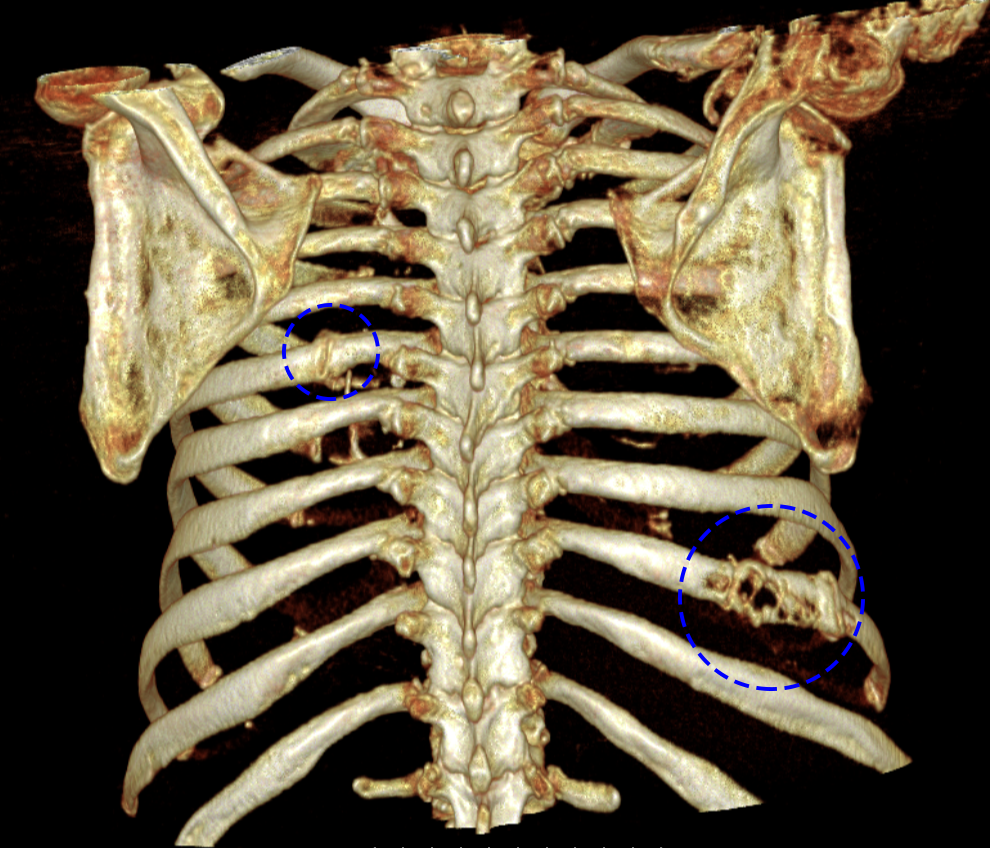 |
Osteolytic lesions in Mr. Thinh's CT scan. Photo: Tam Anh General Hospital
Similarly, three months ago, Ms. Ly, 71, suffered a broken arm after a minor impact. For the past month, she had back pain and was diagnosed with osteoporosis and lumbar spinal degeneration by a doctor at another hospital. Her prescribed medication brought no relief. She came to Tam Anh General Clinic Cau Giay, where blood tests showed anemia, hypercalcemia, and abnormal IgG antibody levels. Immunoelectrophoresis results indicated plasmocyte proliferation. A bone biopsy at the osteolytic lesion on the upper end of her right humerus, the site of her old fracture, detected multiple myeloma plasmocytes; a myelogram and gene testing confirmed the disease.
Doctor Vu Huu Khiem, Head of the Oncology Department, states that multiple myeloma is a highly malignant disease that is currently incurable. Alongside treatment to control symptoms and prevent disease progression, patients undergo rehabilitation to improve their quality of life.
Treatment options for multiple myeloma are complex, including: various combination drugs, autologous stem cell transplant, CAR-T cell therapy for relapsed or refractory multiple myeloma, along with anti-resorptive drugs, adjuvant radiation therapy, and surgery when necessary. Recommended treatment strategies vary depending on the patient's condition and physical health.
The best option for multiple myeloma patients is a bone marrow transplant, which involves collecting the patient's own blood stem cells, using high-dose chemotherapy to destroy mutated plasmocytes, and then reinfusing the stem cells to regenerate new bone marrow. This method can lead to remission for several years but is typically indicated for younger patients in good health who can tolerate high-dose chemotherapy.
Due to his advanced age and frail condition, Mr. Thinh is not a candidate for a bone marrow transplant. However, he can receive mild chemotherapy drugs to induce cancer cell death, and radiation therapy to help control symptoms at the osteolytic lesions, reducing the risk of fractures. Ms. Ly is in better health and can undergo more aggressive treatment with a combination chemotherapy regimen to quickly alleviate bone pain, protect her kidneys, and reduce hypercalcemia.
 |
Associate Professor Hoa examining Ms. Ly. Photo: Tam Anh General Hospital
Multiple myeloma often leads to dangerous complications such as anemia, kidney failure requiring dialysis, increased risk of fractures, infections, and death, according to Associate Professor Hoa. Therefore, it is crucial to differentiate between back pain due to degeneration (which usually subsides with rest and responds to medication) and pain caused by multiple myeloma (which is often continuous day and night, unrelieved by rest or treatment). When suspicious symptoms arise, patients should seek examination at a multispecialty medical facility for in-depth diagnosis, early detection, and timely treatment.
Currently, there are no specific preventive measures for the disease. Maintaining a healthy lifestyle, a nutritious diet, adequate sleep, regular exercise, not smoking, and limiting alcohol consumption are recommended. Stress management and avoiding exposure to toxins or radiation can offer partial prevention. Regular health check-ups, blood tests, urine tests, and X-rays can help detect the disease early.
Thanh Long
*Patient names have been changed