Dr. Dam Thi Thuy Hong, Head of the Aesthetics Department at Tam Anh General Hospital Hanoi, used a dermoscopy to magnify Minh's scalp structure and hair follicles. She assessed that his hair density was reduced for his age, with many fine hairs and shrunken, less active follicles that had not yet fully atrophied. His condition was identified as early-stage hair loss, a "golden time" for effective recovery with proper treatment.
Dr. Hong prescribed platelet-rich plasma (PRP) injections for Minh. This method uses the patient's own blood to support, restore, and stimulate hair follicle activity. PRP offers high safety, minimizing risks of irritation, allergies, or complications, making it particularly suitable for young individuals with early-stage hair loss where follicles are not yet completely atrophied.
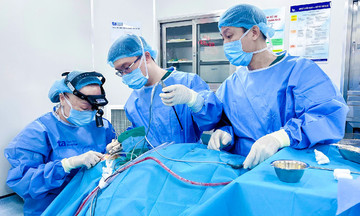
The doctor drew an adequate amount of Minh's blood, which was then processed using a specialized centrifugation system to extract the platelet-rich plasma. This plasma contains a high concentration of biological growth factors that stimulate cell proliferation, supply oxygen and nutrients around hair follicles, promote tissue regeneration, and reactivate weakened hair follicles. As a result, hair loss is reduced, and new hair grows thicker and stronger over time.
The doctor injected PRP directly into the thinning areas of Minh's scalp using small needles, a procedure lasting 45-60 minutes, after which Minh did not require recovery time. After approximately one month, his hair loss decreased. Following three personalized PRP sessions, baby hairs were visibly growing on his forehead, his part line gradually narrowed, and his hair strands became thicker and stronger.
 |
Minh's blood is drawn for platelet-rich plasma extraction to treat hair loss. *Photo: Tam Anh General Hospital* |
Dr. Hong noted that PRP does not yield immediate results but improves gradually according to the natural growth cycle of hair follicles. Typically, hair loss reduces after four to six weeks, new hair becomes more noticeable after two to three months, and continues to develop in subsequent months. The effectiveness is well-maintained with proper scalp care and follow-up treatments as prescribed.
According to Dr. Hong, hair loss is not only observed in middle-aged individuals but is significantly increasing among young people, especially those aged 20-35. At the Aesthetics Department of Tam Anh General Hospital, approximately 52% of hair loss treatment cases are patients under 35 years old. Work pressure, prolonged stress, late nights, circadian rhythm disorders, micronutrient deficiencies, and overuse of hair styling products are key factors contributing to premature hair follicle weakening. Many often assume hair loss is temporary, only seeking medical attention when their hair is noticeably thin and the scalp becomes visible, making recovery more challenging.
Young people experiencing hair loss should seek early examination to correctly identify the cause and intervene promptly, as treatment response is better when hair follicles are not permanently damaged. Modern diagnostic methods help differentiate between temporary hair loss, hormonal hair loss, or hair loss due to other medical conditions, enabling doctors to develop personalized treatment plans.
Thanh Ba