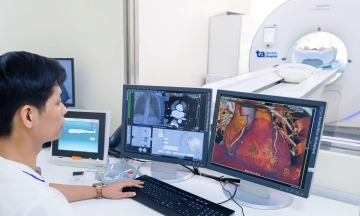
Anh Nam's symptoms persisted for over two years, including frequent headaches, sore throat, and fatigue. Recently, worsening sore throat and reduced sleep quality prompted him to visit Tam Anh General Hospital Ho Chi Minh City for an examination.
Professor Dr. Tran Phan Chung Thuy, Director of the Ear, Nose, and Throat Center, performed an ear, nose, and throat endoscopy. He diagnosed Anh Nam with edematous rhinosinusitis, a deviated septum, inferior turbinate hypertrophy, pharyngeal narrowing, and hypertrophic tonsillitis. Respiratory polysomnography revealed severe obstructive sleep apnea and reduced blood oxygen saturation. This condition had already led to hypertension and cardiovascular disease, significantly increasing his risk of stroke.
Professor Chung Thuy prescribed a "4-in-1" surgery for Anh Nam to address four issues in one operation: inferior turbinate plasty, nasal septum correction, tonsillectomy, and pharyngeal veloplasty, aiming to widen his airway. The surgical team removed the hypertrophic tonsils causing pharyngeal narrowing, resected part of the soft palate, and performed uvulopalatoplasty to enhance soft palate flexibility, improve speech, and prevent nasal regurgitation post-surgery. Following the procedure, the uvula was reduced, and the soft palate partially resected and reshaped, creating a clearer pharyngeal space. This allowed Anh Nam to breathe more easily and significantly reduced his sleep apnea.
Professor Chung Thuy noted that the "4-in-1" surgery prevents the patient from undergoing multiple operations and preserves sinonasal function. Over two months post-surgery, Anh Nam no longer snores or experiences nocturnal choking. His respiratory polysomnography readings stabilized, blood pressure is controlled, and cardiovascular symptoms have improved significantly.
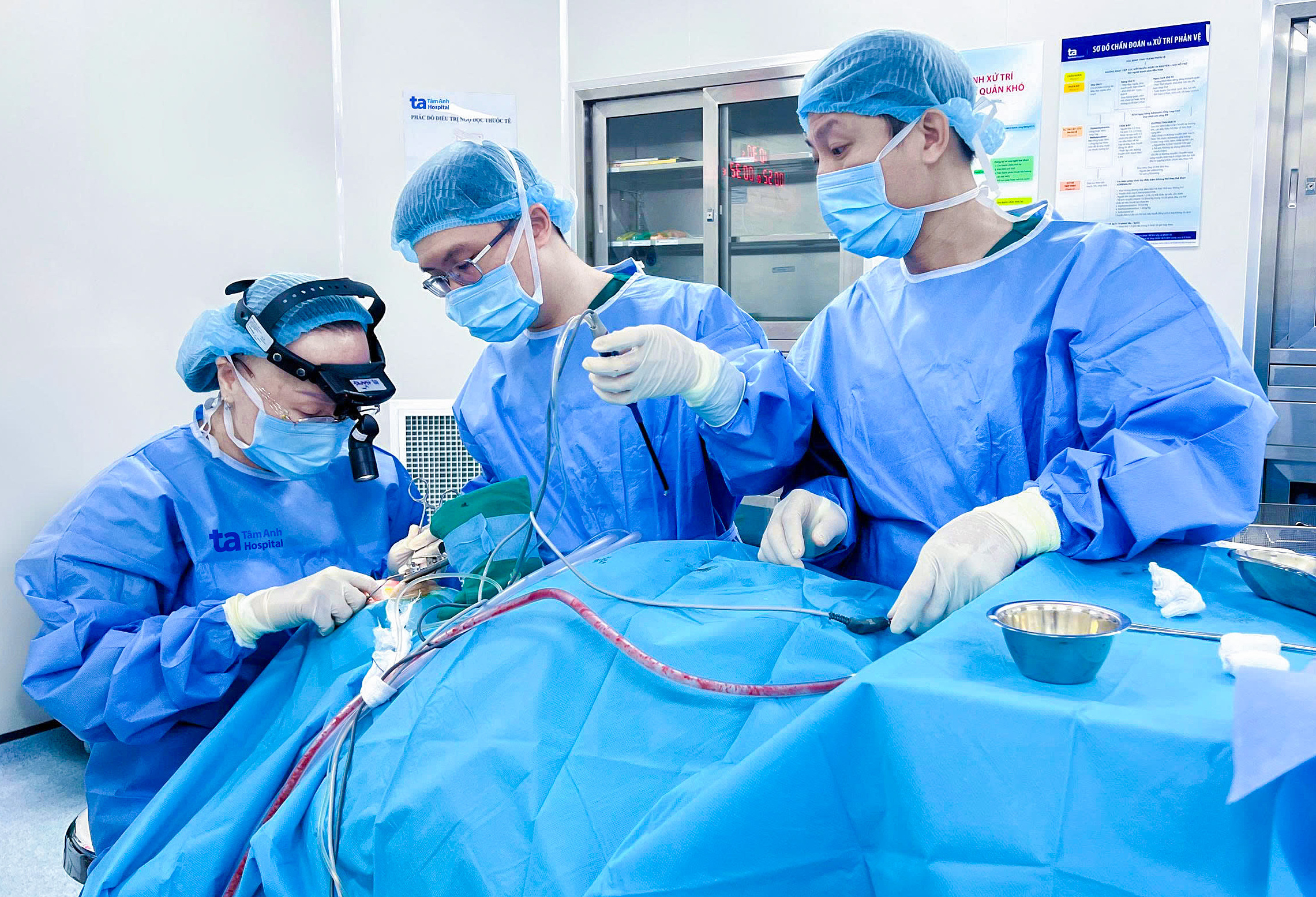 |
Professor Chung Thuy (seated) performs pharyngeal and uvulopalatoplasty on a patient. *Photo: Tam Anh General Hospital* |
Obstructive sleep apnea (OSA) is a condition characterized by breathing cessation for over 10 seconds, followed by abrupt awakening, reduced blood oxygen, loud snoring, and sleep disruption. It often leads to hypertension, diabetes, memory impairment, depression, and an increased risk of cardiovascular disease and stroke.
To diagnose sleep apnea, doctors typically order flexible ear, nose, and throat endoscopy to evaluate the pharyngeal region, along with polysomnography and respiratory polysomnography. In some cases, CT scans or MRIs may be necessary. Polysomnography technology uses electrodes to record physiological sleep parameters such as brain activity, eye movements, breathing rate, airflow in and out of the lungs, leg movements, blood pressure, and heart rate. Based on these recorded parameters, doctors diagnose and assess the severity of obstructive sleep apnea and other sleep disorders.
According to Professor Chung Thuy, the condition can be treated medically or surgically. Pharyngeal veloplasty is the most frequently applied surgical method, yielding positive results for patients. Additionally, other approaches may be prescribed: pharyngeal muscle exercises, maxillofacial surgery, base of tongue plasty, or implanting a 12th cranial nerve stimulator to increase tongue base muscle tone.
Professor Chung Thuy recommends that individuals experiencing loud, frequent, and continuous snoring accompanied by difficulty breathing, sleep apnea, headaches, and fatigue seek medical consultation. This ensures timely diagnosis and treatment to prevent complications.
Uyen Trinh
| Readers can submit questions about ear, nose, and throat conditions here for doctors to answer. |