A small tumor appeared near Tien's right eye. After three months, it grew, leading to a diagnosis of sebaceous carcinoma, a rare form of skin cancer accounting for under 1% of all skin cancers.
One year later, the tumor caused pain, prompting Tien to seek examination at Tam Anh General Hospital Ho Chi Minh City. Her right eye's vision was 6/10, while her left eye's vision was 10/10. Her intraocular pressure in both eyes was 16 mmHg, within the normal range, and no abnormalities were noted in the fundus.
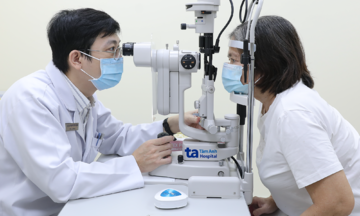
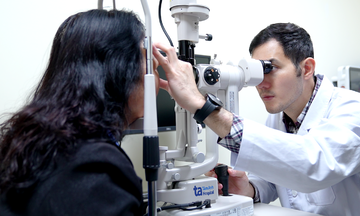
Dr. Nguyen Tra Thao Nhi, from the High-Tech Eye Center, noted that the right eye exhibited clear signs of damage, including restricted downward movement, conjunctival edema, and hyperemia. A hard, non-mobile mass was palpable at the outer corner of the upper eyelid. Compared to a CT scan one year prior, the lesion had progressed rapidly. In such a case, surgical intervention would typically involve orbital exenteration, resulting in a disfiguring defect and potentially the loss of the right eye. Consequently, doctors convened a multidisciplinary consultation to find an alternative treatment that would allow the patient to retain her eye.
Dr. Nguyen Huy Loc, from the Radiation Therapy Department, explained that radiation therapy is not usually the primary treatment for sebaceous carcinoma; it is often prescribed after surgery to mitigate recurrence risk. However, in specific circumstances, such as when a patient cannot undergo or declines surgery, radiation therapy can serve as an alternative with the goal of preserving the eye's structure. Despite this, the eye's lens is sensitive to radiation, and there is a high risk of vision loss in the right eye after treatment, so the patient needed to be psychologically prepared.
The doctor prescribed 33 radiation sessions. Before treatment, the patient underwent a simulation CT scan to create 3D images and design a head and neck immobilization mask. This measure ensured that the radiation beams were precisely focused on the right eye, minimizing impact on adjacent organs. Since the tumor was located close to the skin's surface, a bolus of about 1 cm thick was used to increase the radiation dose to the affected area, enhancing treatment effectiveness.
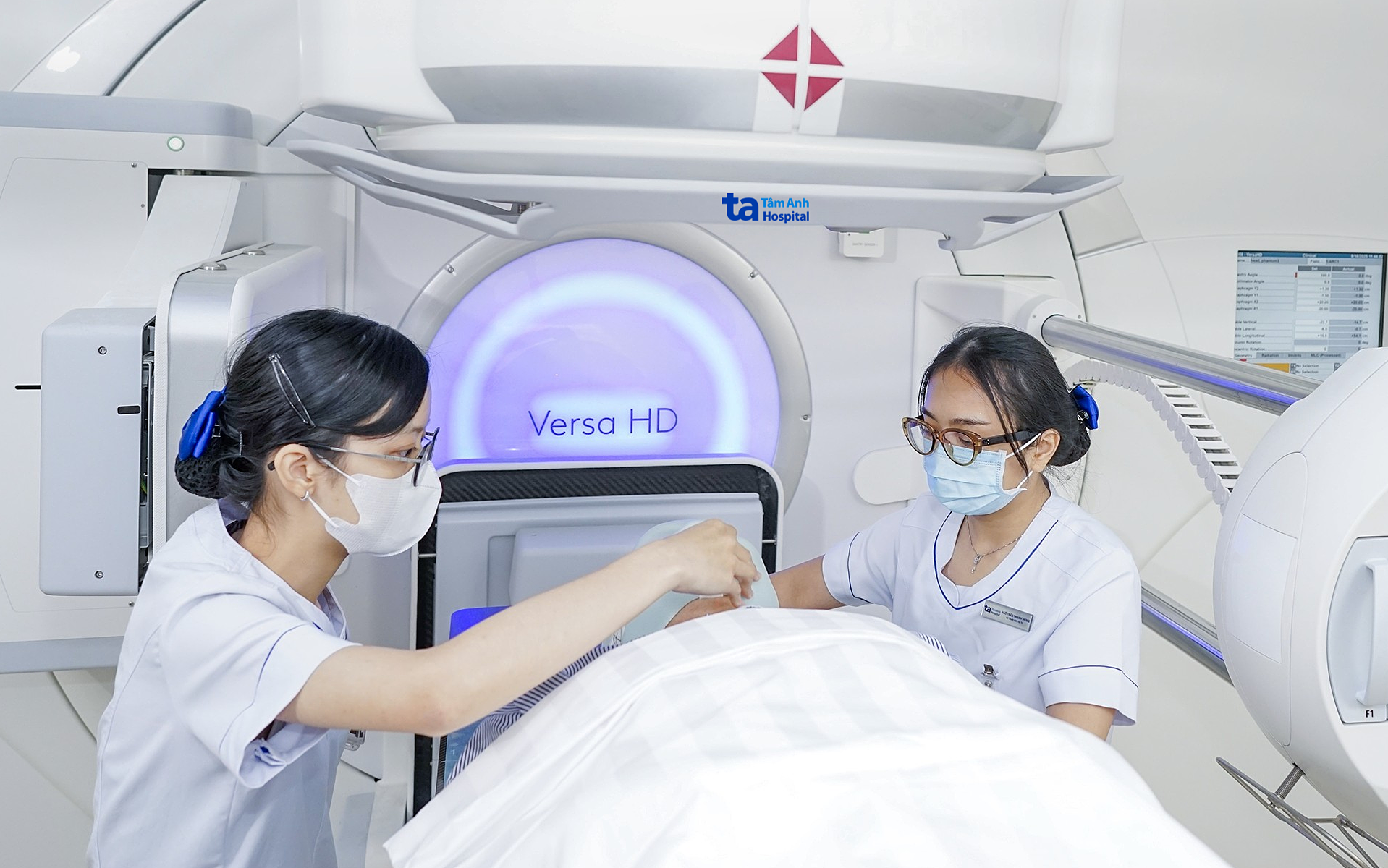 |
A technician adjusts the patient's position before radiation delivery. Photo: Tam Anh General Hospital.
After half the treatment course, the tumor responded well, decreasing in size, and the eye's swelling and redness subsided.
"If it progresses well, the tumor will completely disappear," Dr. Loc stated. He added that no adverse effects on the patient's vision due to radiation have been recorded yet, but further monitoring is required after the radiation therapy concludes.
During the radiation process, the patient was advised not to rub her eyes, avoid smoke and dust, rest, and refrain from heavy work.
Sebaceous carcinoma is most common in the head, face, and neck region, particularly the eyelids, due to the high concentration of sebaceous glands there. However, it can also appear in other locations such as the scalp, trunk, or genitals. This cancer typically affects individuals over 50 years old, those with compromised immune systems, or those linked to Muir-Torre syndrome (a rare genetic disorder involving sebaceous glands).
According to Dr. Loc, sebaceous carcinoma is often misdiagnosed as a chalazion, stye, or blepharitis, leading to late detection. If left untreated, the disease will destroy the eyelids, cornea, and orbit, metastasize to preauricular and cervical lymph nodes, and spread to distant sites like the lungs, liver, and brain. Therefore, upon detecting any abnormality, patients should seek medical examination promptly to prevent disease progression, which can lead to less effective treatment outcomes.
Nhat Minh
*Patient's name has been changed
| Readers can submit questions about cancer here for doctors to answer. |